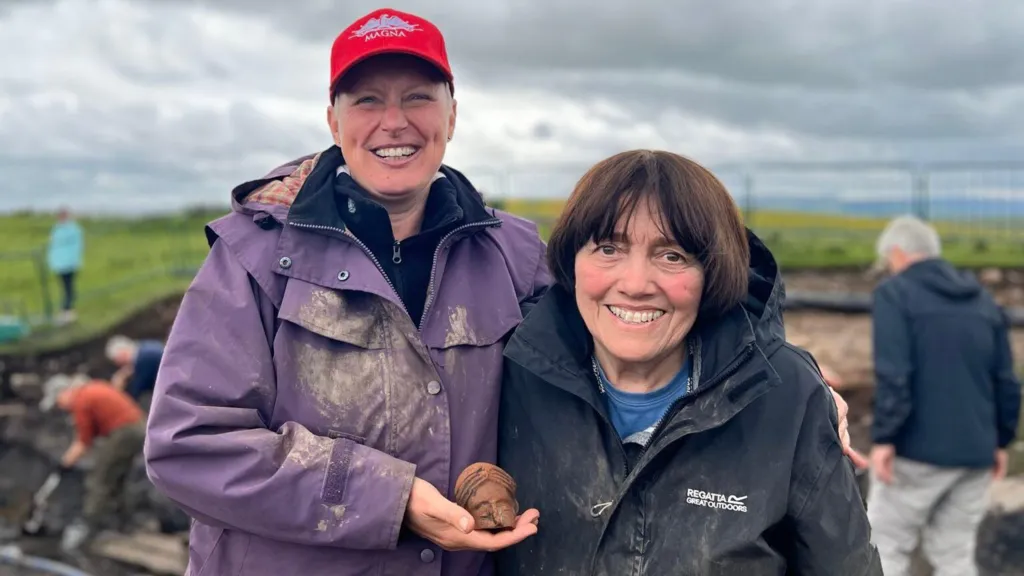
A routine excavation along the northern defences of Magna Roman Fort has produced an unexpected and unusually intimate discovery — a small terracotta head, recovered not by a senior specialist, but by two volunteers working side by side in the trench.
Rinske de Kok and Hilda Gribbin were carefully clearing soil when the fired clay fragment emerged. At just 78 mm by 67 mm, it fits easily in the palm of a hand. Yet the face it carries feels deliberate. Composed. Almost authoritative.
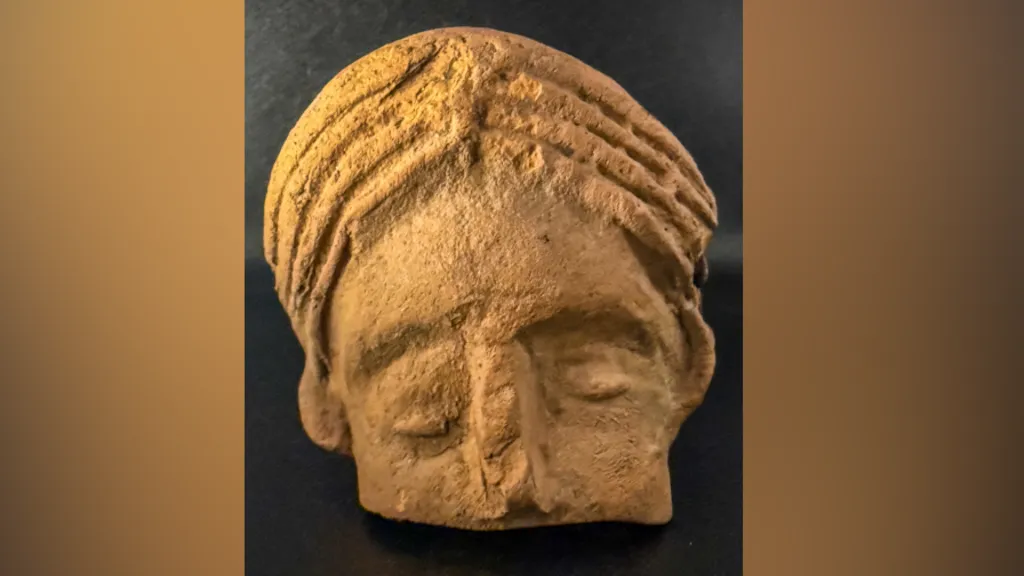
The head depicts a woman with a centrally parted hairstyle arranged into four distinct plaited strands. The craftsmanship is competent but not refined — something that immediately drew scholarly attention.
Roman artefact specialist Linsay Allason-Jones has suggested the piece may be “a practice work made by an inexpert hand,” possibly produced locally at the fort near Haltwhistle. Terracotta face pots are common in Roman Britain. Freestanding heads, however, are not. That alone places this fragment in a more unusual category.
Echoes of a 19th-Century Find
What makes the discovery particularly compelling is Magna’s own past.
In the 19th century, another terracotta female head — more finely executed — was uncovered at the same site. That earlier piece was eventually donated to the Society of Antiquaries of Newcastle and is now preserved at the Great North Museum: Hancock.
Senior archaeologist Rachel Frame notes striking similarities between the two objects. The hairstyle, proportions, and facial framing suggest they were intended to represent the same figure.
Her working hypothesis is cautious but intriguing: the newly unearthed head could be a locally made copy of the earlier example — and the earlier one may itself have been imported into the frontier zone.
If that interpretation holds, Magna was not just receiving objects. It was reproducing them.
Who Was the Woman in Clay?
The identity of the figure remains uncertain. Possibilities include an imperial woman — perhaps linked to official Roman portrait traditions — or a goddess revered by the community stationed at Magna.
Frontier forts were rarely just military compounds. They were lived spaces. Soldiers, families, traders, craftsmen — all negotiating identity at the edge of empire. Religious expression in such settings was often layered: Roman deities mingled with local cults, and imperial figures could carry symbolic weight beyond politics.
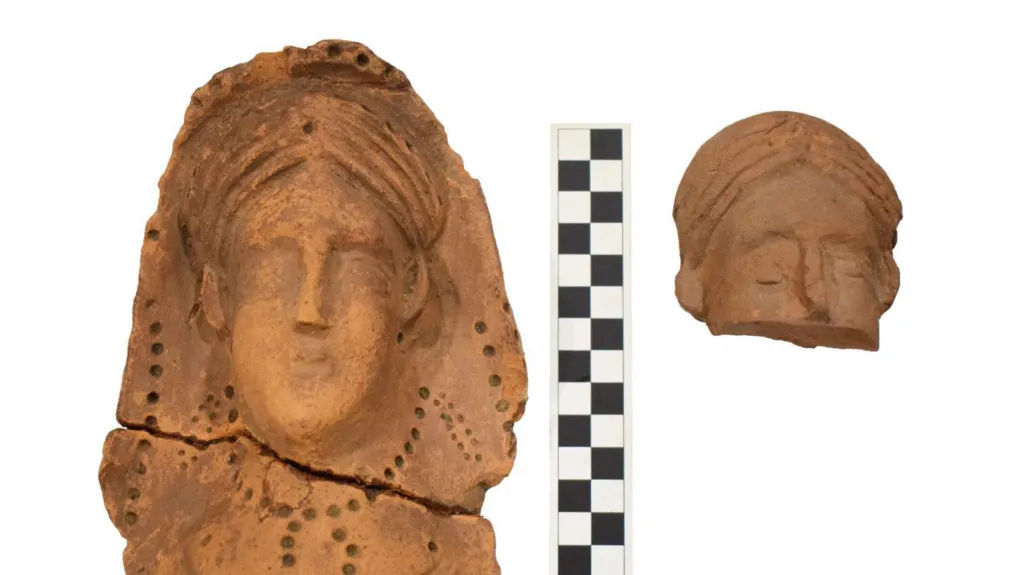
Frame has stated that “the woman depicted was clearly important to the people living at Magna.” The existence of two similar heads, decades apart in discovery but likely closer in origin, suggests intentional continuity rather than coincidence.
Without inscription or shrine context, certainty remains out of reach. But repetition is rarely accidental in Roman visual culture.
From Trench to Museum
Barbara Birley, curator for the Vindolanda Trust, has confirmed that the newly discovered head will be displayed at the Roman Army Museum as part of an exhibition showcasing recent finds.
For Malavika Anderson, museum manager at the Great North Museum, the link between the new discovery and the object already held in storage underscores the long-term importance of curated collections. Artefacts preserved decades ago continue to inform present-day excavation. The conversation between trench and museum is ongoing.
And in this case, it is unexpectedly personal.
A small clay face, shaped by hands nearly two thousand years ago. Perhaps imperfect. Perhaps experimental. But significant enough to echo across centuries.
At Magna — a frontier fort on the northern limits of Roman Britain — volunteers uncovered more than a fragment of pottery. They uncovered a quiet continuity of belief and memory.
The woman’s name may be lost.
Her presence, clearly, was not.
Cover Image Credit: The Vindolanda Trust