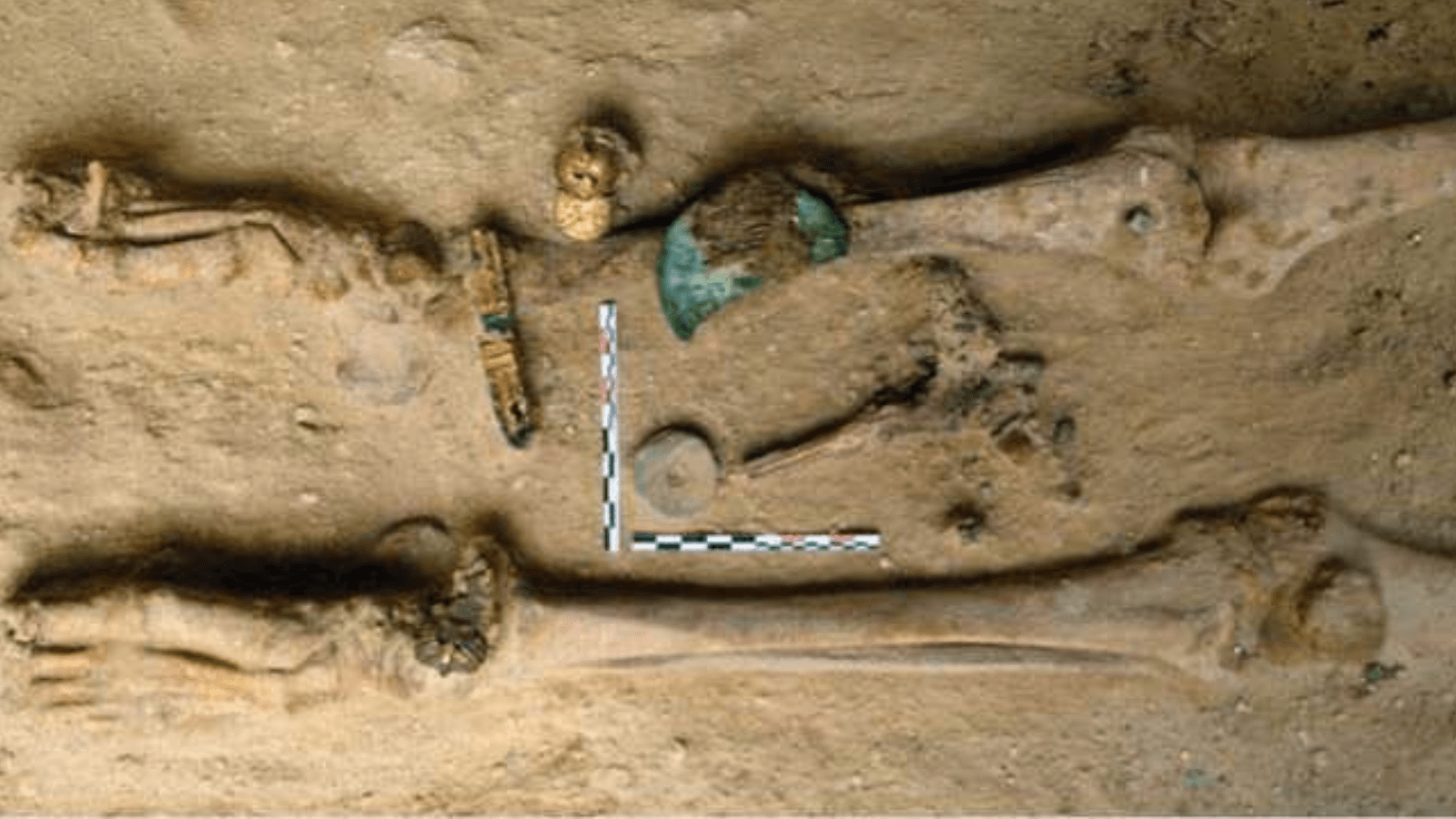
A richly furnished grave on Kazakhstan’s Caspian coast has revealed 1,500-year-old gold-covered shoe fittings belonging to a noblewoman whose burial shows striking connections with the Hunnic world.
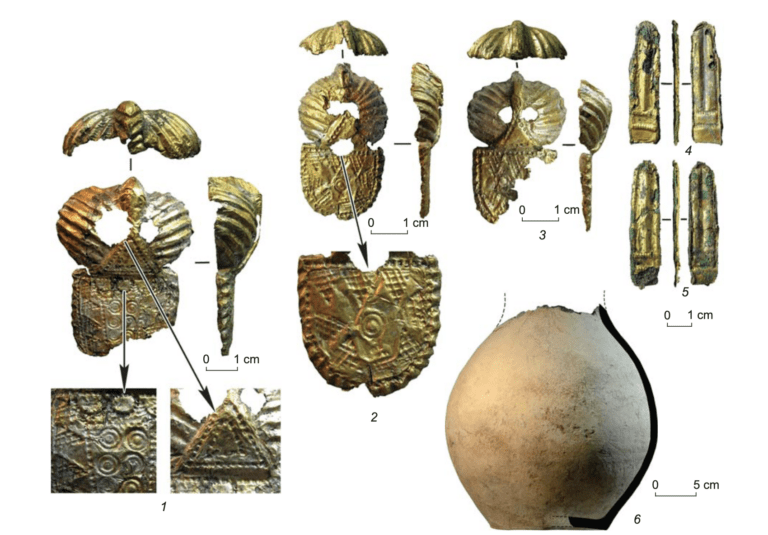
The objects, sometimes described as “golden shoes,” were not footwear made entirely of precious metal. Archaeologists instead recovered elaborate shoe buckles and strap fittings covered with thin gold foil, apparently attached to wooden or other organic components. Together with gold ornaments from a headdress and belt, they formed part of an exceptional funerary costume.
The grave was excavated in 2019 at the Karakabak cemetery on the Mangyshlak Peninsula, near the modern city of Aktau. The burial itself is not a new discovery, but it has returned to attention as archaeologists continue investigating the nearby Karakabak settlement and its role in the far-reaching trade networks of ancient Eurasia. Excavations at the settlement resumed in June 2026.
A Noblewoman Buried in an Imitation of Royal Dress
The grave, identified as Burial 11, dates to the second half of the fifth century or the beginning of the sixth century AD, during the turbulent period commonly associated with the Hunnic migrations and their aftermath.
Archaeologists Andrei E. Astafyev and Evgeny S. Bogdanov examined the burial in a study published in Archaeology, Ethnology & Anthropology of Eurasia. They described the deceased as a girl dressed in an outfit that imitated royal vestments, indicating that she occupied an unusually elevated social position.
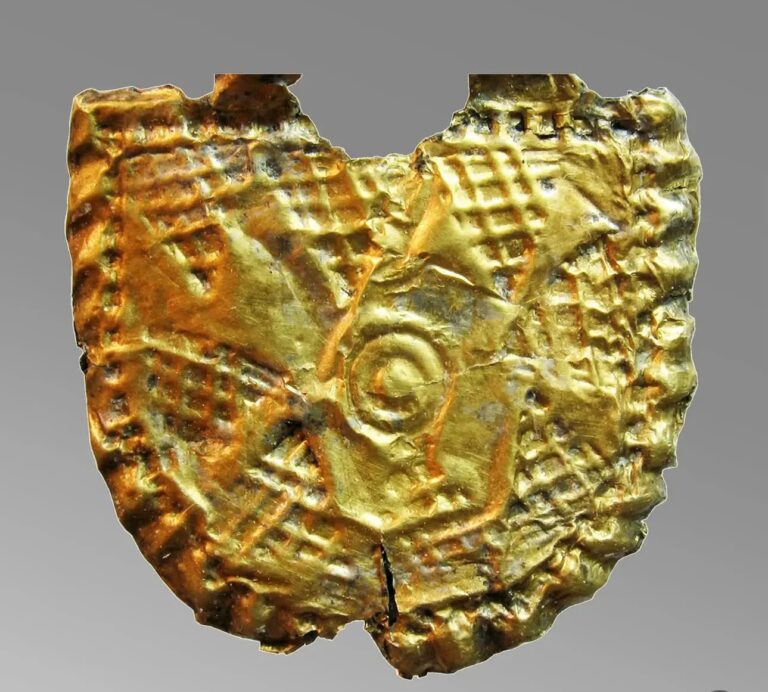
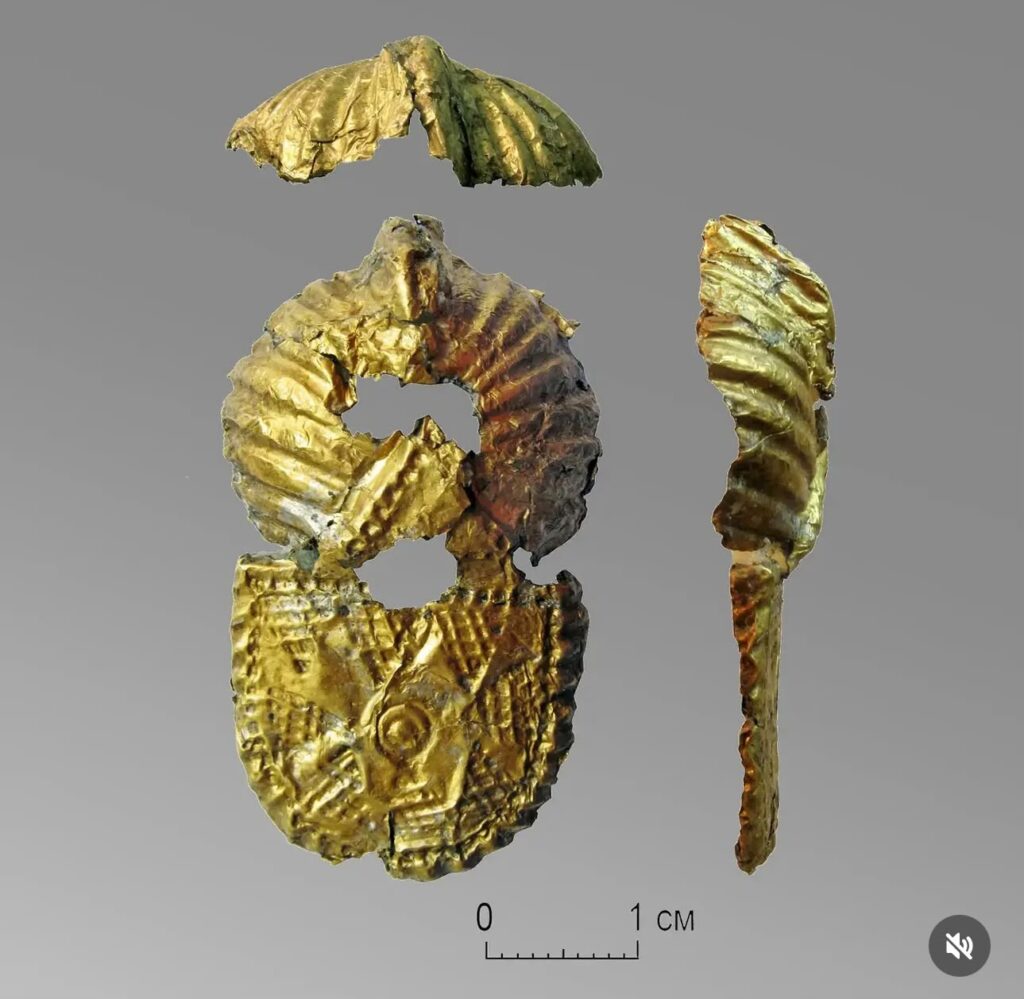
Her reconstructed headdress was particularly elaborate. It included a cape decorated with round gold plaques and a diadem-like headband made from red fabric and adorned with mask-shaped ornaments. A central plaque positioned over the forehead reproduced the form of a Hellenistic gorgoneion, showing how traditions from very different parts of Eurasia could converge in a single elite costume.
The footwear carried another conspicuous display of wealth. Gold-covered buckles and strap fittings accompanied the burial, but the researchers concluded that some of the objects showed no signs of having served as functional parts of everyday clothing. They appear to have been produced specifically for the funerary ceremony.
Strong Ties to the Hunnic World
The wider significance of the grave comes from the style, technology and geographical parallels of its objects.
The principal finds belong to the Shipovo horizon, an archaeological horizon associated with the late fifth and early sixth centuries. The assemblage combines Sarmatian and Late Sarmatian traditions with new elements characteristic of the cultural transformations taking place across the Eurasian steppe during the Hunnic and post-Hunnic periods.
Metal ornaments made in the polychrome style also connect Mangystau with what researchers call the “Pontic fashion,” a tradition otherwise documented much farther west. Parallels for some of the ornaments can be traced toward the Volga region and the northern Black Sea.
These similarities led the researchers to place Karakabak within a much wider cultural world shaped by population movements and contacts during the Hunnic period.
Yet the grave also presents an intriguing complication.
Although much of the burial belongs to a Sarmatian-Alanian cultural environment shaped by wider elite networks across the Eurasian steppe, Astafyev and Bogdanov suggested that the woman herself may have been a foreigner who was not of Sarmatian-Alanian origin. The conclusion remains a hypothesis rather than a confirmed ethnic identification, and the authors noted that further research, including genetic analysis, could help clarify her origins.
That distinction also matters when describing the burial as connected to the Hunnic world. The archaeological evidence does not demonstrate that the woman was ethnically Hun, nor does it justify identifying her specifically as a “Hun princess.” Instead, her grave reflects the cultural networks that developed across Eurasia during a period when Hunnic political power and population movements were transforming the steppe.
A Caspian Hub Connected to Distant Lands
The location of the burial may help explain this unusual mixture of influences.
Karakabak was not an isolated nomadic encampment. Archaeological research increasingly points to a substantial manufacturing and commercial center on the eastern Caspian coast, where metallurgy, jewelry production, glassmaking and pottery were practiced. Finds include both locally produced objects and material originating far beyond Mangystau.
More than 150 coins dating from the first century to the first half of the sixth century AD provide some of the clearest evidence for these connections. The collection includes coinage from Parthia, ancient Khorezm, Bukhara Sogdiana, Sasanian Iran, the Kushano-Sasanian realm, the Byzantine Empire and China. Archaeologist Andrey Astafyev has argued that the coins demonstrate Karakabak’s participation in international trade and economic networks.
Researchers are now examining whether a branch of the Silk Road passed through Mangystau and whether Karakabak formed part of a broader Caspian corridor connecting Central Asia with the Volga region, the Caucasus and Eastern Europe.
Against that background, the noblewoman’s extraordinary costume becomes more understandable. Its mixture of Sarmatian traditions, Hellenistic imagery and objects linked to the Hunnic-era steppe reflects a region where people, technologies and ideas were moving over enormous distances.
The “golden shoes” therefore reveal more than the wealth of a single burial. They place a young woman buried on the Caspian coast around 1,500 years ago at the intersection of the Sarmatian-Alanian world, Hunnic-period cultural networks and long-distance Eurasian trade—while leaving her own origins as one of the grave’s most intriguing unanswered questions.
Cover Image: The lower legs of the woman in Burial 11 at Karakabak, with surviving remains of the gold-decorated shoe straps around the ankles. Credit: A. E. Astafyev and E. S. Bogdanov