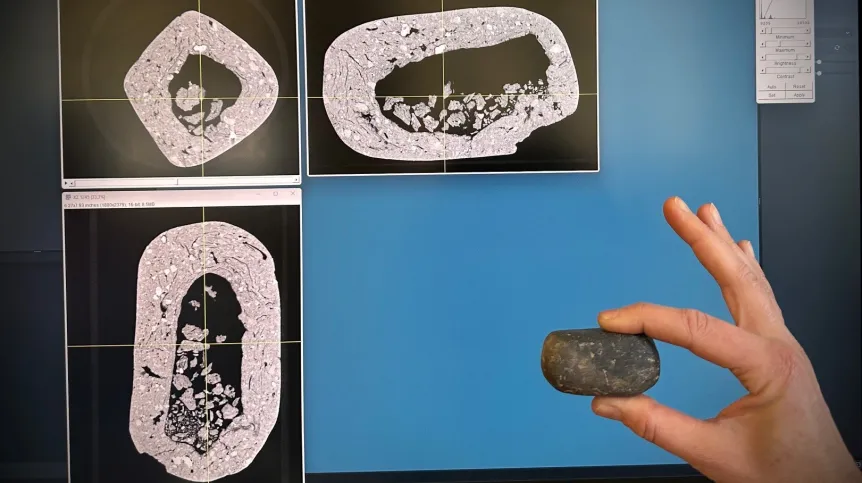
A small clay rattle more than 2,000 years old, preserved in the collections of the Tarnów Regional Museum in southern Poland, has revealed its hidden internal structure after being examined with computed tomography (CT).
The non-invasive scan allowed researchers to look inside the fragile artifact without opening it, uncovering the mechanism responsible for the faint rattling sound the object still produces today.
Ancient sound preserved for two millennia
The artifact was originally discovered during archaeological excavations in 1991 at Pasieka Otfinowska, a site near the city of Tarnów in southern Poland. Today it forms part of the permanent exhibition at the Museum of the History of Tarnów and the Region.
For years, archaeologists had been intrigued by the delicate sound produced when the rattle was gently shaken. However, examining its interior posed a problem because any attempt to open the object could damage the artifact.
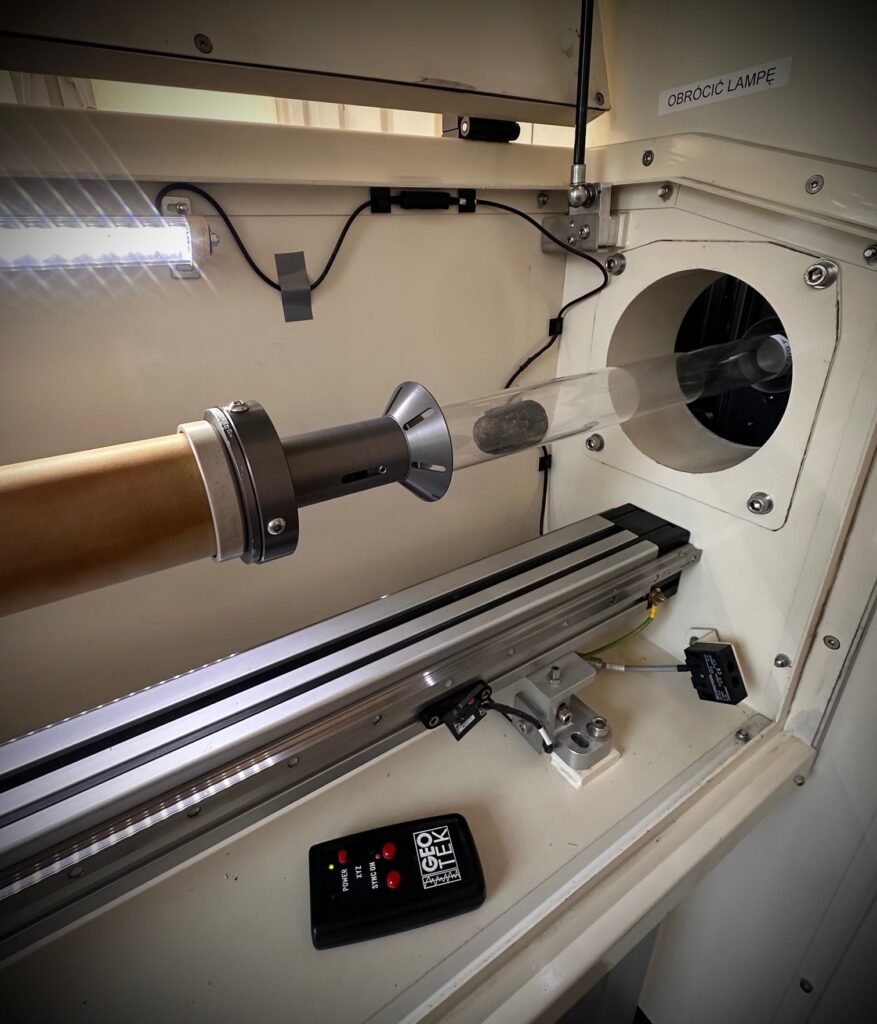
To solve the mystery, researchers used computerized tomography, a technique commonly used in medical imaging that can also reveal internal structures in archaeological materials without physically altering them.
CT scan reveals clay pellets inside
The scans showed that the ancient rattle has relatively thick ceramic walls surrounding a small internal chamber. Inside this cavity, researchers identified several loose lumps of clay of different sizes.
These small clay fragments move within the chamber when the object is shaken, producing the characteristic rattling sound.
Magdalena Szumańska-Wach, head of the archaeology department at the Tarnów Regional Museum, explained that the sound produced by the artifact is extremely soft and delicate.
Hearing such a sound today, she noted, is a remarkable experience—essentially listening to a noise created more than two millennia ago.
Fresh research still under analysis
The CT imaging was carried out this week at the Oil and Gas Institute – National Research Institute in Kraków, by engineer Katarzyna Drabik, who specializes in advanced scanning technologies.
Because the investigation is still in its early stages, researchers say a detailed analysis of the scans will continue. Future study may even identify the small opening through which the clay pellets were originally inserted into the rattle before it was sealed during manufacture.
Earlier CT study examined a Neolithic figurine fragment
This is not the first time the museum has used tomography to study artifacts in its collection.
Researchers previously applied the same method to analyze a Neolithic clay figurine fragment known as the “Leg from Gwoździec.” The piece, dating back roughly 7,000 years, represents part of a human foot with clearly marked toes and is believed to belong to a larger anthropomorphic figurine associated with early farming communities in the region.
The earlier investigation led to a scientific publication and was presented at an archaeological conference.
Technology opening new windows into ancient objects
The CT scan of the clay rattle demonstrates how modern imaging technologies are transforming archaeological research. By allowing scientists to examine the internal structure of fragile artifacts without damaging them, these methods can reveal details about ancient craftsmanship, manufacturing techniques, and object function that would otherwise remain hidden.
In the case of the Tarnów rattle, the technology has brought to light the simple yet ingenious design that allowed a small ceramic object to carry its sound across more than two thousand years of history.
Cover Image: Tarnów Regional Museum