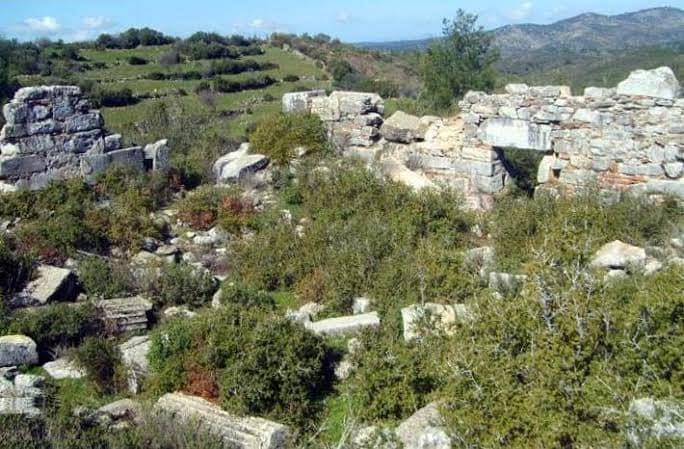
Hidden in the rugged hills of western Turkey, the ancient city of Amyzon has survived for more than two millennia behind towering stone walls. Today, however, the site faces a different danger — illegal excavations and neglect.
Despite its archaeological importance, Amyzon has remained largely untouched by modern scientific excavation. The absence of a permanent archaeological project has left the ancient city exposed, and parts of the site have reportedly suffered damage from looters searching for artifacts.
A Carian City Still Waiting to Be Explored
Amyzon lies in Aydın Province near the town of Koçarlı, within a landscape once dominated by the ancient civilization of Caria. Although the ruins preserve impressive architectural remains the site has not been the focus of sustained archaeological fieldwork for decades.
In 2021, authorities announced plans to begin official excavations at the site. The project was expected to mark the first formal archaeological campaign in nearly eighty years, raising hopes that the long-neglected city would finally be studied in detail.
Those plans, however, stalled before excavations could begin. Without the establishment of an official excavation directorate, the project was unable to move forward.
As a result, Amyzon remains effectively without systematic archaeological protection.
Looting and Lost Artifacts
In the absence of regular archaeological supervision, several areas of the site have reportedly become targets for illegal digging.
Treasure hunters searching for antiquities have caused damage in parts of the ancient settlement. Such activities not only destroy archaeological layers but also erase valuable historical evidence that could otherwise help researchers reconstruct the city’s past.
Local residents also recount stories dating back to the 1940s, when a foreign researcher is said to have carried out excavations in the area with workers from nearby villages. According to these accounts, a number of inscribed stones were uncovered during that time and later disappeared, although documentation of the work remains unclear.
Monumental Fortifications Still Stand
Even without systematic excavation, Amyzon’s surviving architecture reveals a city of considerable importance.
The settlement is enclosed by massive fortification walls built from large isodomic stone blocks, rising to nearly six meters in height. The precision of this masonry reflects the defensive architecture typical of the Hellenistic period, when cities across western Anatolia invested heavily in monumental fortifications.
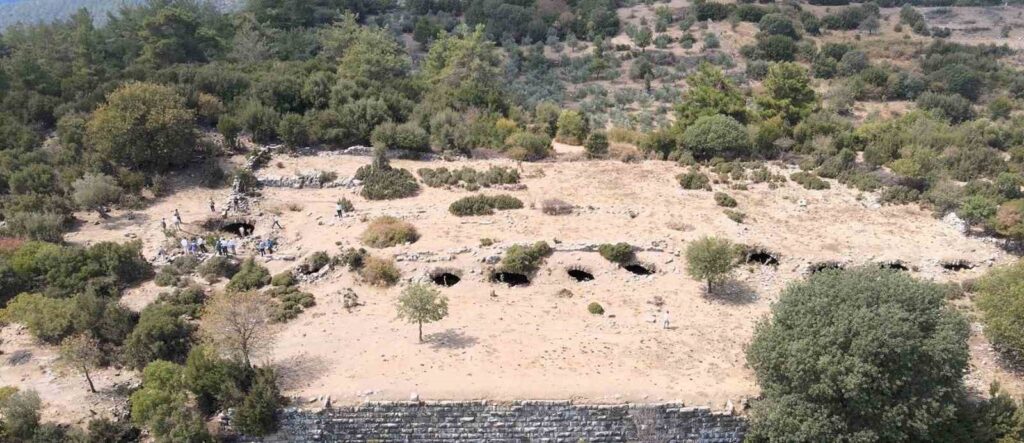
Within the ancient settlement, archaeologists have also identified parallel rows of underground vaulted chambers. These structures are believed to have served as storage facilities or granaries, indicating that Amyzon once played a significant role in the regional economy.
A Silent City Waiting Beneath the Soil
Today the ruins of Amyzon sit quietly within a landscape of forests and rocky hills that attracts hikers and history enthusiasts.
Yet much of the ancient city still lies buried beneath the soil. Archaeologists believe that systematic excavation could reveal important information about urban life, trade networks, and political structures in ancient Caria during the Hellenistic era.
For now, however, Amyzon remains a forgotten city — its walls still standing, its deeper history waiting to be uncovered.
Cover Image Credit: Aydın Provincial Directorate of Culture and Tourism