When Alexander the Great’s armies entered Central Asia, they opened a frontier where Greek military power, local communities and new Hellenistic kingdoms remained entangled for generations. A hilltop in southern Uzbekistan may now preserve a rare trace of that world.
Archaeologists working at Iskandar Tepa, a site once interpreted as a small rural settlement, say new geophysical surveys and excavations point instead to a short-term Greek military camp in the borderlands between ancient Bactria and Sogdiana.
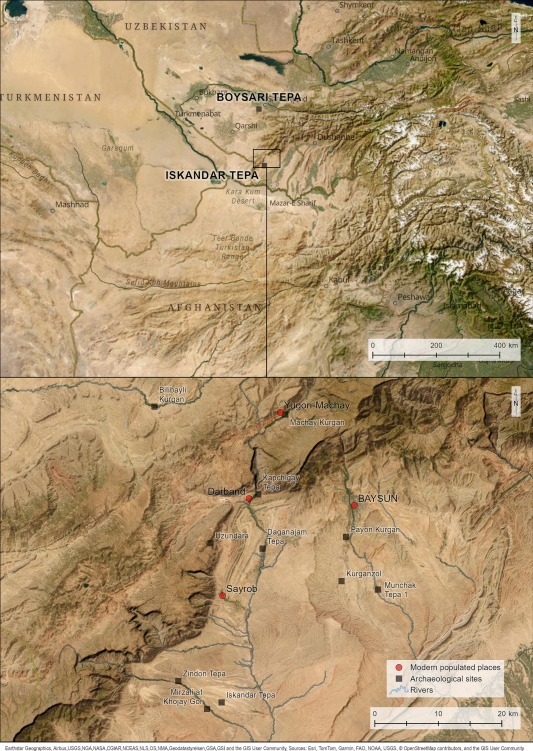
The site lies in the Sherobod District of Surkhan Darya Province, near the Loylagan valley. It occupies a narrow promontory about 20 meters above the valley floor, with a wide view over a small oasis landscape. For a group moving through or controlling the region, the location offered several advantages: visibility, access to routes through the valley and a naturally defensible position.
The study, published in Journal of Archaeological Science: Reports, was carried out by Ladislav Stančo, Jan Kysela, Tomáš Tencer, Peter Milo and Shapulat Shaydullaev.
A Ditch That Only Instruments Could See
Iskandar Tepa was first identified by a Czech-Uzbekistani archaeological team in 2017. Early work confirmed Hellenistic-period activity, but the site did not look like a fortress. There were no standing walls, stone towers or obvious traces of military architecture on the surface.
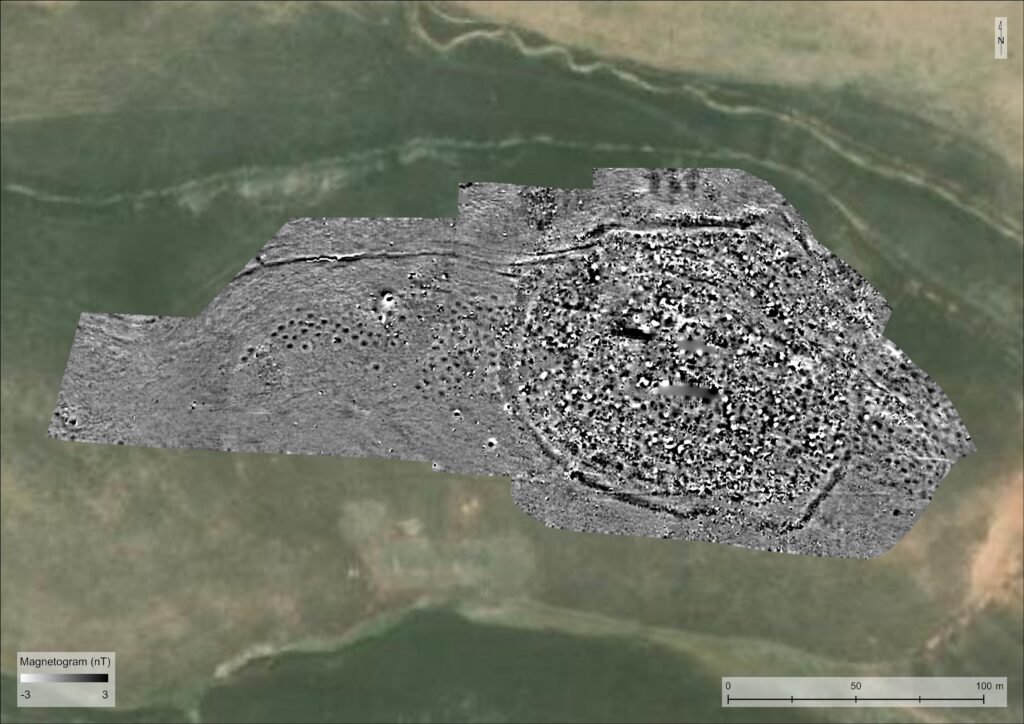
That changed in 2021, when researchers used magnetometry and ground-penetrating radar to examine the hilltop. The survey revealed a large oval feature running around the summit: a perimeter ditch nearly 400 meters long, enclosing about 1.2 hectares.
The ditch was not clearly visible in the terrain or in satellite images. Excavation confirmed that it was a real cut feature. In one trench, it measured about 7 meters wide and 85 centimeters deep. In another, it was about 4 meters wide and roughly 1 meter deep.
Inside the ditch, archaeologists recorded postholes set at regular intervals. These may have supported a light timber structure, perhaps a palisade or another defensive element. The evidence does not suggest a major stone fortress. It points to a protected but temporary installation.
Water Storage on a Dry Hilltop
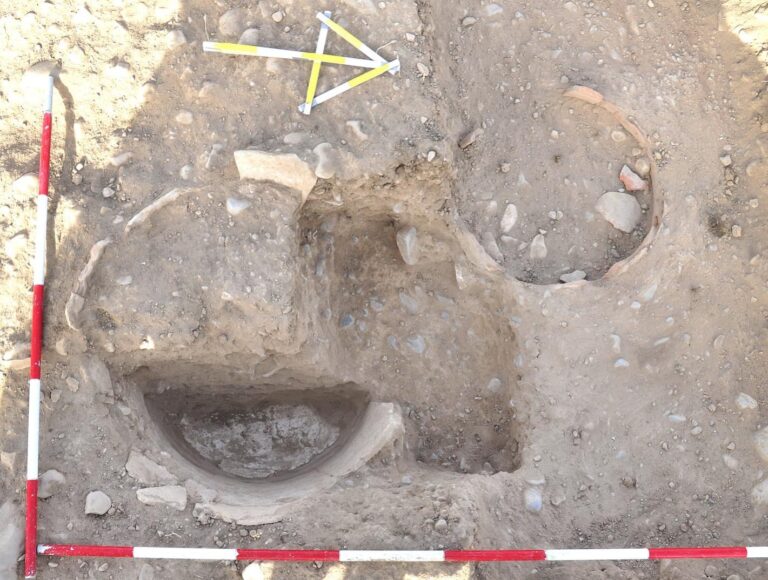
Inside the enclosed area, the team found no clear evidence for substantial stone or mudbrick buildings. Instead, geophysical anomalies led researchers to large ceramic storage jars sunk directly into the ground.
Known locally as khums, these vessels had already been noticed during earlier excavations. The new survey showed that they were spread widely across the site.
Several excavated jars contained white calcareous deposits on their walls and bottoms. The researchers suggest that the vessels may have held liquid, most likely water. This fits the setting: Iskandar Tepa has no known spring or well on the hilltop.
A group stationed there would have needed to bring water from the Loylagan valley, collect rainwater or channel it from nearby sources. One linear feature detected along the northern slope was interpreted as a possible water canal.
For a temporary camp in a semi-arid landscape, water storage was not a minor detail. It was part of the site’s basic infrastructure.
Coins from the World After Alexander
The dating of Iskandar Tepa comes from pottery and metal finds, especially coins recovered during surface survey. These include coins associated with Greco-Bactrian rulers such as Diodotus II, Euthydemus I and Demetrius I.
The main occupation is dated most likely to the 2nd century BCE, with possible continuation into the 1st century BCE. That places the site after Alexander’s own lifetime, in the Hellenistic political world that grew from his eastern campaigns.
By then, Bactria and nearby regions were shaped by Greco-Bactrian rulers, local powers and shifting frontier communities. Iskandar Tepa appears to belong to that later military landscape: not Alexander’s march itself, but the world his conquests helped create.
A Camp Later Reused as a Cemetery
The hilltop did not disappear from local life after its military phase. Around the edges of the site, the survey detected nearly 90 oval features, grouped mainly in eastern and western clusters. Researchers interpret them as burial pits.
Some of these graves appear to date to the 1st century BCE to 1st century CE, during the Transitional or Yuezhi period. In places, burial activity seems to overlap with earlier features of the camp.
That reuse gives the site a longer history. A place first selected for visibility and control later became a burial ground. Iskandar Tepa was not a single-use location, but a hill whose role changed with the region around it.
A Frontier Post with a Light Footprint
Short-term military camps are difficult to recognize archaeologically. Wooden defenses disappear, shallow ditches fill in and temporary occupation rarely leaves ruins that are visible from the ground.
At Iskandar Tepa, the evidence became clear only when geophysics revealed the plan beneath the surface. The elevated position, oval layout, enclosing ditch, possible palisade and absence of permanent buildings all support the interpretation of a military camp.
The researchers also compare the site with Boysari Tepa in central Sogdiana, another elevated settlement with a fortified area and ditch. The interpretation remains cautious, but it changes the character of Iskandar Tepa. What once looked like a modest Hellenistic settlement may be one of the rare archaeological traces of Greek military organization deep in Central Asia.
More than 2,000 years later, the remains are not monumental. They are a ditch, buried jars, postholes and later graves. Together, they show how soldiers may have occupied, supplied and defended a frontier post on the far edge of Alexander’s world.
Stančo, L., Kysela, J., Tencer, T., Milo, P., & Shaydullaev, S. (2026). Geophysical and archaeological survey of the Hellenistic-period settlement Iskandar Tepa in the Bactro-Sogdian borderlands. Journal of Archaeological Science: Reports, 72, Article 105742. https://doi.org/10.1016/j.jasrep.2026.105742
Cover Image Credit: Stančo, Kysela, Tencer, Milo, & Shaydullaev, 2026