
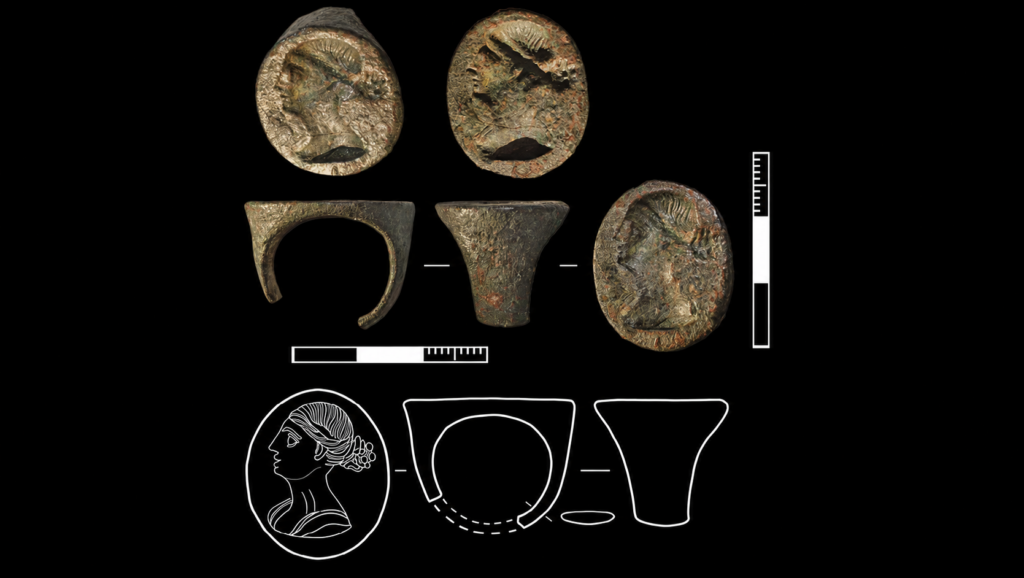
A rare 2,200-year-old bronze ring found near Anapa, in southern Russia, bears the engraved profile of a woman identified by researchers as Arsinoe III, queen of Ptolemaic Egypt between 220 and 204 BC.
The ring was recovered at Voskresenskoye 6, a Hellenistic-period estate group near ancient Gorgippia, in the wider Bosporan world. It was not found in a palace, temple, or elite tomb, but among the everyday remains of an ancient household: broken amphorae, tableware, kitchen pottery, and other traces of life on the northern Black Sea coast.
Its setting is what makes the find especially telling. The image of a Ptolemaic queen appears not in a royal or sacred space, but in the domestic landscape of a Black Sea estate more than two millennia ago.
The study was published by Mikhail Yu. Treister, Irina V. Rukavishnikova, and Denis V. Beylin in Problemy istorii, filologii, kul’tury.
A Royal Face in a Household Pit
The ring is a cast bronze object with an oval bezel and a broad shank, part of which is now missing. On its bezel is an engraved female head in profile, facing left.
The portrait is worn, but the hairstyle remains clear enough for close comparison. The woman has a narrow band along the edge of the hair, long curved locks falling from the crown, and a rounded bun at the back of the head. The bun appears tied at its base and decorated with small rounded elements, which may represent curls, hairpins, or bead-like ornaments.
These details led the researchers to identify the image as Arsinoe III.
That identification gives the object a narrower historical frame. If the portrait is correctly read as a lifetime image of the queen, the ring can be dated between 220 and 204 BC, the years of her reign.
Why Arsinoe III Is the Strongest Candidate
The Anapa ring belongs to a group known as “Ptolemaic-type” rings. These bronze rings are known from the northern Black Sea region, especially the Bosporan Kingdom, and often carry female royal portraits linked to the Ptolemaic dynasty.
Earlier examples have been associated with Arsinoe II, Berenice II, and Arsinoe III. The newly published ring fits a more specific variant, marked by the rounded decorated bun at the back of the head.
Only a small number of comparable examples are known. The study groups the Anapa ring with parallels from Panticapaeum, Verkhnee Dzhemete II, Psenafa, Tenginskaya, and the wider Trans-Kuban region. This distribution points not to a single accidental object, but to a recognizable regional pattern around the Bosporus and its hinterland.
The ring is rare, but not unique. That distinction matters. It should not be presented as the only object of its kind, but as a newly documented example of a small and meaningful group.
Gorgippia and the Northern Black Sea Network
Voskresenskoye 6 lies about 500 meters northwest of Anapa’s modern railway station. In antiquity, this area belonged to the landscape of Gorgippia, a settlement on the Asian side of the Bosporan Kingdom.
Excavations in 2024 investigated household and economic features at the site, including pits, stone remains, fragments of walls, and other traces of Hellenistic occupation. The ring came from Pit 4, which also contained 112 pottery fragments.
The ceramic material helps place the object in context. Amphora fragments from Heraclea Pontica, Chios, Colchis, Knidos, and other production centers show that this was a connected coastal zone. Goods moved through it. So did styles, symbols, and images.
The ring’s presence there does not require an Egyptian resident at the site. Nor does it prove any direct political link between Arsinoe III and Gorgippia. A safer reading is also the more interesting one: Ptolemaic royal imagery had entered the visual culture of the Black Sea through Hellenistic networks of exchange, imitation, and prestige.
Rare, but Not Alone
The metal composition also connects the Anapa ring with the broader Ptolemaic-type group. According to the study, it was cast from leaded tin bronze, a composition also recorded in comparable rings from the Bosporus and Chersonesus.
This technical detail supports the idea that the object belongs within a recognized archaeological category rather than standing apart as an exotic oddity.
Its value lies in the combination of image, place, and date. A Ptolemaic queen’s portrait appears on a bronze ring found near Gorgippia, in a deposit whose pottery fits the Hellenistic horizon. If the Arsinoe III identification is accepted, the ring can be tied to a short span of history during the late 3rd century BC.
What the Ring Shows — and What It Doesn’t
The ring was not Arsinoe III’s personal possession. It was not found in Egypt. It does not show that the queen visited the Black Sea or ruled there directly.
What it does show is more grounded: the northern Black Sea was not culturally distant from the Mediterranean world. Royal imagery from Ptolemaic Egypt could be adopted, reproduced, and worn far from Alexandria.
For a modern reader, the object is striking because of the distance between its image and its findspot. A queen of Egypt appears not on a monumental coin or marble portrait, but on a damaged bronze ring buried near Anapa.
That is where the discovery gains its force. It brings the Hellenistic world down to the scale of a personal object: small enough to wear, but connected to routes, fashions, and political imagery that crossed seas.
Treister, M. Yu., Rukavishnikova, I. V., & Beylin, D. V. (2026). A bronze ring with a portrait of Arsinoe III from the excavations at the “Voskresenskoye 6” Estate in the Anapa Region. Problemy istorii, filologii, kul’tury, 1, 161–173. https://doi.org/10.18503/1992-0431-2026-1-91-161–173