
A 2,400-year-old iron workshop in Senegal is forcing archaeologists to rethink how and where iron technology developed in the ancient world. Excavated in the Falémé River Valley, the site reveals not a short-lived experiment, but a remarkably stable production system that operated for nearly 800 years.
The discovery, led by researchers from the University of Geneva in collaboration with Institut Fondamental d’Afrique Noire, was uncovered at the site of Didé West 1 (DDW1) in eastern Senegal. The findings, published in African Archaeological Review, offer one of the clearest pictures yet of early ironworking traditions in West Africa.
An 800-Year Production Landscape Preserved in Detail
At first glance, the site appears as a vast accumulation of industrial debris. In reality, it represents a highly organized metallurgical landscape.
Archaeologists identified a slag heap weighing nearly 100 tons, evidence of sustained iron production over centuries. Surrounding it were at least 35 circular furnace bases, each carefully constructed and reused, along with a semicircular arrangement of approximately 30 clay tuyères—devices used to inject air into furnaces and maintain the high temperatures required for smelting.
What makes the site exceptional is not only its preservation, but its longevity. Unlike most ancient workshops that operated briefly, this system remained active from the 4th century BCE to the 4th century CE, suggesting a deeply rooted and continuously transmitted technical tradition.
A Technological Signature Unique to West Africa
The workshop belongs to a distinct metallurgical tradition known as FAL02, identified through its furnace design, spatial organization, and waste patterns.
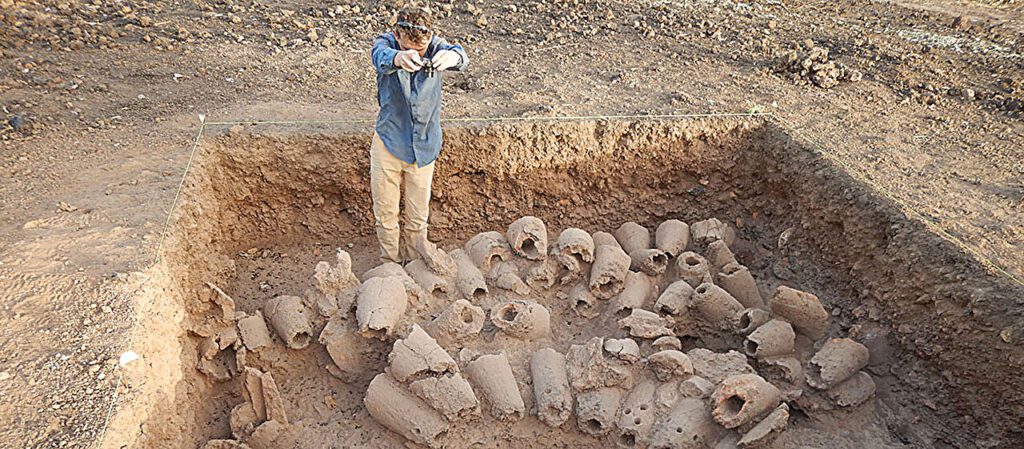
These furnaces were relatively small and circular, topped with removable chimney structures. The tuyères, however, reveal a more advanced level of engineering than previously assumed. Instead of a single air outlet, they feature multiple small perforations connected by lateral channels, allowing air to spread evenly across the base of the furnace. This design would have significantly improved combustion efficiency.
Then comes one of the most unexpected findings:
palm nut shells deliberately placed at the base of the furnaces.
This practice has never been documented before in African ironworking contexts. Researchers suggest it may have helped regulate airflow, stabilize internal temperatures, or protect structural elements during repeated firing cycles. Whatever its exact function, it points to local experimentation and adaptation, rather than simple technological transfer.
Beyond Diffusion: A Case for Local Innovation
For decades, the origins of iron metallurgy in sub-Saharan Africa have been debated. The earliest known iron production emerged in Anatolia and the Caucasus during the 2nd millennium BCE, later spreading into Europe. Whether African metallurgy developed independently or through diffusion remains unresolved.
The evidence from Didé West 1 complicates that narrative.
The technical consistency, long-term continuity, and unique construction features observed at the site suggest that West African communities were not merely adopting external methods. Instead, they were maintaining and refining a system adapted to local environmental and cultural conditions over many generations.
Remarkable Stability Across Centuries
One of the most striking aspects of the workshop is how little its core technology changed over time.
According to lead researcher Mélissa Morel, the site offers a rare opportunity to observe long-term stability in metallurgical practice, with only minor adjustments over several centuries. This contrasts sharply with other regions, where ironworking techniques often evolved more rapidly.
Such stability may reflect more than technical efficiency. It likely indicates a strong tradition of knowledge transmission, where metallurgical practices were preserved, taught, and repeated with precision across generations.
Production for Daily Life, Not Empire
Despite the scale of the slag deposits, the workshop was not geared toward mass production or centralized industry. Instead, it likely served local communities, producing iron tools essential for agriculture and daily life.
This aligns with broader patterns in West African archaeology, where iron technology is closely tied to subsistence and regional economies, rather than imperial expansion.
A Rare Archaeological Benchmark
The Falémé Valley has been the focus of interdisciplinary research since 2012, combining archaeology with ethnographic studies of modern metalworking traditions. Yet securely dated early iron production sites remain scarce across West Africa.
Didé West 1 stands out as one of the most complete examples discovered to date.
With its preserved layout, identifiable technical system, and long occupational span, the site provides a rare baseline for comparing other metallurgical traditions across the region.
Ongoing Research Across Senegal
Fieldwork is continuing at multiple sites in Senegal, where researchers aim to map variations in smelting techniques and trace how these traditions evolved and interacted over time.
Each new discovery adds nuance to a broader picture that is still emerging—one in which Africa is not a peripheral recipient of iron technology, but a region of independent innovation and enduring technical knowledge.
Cover Image: Aerial view of the Didé Ouest 1 iron smelting site after the 2018 excavation, highlighting a distinctive accumulation of used clay tuyères arranged in two semicircular formations. Credit: Camille Ollier
Mélissa Morel et al, Evolution of an Early and Long-Lasting Iron Smelting Technique at Didé West 1, Falémé Valley, Eastern Senegal, African Archaeological Review (2026). DOI: 10.1007/s10437-026-09653-z