
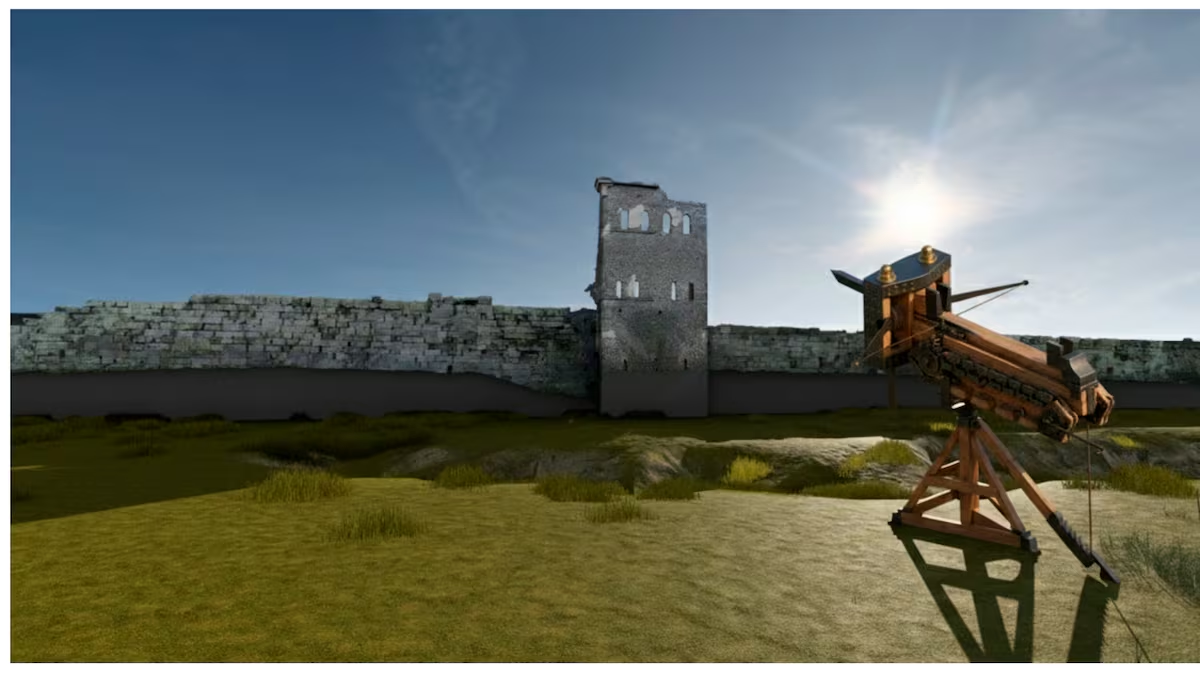
Pompeii evidence points to an ancient automatic weapon known as the Roman polybolos—an advanced repeating machine once thought to exist only in ancient texts.
Unusual patterns carved into the city’s defensive walls suggest that this elusive device may have been used during the Roman siege of 89 BC, leaving behind a distinct signature unlike any known form of conventional Roman artillery.
If confirmed, the findings would offer the first physical evidence of a rapid-fire mechanical weapon in the ancient world, challenging long-held assumptions about the limits of early military engineering.
Unusual Impact Marks on Pompeii’s Walls
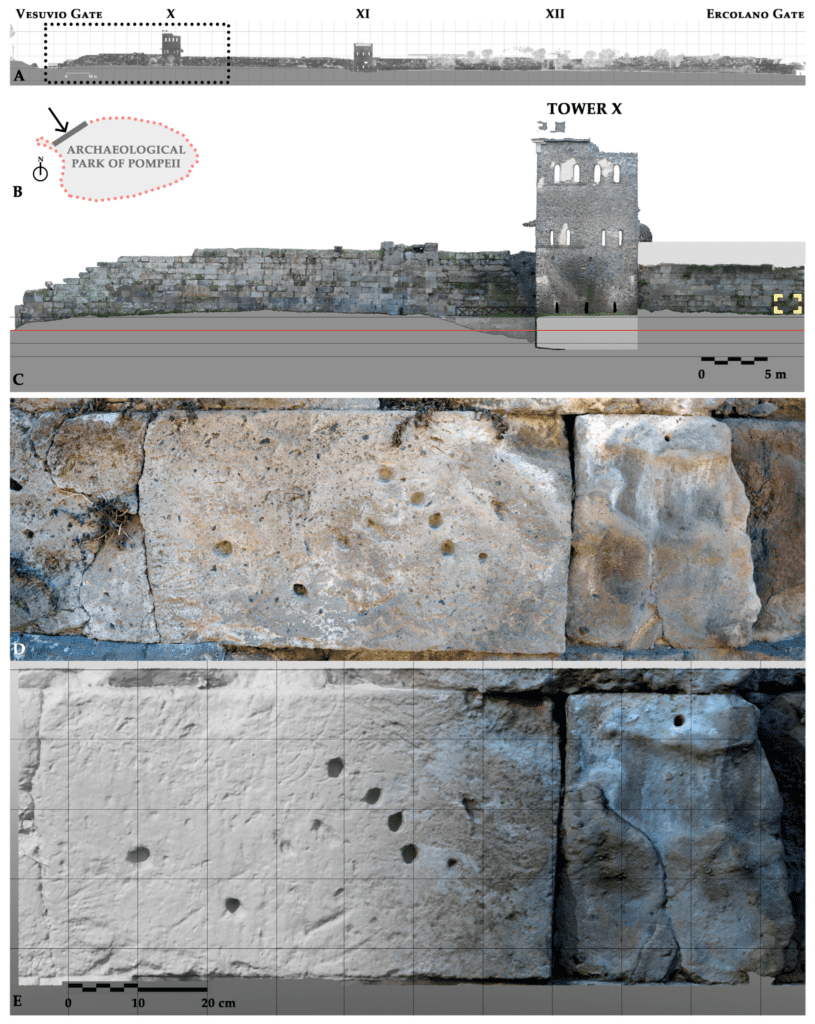
At the center of the study are clusters of sharply defined cavities embedded in the volcanic stone of Pompeii’s northern fortifications. These marks survived the eruption of Mount Vesuvius in AD 79, which sealed the city beneath layers of ash and debris, preserving earlier events with remarkable clarity.
What makes these traces compelling is not simply their presence, but their pattern.
Unlike the rounded impressions typically left by Roman artillery such as catapults and ballistae, these cavities form tight, repeated groupings. They appear at regular intervals and follow subtle curved paths across the wall surface—a pattern that cannot be explained by conventional siege engines.
A Weapon Known Only from Ancient Texts
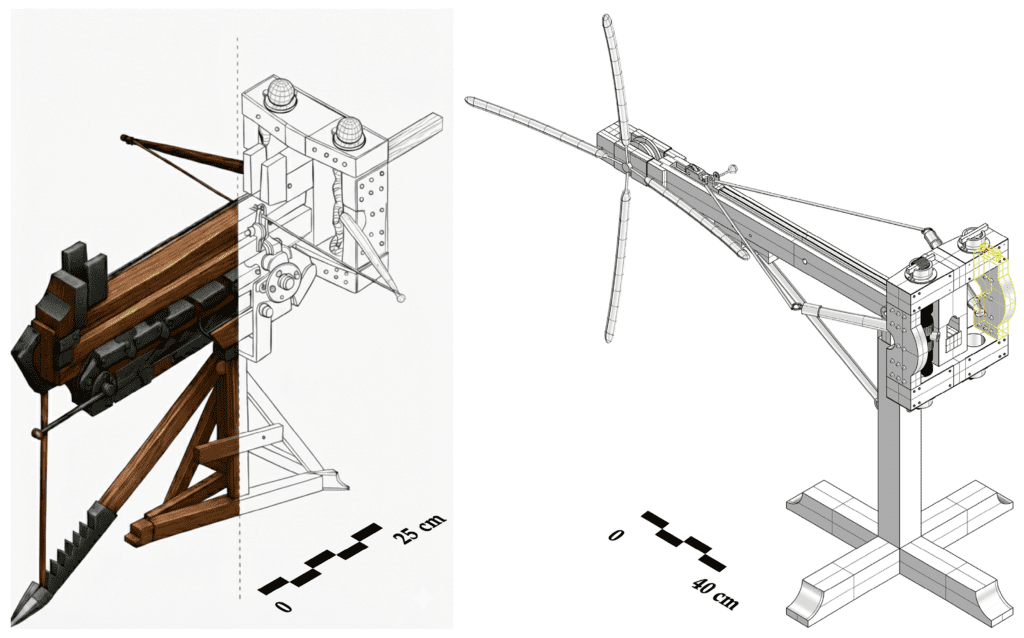
Researchers argue that the marks closely align with descriptions of the polybolos, a mechanical weapon developed in the Hellenistic world. Attributed to the engineer Dionysius of Alexandria in the 3rd century BC, the system used a chain-driven mechanism and a bolt magazine to fire projectiles automatically, without requiring manual reloading between shots.
For centuries, the polybolos has existed largely in theory. Ancient engineers such as Philo of Byzantium described its operation in technical detail, yet no confirmed archaeological evidence of its use had ever been identified in the field.
That gap may now be narrowing.
Digital Reconstruction Strengthens the Case
To test their interpretation, researchers employed high-resolution digital techniques, including laser scanning and photogrammetry. Each impact mark was recorded and reconstructed with millimetric precision, allowing the team to analyze both individual cavities and their spatial distribution.
What emerges is not randomness, but a consistent and deliberate pattern.
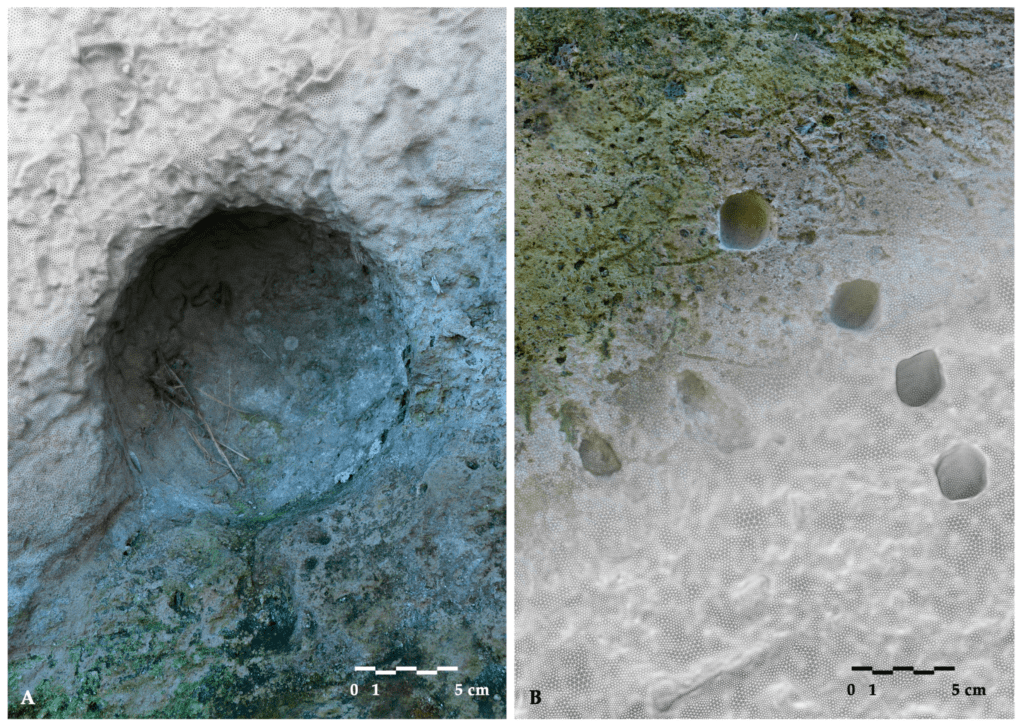
The geometry of the marks suggests metal-tipped bolts striking the wall in rapid succession, likely missing their intended targets by only a narrow margin. In several sections near the Vesuvio and Herculaneum gates, the impacts appear at heights consistent with defensive positions—indicating a possible attempt to suppress defenders along the ramparts.
A Siege Rewritten Through Stone
The historical context reinforces this interpretation. In 89 BC, Pompeii was besieged by the Roman general Lucius Cornelius Sulla during the Social War. The northern walls—where the marks are concentrated—would have been among the most vulnerable sections of the city’s defenses.
At the same time, Roman forces were increasingly incorporating advanced engineering knowledge from the Greek world. Centers such as Rhodes were renowned for their expertise in mechanical weaponry, particularly torsion-powered artillery systems.
The possibility that this knowledge extended to more complex, rapid-fire devices is not only plausible—it is increasingly difficult to dismiss.
Rethinking Ancient Military Technology
Caution remains. No physical remains of a polybolos have been recovered at Pompeii, and the interpretation relies on the correlation between material traces and ancient technical descriptions. Still, the convergence of archaeological evidence, digital modeling, and historical sources presents a compelling case.
More importantly, the study introduces a new way of reading ancient battlefields.
Rather than relying solely on written sources or reconstructed models, researchers can now treat stone surfaces as records of mechanical action. Each impact becomes a trace of motion, force, and intent—a silent testimony preserved in stone.
In this light, Pompeii offers more than a glimpse of a lost weapon. It reveals a level of mechanical sophistication that challenges long-standing assumptions about ancient warfare.
Rossi, A., Bertacchi, S., & Casadei, V. (2026). From Pompeii to Rhodes, from survey to sources: The use of polybolos. Heritage, 9(3), 96. https://doi.org/10.3390/heritage9030096
Cover Image Credit: Veronica Casadei. Rossi, A., et al., 2026