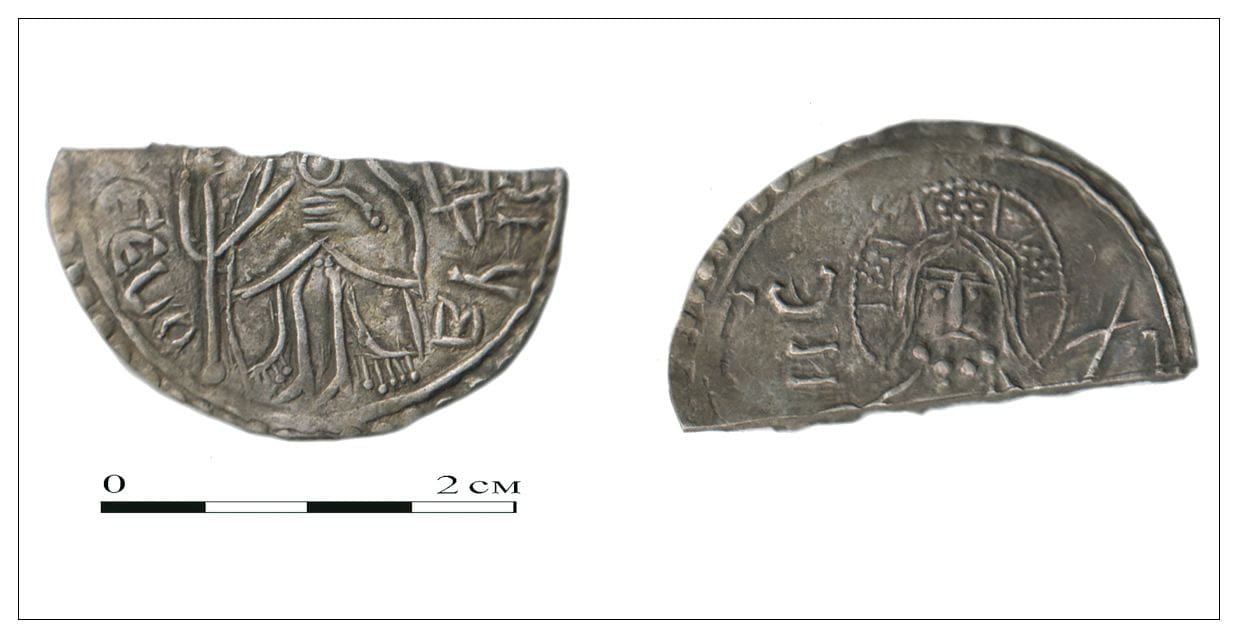
Archaeologists in Veliky Novgorod have discovered half of a rare silver coin issued by Prince Vladimir Sviatoslavich, one of the rulers most closely associated with the formation and Christianization of the early Rus’ state.
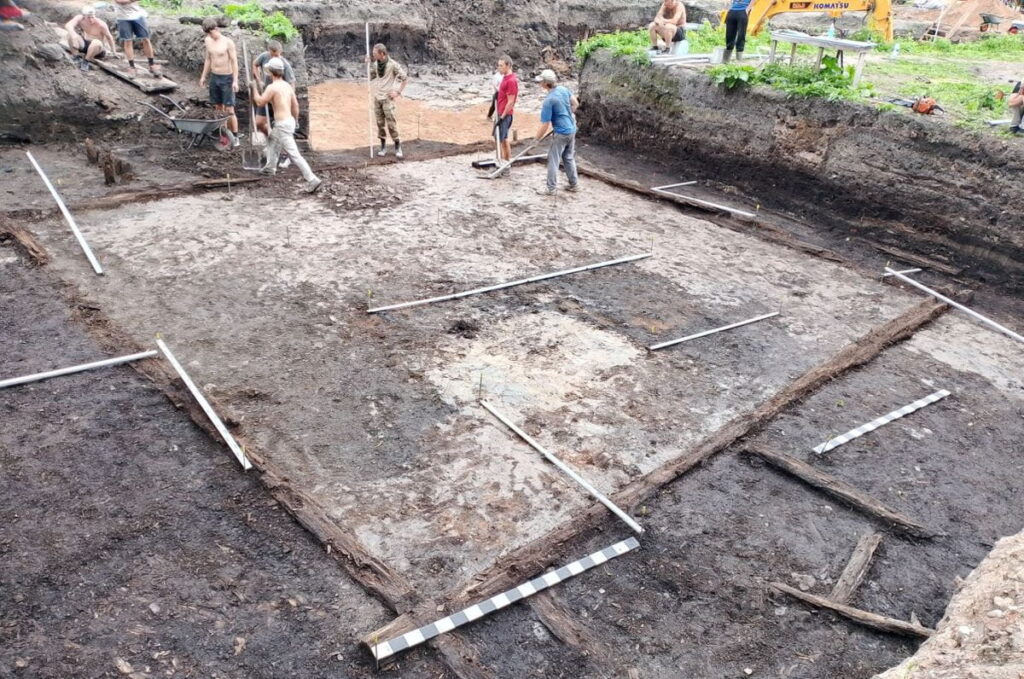
The fragment was found on July 24 during rescue excavations in the historic Lyudin district, where archaeologists from the Institute of Archaeology of the Russian Academy of Sciences were working ahead of the construction of a hotel.
It is only the third coin of Prince Vladimir ever found in Veliky Novgorod.
The coin belongs to a group known as srebreniks, among the earliest silver coins produced by the Rus’ rulers. One side shows Vladimir seated in a cloak, holding a cross on a long staff. Near his shoulder is the trident-shaped emblem of his dynasty.
Part of the inscription can still be read and is reconstructed as: “Vladimir, and this is his silver.”
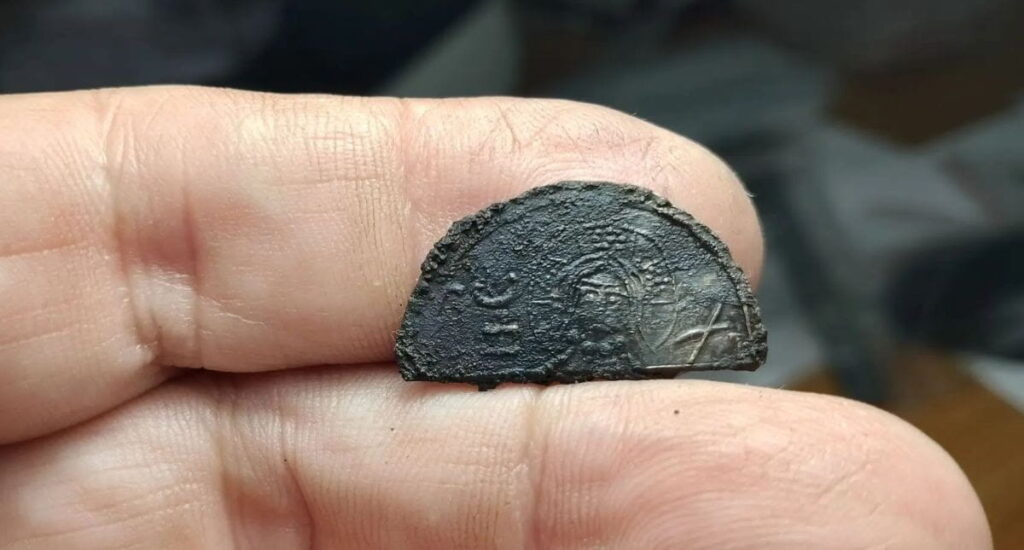
On the other side is an image of Jesus Christ holding the Gospel, with the abbreviated Greek inscription “IC XC” beside him.
The coin was made from high-grade silver, but it had been cut in half in antiquity. The surviving piece weighs 1.90 grams. Archaeologists do not yet know why it was divided.
A coin from a turning point in Rus’ history
The newly found fragment belongs to the earliest of four known types of Vladimir’s silver coinage.
Historians usually connect the production of these coins with the adoption of Christianity by Rus’ at the end of the 10th century. Their imagery was strongly influenced by Byzantine coins, which often placed the emperor on one side and Christ or another Christian figure on the other.
Vladimir used the same visual language, but adapted it to his own rule. His portrait, the cross and the image of Christ turned the coin into a political statement as much as a piece of silver currency.
Around 800 srebreniks of Vladimir are currently known. Roughly 300 belong to this earliest type, and researchers believe that at least 100 different pairs of dies were used to strike them.
The Veliky Novgorod example is well preserved enough for specialists to identify other coins produced with the same dies. Similar examples were found in a hoard near the village of Peremyshl in the Kaluga region, while another coin was discovered in the Chernihiv region.
Why the location matters
Most researchers believe Vladimir’s coins were minted in Kyiv. The majority have been found in southern regions linked to Kyiv, Chernihiv and Pereiaslav, while discoveries farther north remain rare.
That is what gives the Veliky Novgorod fragment much of its importance.
The first srebrenik of Vladimir found in the city was uncovered in 2010. A second appeared during construction-related excavations in 2023. The latest find brings the total to three.
The discovery has attracted attention in archaeology news not only because of the rarity of the coin, but because it was found far from the main area where Vladimir’s money usually appears.
According to Petr Gaidukov, adviser to the director of the Institute of Archaeology, the coin expands the known distribution of early Rus’ currency and offers further evidence of contact between Novgorod and Kyiv.
That matters because the first decades of Novgorod’s history are only thinly recorded in written sources.
Found in one of the city’s earliest layers
The excavation area lies close to medieval Proboynaya Street, in the heart of historic Veliky Novgorod.
Archaeologists found that the site was first occupied near the end of the 10th century. It may originally have formed part of a large estate facing the street. Houses and working buildings continued to occupy the property from the 11th to the 15th century.
More than 600 individual objects were recovered, including items made from iron, non-ferrous metals, bone, amber, glass, stone and clay. The team also collected pottery fragments, leather offcuts and animal remains.
The oldest layers contained pits, postholes and traces left by ploughing. Pottery and dirhams from the Arab Caliphate helped date these deposits to the late 10th and early 11th centuries.
That places the silver fragment close to the period in which it was first struck.
Coin production under Vladimir and his sons lasted no more than about 30 years. It never became a long-running monetary system, but the coins survived as evidence of a state defining both its political authority and its new Christian identity.
The Veliky Novgorod fragment is small, but its archaeological context makes it one of the most informative examples yet found in northern Russia.