
High in the frozen mountains of the Altai, where winds carve across the Ukok Plateau, a woman survived what should have been a fatal injury. Two and a half millennia later, modern CT imaging has revealed how.
Researchers from Novosibirsk State University have identified what may be the earliest documented case of temporomandibular joint (TMJ) reconstruction in deep antiquity — a technically precise jaw surgery performed on a young woman of the Pazyryk culture around the 5th century BCE.
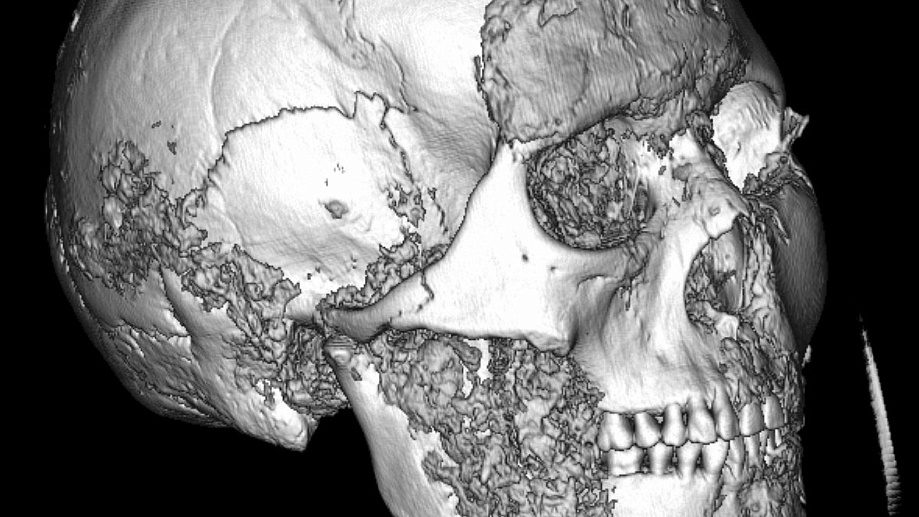
The evidence comes from a skull recovered at the Upper Kaljin-2 burial ground, part of the Scythian-era Pazyryk horizon known for its frozen kurgans. Using high-resolution computed tomography at NSU’s Laboratory of Nuclear and Innovative Medicine, scientists digitally removed preserved soft tissue and generated a 3D reconstruction from 551 ultra-thin slices.
What they saw was astonishing.
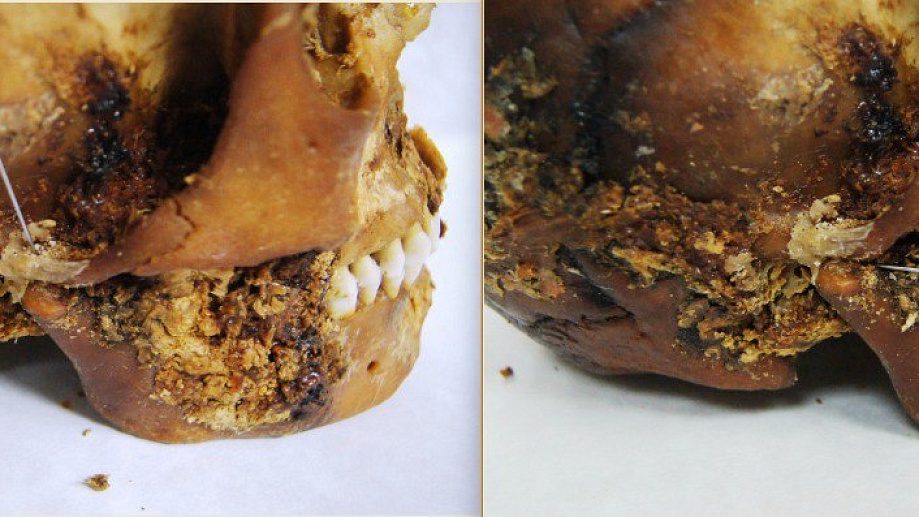
The woman had suffered a severe depression fracture to the right temporal bone, destroying the temporomandibular joint. Without intervention, such trauma would likely have left her unable to chew or speak — and survival in the harsh mountain environment would have been doubtful.
Instead, researchers discovered two precisely drilled bone channels, each roughly 1.5 mm wide, intersecting at a right angle across the damaged joint. One passed through the mandibular head; the other through the zygomatic process of the temporal bone. Around the perforations, ring-shaped bone growth confirmed healing — proof the procedure was performed during her lifetime.
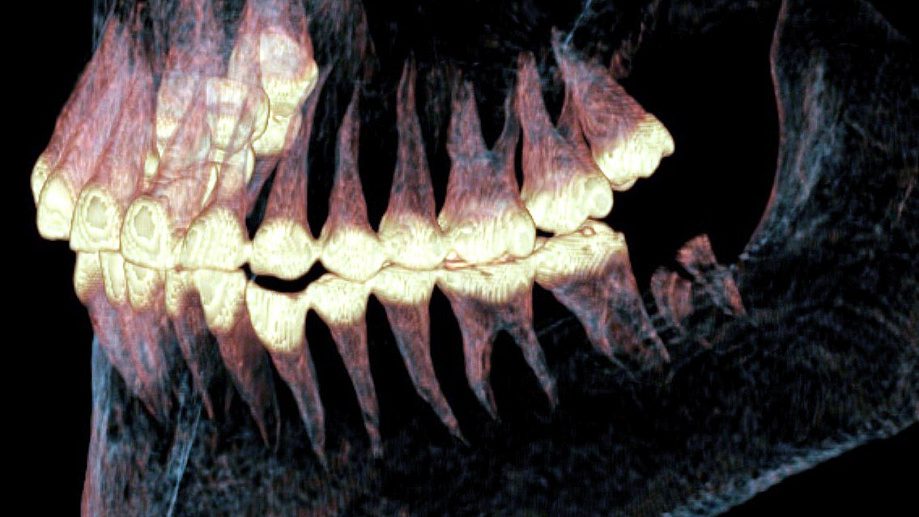
Even more remarkable, traces of elastic organic material were detected within the channels — possibly horsehair or tendon — suggesting a ligature system used to stabilize the joint. In effect, this appears to represent an early form of prosthetic fixation.
Dental wear patterns offer further confirmation of long-term survival. The left side of her jaw shows heavy overuse and inflammatory changes, while the injured right side remains comparatively preserved. She adapted, shifting the burden of chewing to one side for months — perhaps years — after surgery.
Estimated to have died between 25 and 30 years old, she lived well beyond the immediate trauma.
A Society That Valued Life
Her burial at Upper Kaljin-2 was architecturally elaborate, constructed from massive larch logs transported onto the largely treeless Ukok Plateau. Yet it contained almost no grave goods aside from a traditional wig.
As archaeologist Natalia Polosmak noted, the surgical intervention itself signals social significance. In a small, mobile population facing harsh environmental pressures, every life mattered.
The Pazyryk are already known for sophisticated mummification practices and advanced craftsmanship — leather garments stitched with extraordinary precision. Previous research on another Ukok mummy revealed cranial trepanation. Together, these findings suggest that Iron Age Siberia possessed a structured body of anatomical knowledge.
The parallels with ancient Egypt are difficult to ignore.
Rewriting the History of Ancient Medicine
Radiologist Andrey Letyagin operated the CT scanner at maximum settings, producing exceptionally detailed images rarely achievable in clinical practice. The results may represent the first scientifically documented example of TMJ reconstruction in the ancient world.
In the windswept mountains of the Altai, a community refused to abandon one of its own. They drilled, stabilized, and repaired a shattered jaw — restoring speech, eating, and life itself.
Far from primitive, the Pazyryk people demonstrated surgical innovation that reshapes our understanding of Siberian Iron Age medicine.
Novosibirsk State University (NSU)
Cover Image: AI-generated image of a Pazyryk woman from the Ukok Plateau. Arkeonews