
Archaeologists excavating a 3,600-year-old kurgan in western Azerbaijan have uncovered a polished stone staff head that may once have served as an emblem of authority. A bronze dagger and finely worked arrowheads found in the same burial suggest that the person laid to rest there held an elevated military and social position.
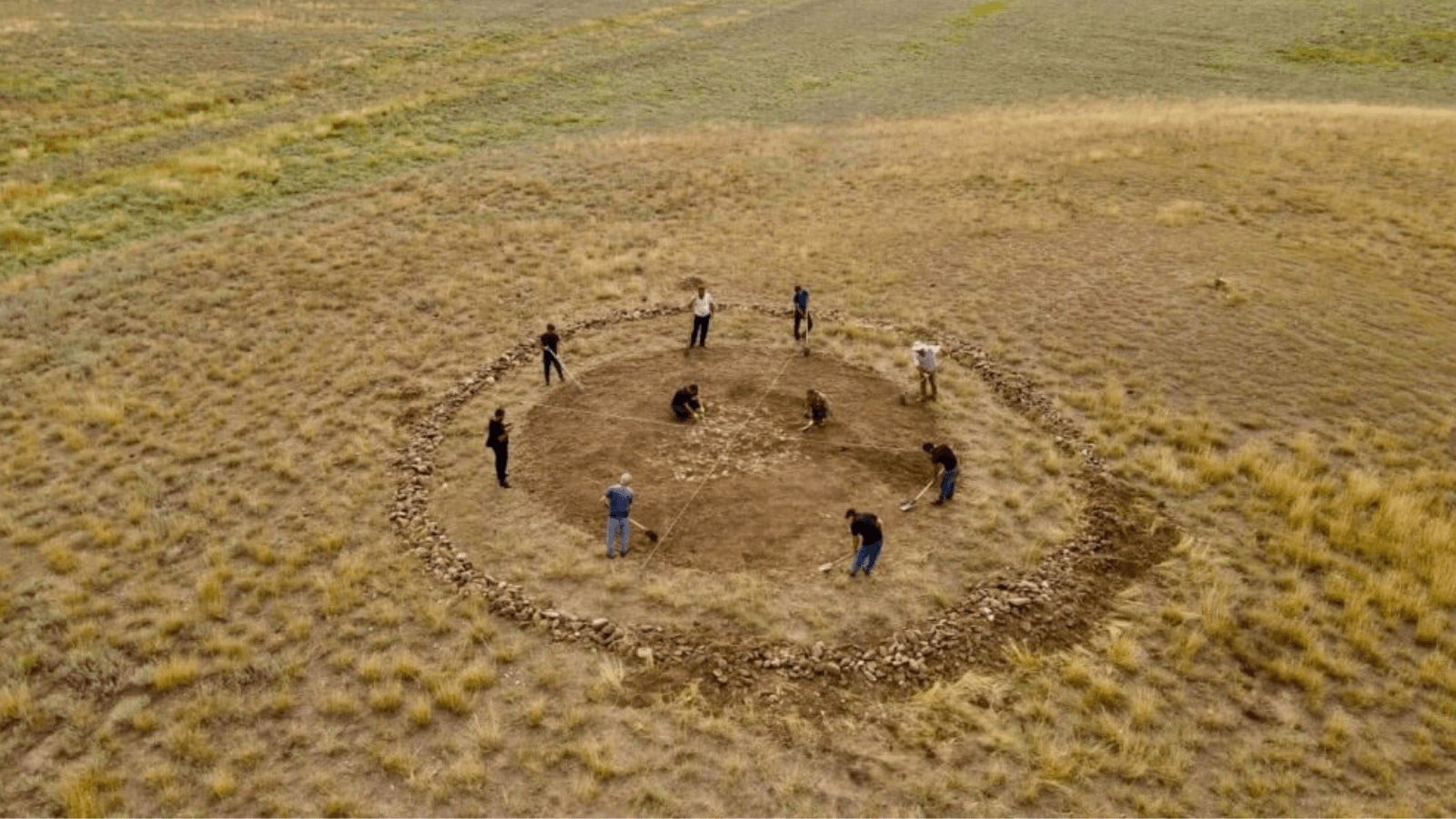
The burial, designated Kurgan No. 4, lies in the Sarıyoxuş area of the Keşikçidağ Kurgan Valley in Azerbaijan’s Ağstafa District. Researchers are investigating it as part of the sixth “Scientific Archaeological Excavations and Summer School in Keşikçidağ” project.
A burial associated with status and warfare
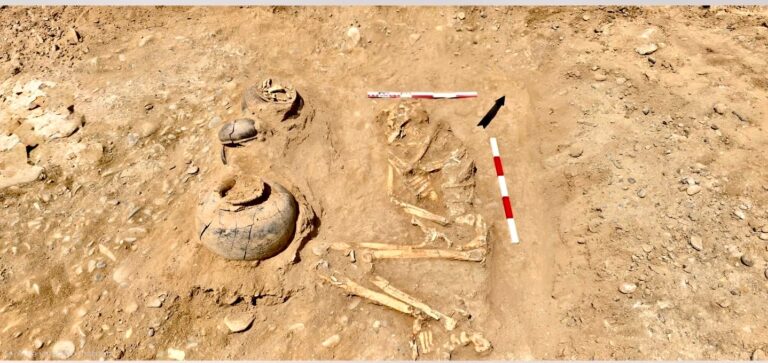
The stone-covered mound measures approximately 12 meters in diameter and rises about 80 centimeters above the surrounding ground. Its burial chamber extends to a depth of between one and 1.2 meters.
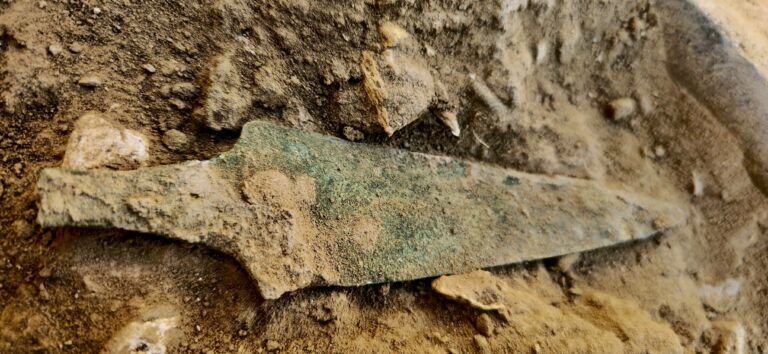
Objects recovered from the chamber include a bronze dagger, ceramic vessels, flint and obsidian arrowheads, and the perforated stone staff head. Archaeologists believe this combination points to a high-ranking warrior or community leader whose authority may have extended beyond the battlefield.
The excavation is being directed by Vaqif Asadov, a leading researcher at the Institute of Archaeology and Anthropology of the Azerbaijan National Academy of Sciences. The artifacts have provisionally been placed in the late Middle Bronze Age, around the seventeenth or sixteenth century BCE.
Researchers have also linked the forms of the dagger and ceramics with the early phase of the Khojaly-Gadabay archaeological culture. This material tradition developed across parts of the South Caucasus during the later Bronze Age and is known from settlements and burials containing distinctive pottery and metalwork.
A carefully shaped symbol of authority
The most unusual object from the kurgan is a polished staff head made from diorite. Weighing approximately 400 to 500 grams, it has a central perforation through which a wooden or bone shaft may once have passed.
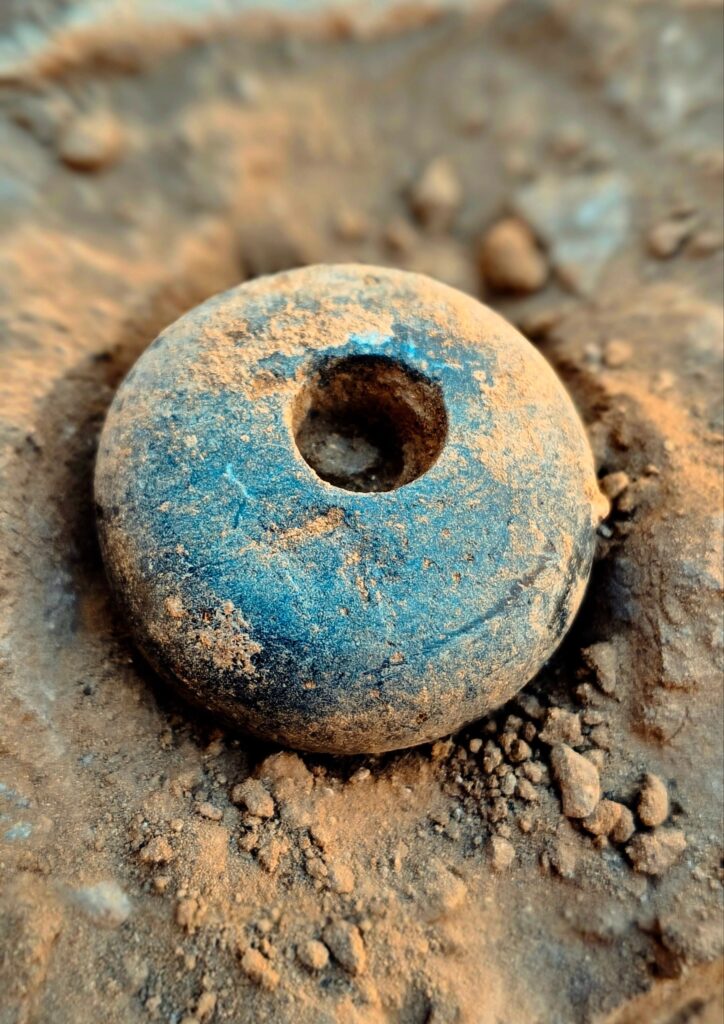
Archaeologists do not believe such objects necessarily had an exclusively practical function. The Keşikçidağ example may have been carried during ceremonies or used as a visible sign of rank by a member of the military aristocracy, a tribal leader or another person with recognized authority.
Its smooth surface, symmetry and balanced form also reveal the care invested in its production. Shaping and perforating a hard stone such as diorite would have required both experience and considerable labor, adding to the object’s value within the community.
A dagger and arrows placed beside the dead
The bronze dagger provides the clearest connection with warfare. As a close-combat weapon, it may have represented the deceased person’s identity as a warrior, although the full meaning of the grave assemblage will become clearer only after the excavation and analysis are complete.
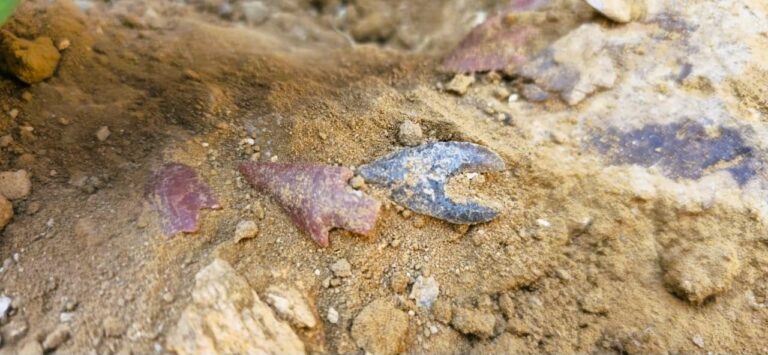
Several arrowheads were also recovered from what may originally have been a quiver, although its organic parts have not survived. Most were made from flint in reddish-brown, grey and darker shades, while two black examples were fashioned from obsidian.
Some of the flint arrowheads have an unusual winged form and display particularly careful workmanship. Their presence alongside the dagger and staff head strengthens the interpretation of the burial as belonging to someone whose position was closely connected with weapons and authority.
The obsidian pieces may eventually offer evidence of regional contacts. Because suitable obsidian occurs in restricted geological zones, identifying the source of the material could help trace the movement of raw materials between Bronze Age communities in the South Caucasus.
Scientific analysis could refine the date
The widely reported age of approximately 3,600 years currently rests on the archaeological characteristics of the burial and comparisons with related artifacts. It should therefore be understood as a provisional date rather than the result of completed radiocarbon testing.
Selected samples from the kurgan are expected to undergo radiocarbon analysis. The results could establish a more precise chronology and clarify whether the burial belongs securely to the late Middle Bronze Age or the transition toward the Late Bronze Age.
Ceramic vessels and other objects from the excavation are meanwhile undergoing initial conservation, documentation and laboratory processing by specialists at the reserve. After this work is completed, the finds will enter the collection of the Keşikçidağ State Historical and Cultural Reserve.
A glimpse of Bronze Age leadership
Systematic excavations in the Keşikçidağ Kurgan Valley are gradually revealing how local communities expressed identity, status and authority through burial. Kurgan No. 4 is especially significant because its grave goods bring together weapons, skilled craftsmanship and an object that may have publicly identified its owner as a leader.
The name and precise role of the person buried beneath the mound remain unknown. Yet the deliberate combination of the dagger, arrows and stone staff head suggests that military standing and political authority were already closely intertwined in this part of the South Caucasus around 3,600 years ago.
Source: Institute of Archaeology and Anthropology of the Azerbaijan National Academy of Sciences
Cover Image: Archaeologists excavate the 3,600-year-old kurgan discovered in Azerbaijan. The circular stone boundary clearly marks the Bronze Age burial mound. Credit: Keshikchidagh State Historical and Cultural Reserve