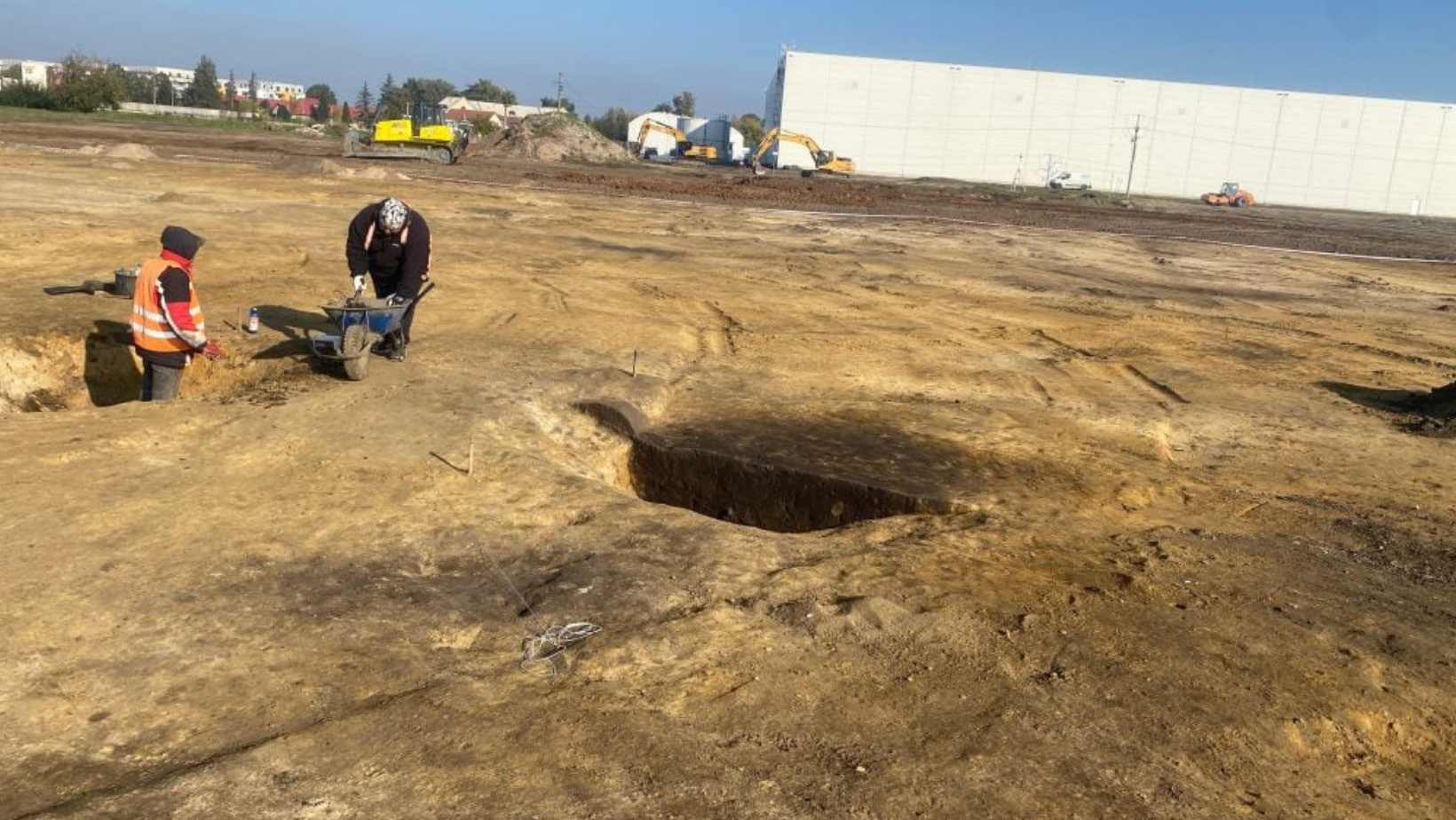
Archaeologists from the East Bohemian Museum in Pardubice have unearthed the remains of a 3,000-year-old Bronze Age village during a rescue excavation in the town of Dašice, ahead of a planned construction project. What began as a routine preventive investigation quickly turned into one of the region’s most instructive glimpses into everyday prehistoric life.
A semicircular settlement with a planned layout
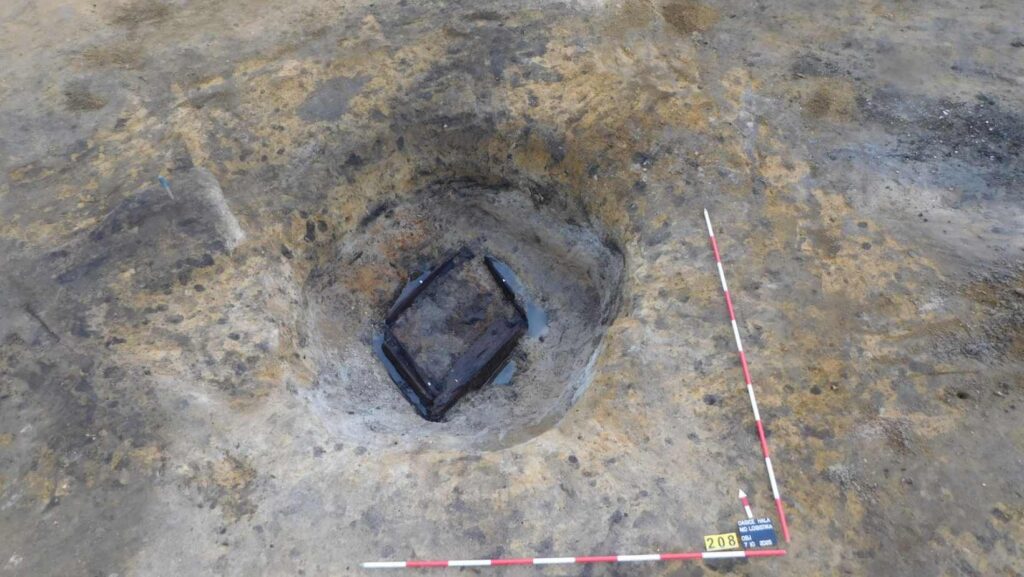
According to excavation leader Tomáš Zavoral, the settlement was built in a semicircular form, organized around a small open square and equipped with a wood-lined well—a rare feature showing early attempts at controlled water use. One of the dwellings revealed its entrance, load-bearing columns, and a clay-coated wall, indicating that the structure had been made with a mixture of plant materials, charcoal, and mud, then roofed with masonry slabs. The design suggests a well-planned, long-term settlement rather than a temporary camp.
A window into Late Bronze Age life
Preliminary study places the site in the Late Bronze Age (ca. 1200–800 BCE), a period known for its dense rural networks and technological advances across Central Europe. Archaeologists suspect the Dašice community was part of the Urnfield cultural horizon, whose settlements extended from the Danube to the Elbe valleys. These small, connected communities cultivated grains, raised livestock, and exchanged raw materials such as bronze and salt.
Fragments of domestic pottery, animal bones, and grinding stones recovered from the site suggest a self-sufficient household economy, focused on food storage and processing. “The layout and material culture imply that these were permanent homes, not seasonal shelters,” Zavoral noted.
Scientific analysis and environmental reconstruction
The team collected numerous soil and sediment samples for laboratory analysis. Specialists in archaeobotany and geochemistry will examine plant remains and micro-particles to determine what crops grew nearby and how the landscape looked three millennia ago. Radiocarbon dating and micromorphological studies will help establish the sequence of occupation phases, while isotope analysis of animal bones could reveal the herding and dietary patterns of the settlement.
Such interdisciplinary cooperation, Zavoral explained, has become standard practice in Czech archaeology. “We work closely with natural scientists to reconstruct how people interacted with their environment. Each seed or fragment of charcoal helps us understand not only when they lived, but how.”
A region rich in buried history
The Pardubice District is no stranger to archaeological discoveries. Similar Late Bronze Age remains have been found in nearby Hrochův Týnec and Chrudim, suggesting that the region once formed part of a dense settlement zone connected by trade and shared technologies. “We often uncover traces of habitation here,” Zavoral said. “Just two years ago, during the construction of a road bypass, we documented finds from nearly every phase of prehistory.”
These recurring discoveries indicate that eastern Bohemia has been continuously inhabited for thousands of years, shaped by fertile lowlands and access to major river routes.
Preserving the past for the future
All finds from Dašice have been transferred to the East Bohemian Museum in Pardubice, where they are undergoing conservation and cataloguing. Once the scientific analyses are complete, the museum plans to organize a public exhibition highlighting the excavation process and the everyday life of Bronze Age villagers.
For Zavoral and his team, the discovery is less about a single village and more about recognizing the depth of human continuity beneath modern landscapes. “We tend to think of construction sites as places of creation,” he said, “but in archaeology, they also reveal layers of lives already lived.”
The 3,000-year-old settlement at Dašice, emerging quietly beneath a modern development, serves as a reminder that even in the most ordinary fields, traces of the ancient world still endure—waiting for the next careful trowel to bring them back to light.