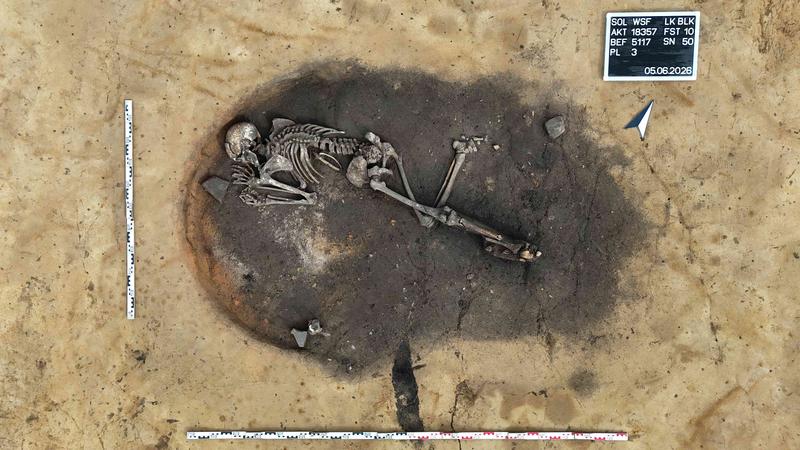
A young man buried inside a prehistoric kiln pit in central Germany has left archaeologists with a rare problem: his grave follows some Corded Ware customs, but its setting and possible skull injury do not fit an ordinary burial.
The find was uncovered near Gerstewitz in the Burgenland district of Saxony-Anhalt, during archaeological investigations ahead of construction work for the SuedOstLink power line. The excavation is being carried out by the State Office for Heritage Management and Archaeology Saxony-Anhalt in coordination with the grid operator 50Hertz.
The burial belongs to the Corded Ware culture, a Late Neolithic cultural horizon that spread across large parts of Europe between about 2900 and 2050 BC. At Gerstewitz, however, archaeologists are dealing with something more difficult than a standard grave.
A Corded Ware burial in an unexpected place
The deceased was a man about 25 years old. His body was found inside a kiln pit made up of two connected underground chambers. Such features are usually empty or contain only traces linked to their original use, which makes the burial setting highly unusual.
Part of the grave still matches known Corded Ware practice. The man had been placed in a crouched position, lying on his right side and facing south. This fits a wider burial pattern in which men were often laid on the right side, while women were commonly placed on the left.
But the grave is not easy to classify. The man’s upper body had shifted after burial, suggesting he may have originally been laid on a perishable surface such as plant material, wood, hide, or another organic layer that later decayed.
Skull injury raises the question of violence
The most important clue may be the skull. Archaeologists have reported signs of injury, though further study is needed before its cause and timing can be understood.
If the trauma occurred around the time of death, the man may have died violently. In that case, the kiln pit might have been used because it was already available, perhaps after a conflict, accident, or hurried burial.
There is also another possibility. Some rare Corded Ware kiln pits have been found with complete cattle skeletons or partially dismembered dog skeletons. These deposits have been interpreted by some researchers as possible offerings. The Gerstewitz burial may belong to a similar category, where a body was placed in a special underground feature for reasons that were not purely practical.
For now, the evidence does not support a single explanation. The burial could point to violence, emergency, ritual behavior, or a combination of these.
Gerstewitz already had a long prehistoric memory
The young man was not buried in an empty landscape. Excavations around Gerstewitz have revealed traces of human activity stretching across roughly 6,000 years, showing that the hill had significance for several prehistoric communities.
During the Baalberge culture, around 4000 to 3400 BC, a monumental burial mound was built at the site. It may once have stood up to 15 meters high and covered a wooden burial chamber. Such mounds were not only graves. They were visible landmarks tied to ancestry, memory, and social authority.
Later, during the Salzmünde culture, around 3400 to 3100 BC, the same area was enclosed by a triple rampart and ditch system. Inside this space, archaeologists found deep pits containing burned house remains, animal bones, human bones, and other deposits linked to repeated ceremonial activity.
By the time the Corded Ware man was placed in the kiln pit, Gerstewitz already had a much older past. The pit may have been chosen by chance, but the broader setting suggests archaeologists must also consider the hill’s earlier ceremonial importance.
A construction route reveals an older landscape
The discovery also shows how large infrastructure projects can expose buried chapters of prehistoric Europe. The SuedOstLink route crosses fertile areas of Saxony-Anhalt that were occupied repeatedly from the Neolithic onward.
Before construction begins, archaeologists are recording sites that would otherwise remain hidden beneath farmland. Near Gerstewitz, the work has revealed burial mounds, enclosure systems, settlement traces, ritual pits, animal deposits, and graves from several prehistoric periods.
The kiln-pit burial now stands out as one of the most puzzling finds from that sequence. Future laboratory analysis of the bones, skull injury, burial environment, and any surviving organic traces may clarify whether the man died violently, whether his body moved after death, and whether the kiln pit had a special role before it became a grave.
More than 4,000 years later, the Gerstewitz burial still resists a simple answer. That uncertainty is part of its value. It preserves a rare moment in which Corded Ware burial rules, possible violence, and the older memory of a prehistoric landscape may have come together underground.
Cover Image Credit: A Corded Ware Culture burial discovered inside a kiln pit at Gerstewitz. Photo: Christian Pabst. © State Office for Heritage Management and Archaeology Saxony-Anhalt.