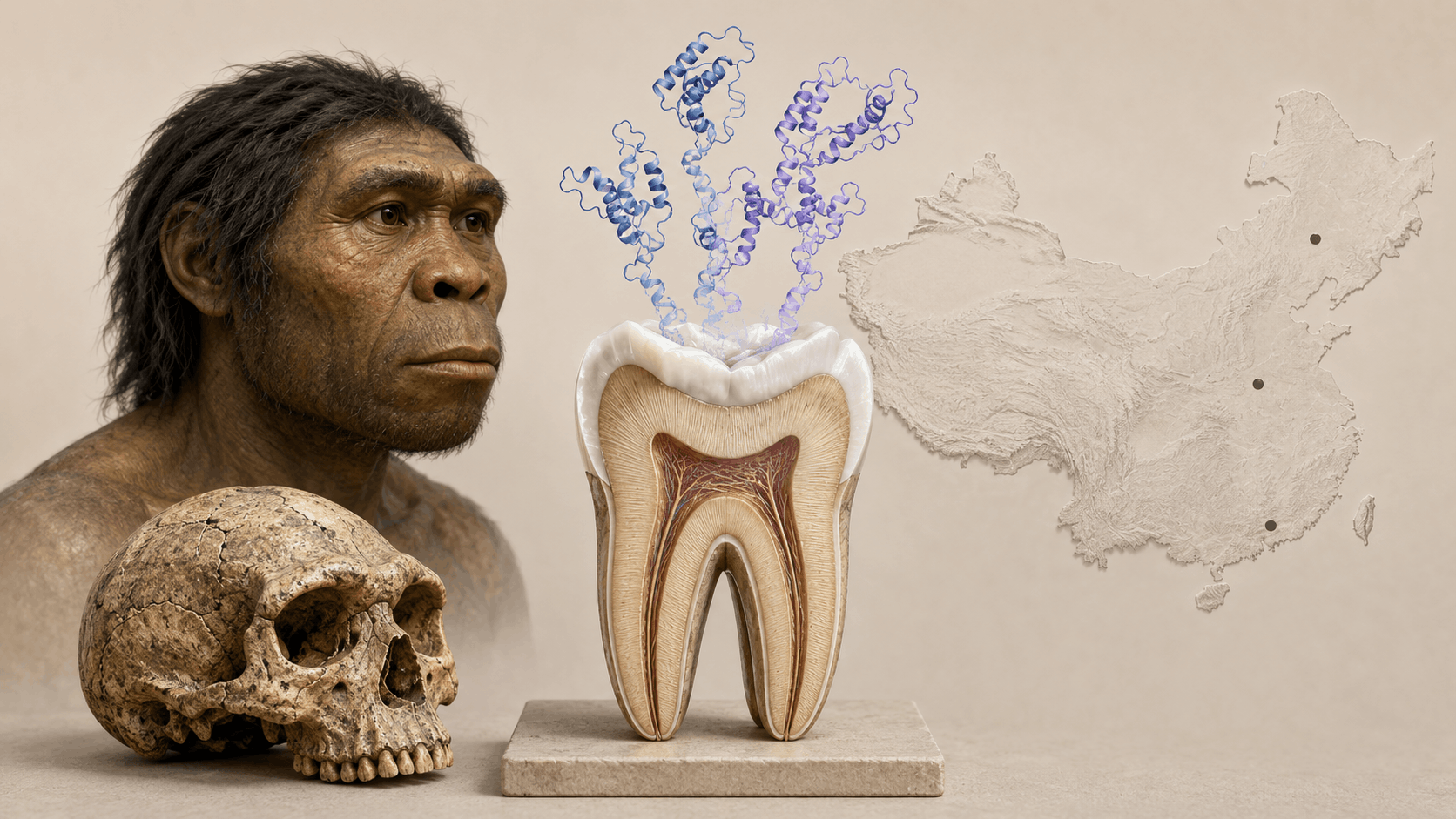
Chinese scientists have recovered the first molecular data from Homo erectus, using proteins preserved inside 400,000-year-old teeth from China.
The discovery, published in Nature, does not involve ancient DNA. Instead, it opens a rarer and more durable archive: tooth enamel, where biochemical traces can survive long after genetic material has disappeared. For a species long known mostly through skulls, jaws, teeth and stone tools, that is a major shift.
The study analyzed six fossil teeth from three important Chinese sites: Zhoukoudian, famous for the Peking Man discoveries, Hexian, and Sunjiadong. Together, they offer the first molecular glimpse into East Asian Homo erectus, one of the most important and still debated human relatives in the deep past.
A species known mostly from bones finally enters the molecular record
Homo erectus has always occupied a powerful place in the story of human evolution. The species appeared nearly two million years ago and became one of the earliest members of the human family to spread widely across Africa and Eurasia.
In East Asia, Homo erectus is especially important. The fossils from Zhoukoudian, often associated with “Peking Man,” helped shape 20th-century ideas about early humans. Yet those fossils could mostly speak through anatomy: the thickness of skull bones, the shape of teeth, the size of jaws and the form of the face.
That left many questions open. Were different Homo erectus groups in China closely related to one another? How did they fit into the wider human family? Did they have any relationship, direct or indirect, with later archaic humans such as Denisovans?
The new study does not solve all of those questions. But it gives researchers something they did not have before: molecular evidence.
The clue was hidden in tooth enamel
Ancient DNA has transformed the study of Neanderthals and Denisovans, but DNA is fragile. Heat, humidity, soil chemistry and time can destroy it. In many ancient fossils, especially from warm or variable environments, DNA simply does not survive.
Tooth enamel is different. It is the hardest tissue in the human body. Proteins locked inside it can remain stable across immense stretches of time, even when DNA has vanished.
The research team, led by Qiaomei Fu of the Institute of Vertebrate Paleontology and Paleoanthropology at the Chinese Academy of Sciences, used paleoproteomic methods to study enamel proteins from six Homo erectus teeth. The work was carried out with a minimally destructive approach, an important detail because fossils of this age are scientifically irreplaceable.
The team identified ancient protein sequences that allowed them to compare the Chinese Homo erectus samples with other ancient and modern human relatives. Five of the individuals were identified as male and one as female.
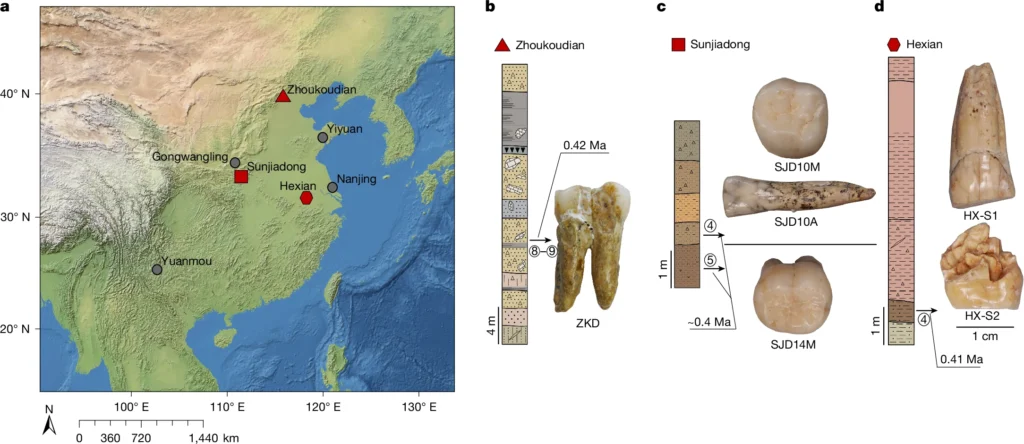
Credit: Fu et al., Nature, 2026 / Natural Earth
A molecular marker for East Asian Homo erectus
One of the most important findings involves a variant in the enamel protein AMBN, known as AMBN-A253G.
This variant appeared in all six Homo erectus teeth from Zhoukoudian, Hexian and Sunjiadong. According to the study, it was not detected in modern humans, Neanderthals, Denisovans, Homo antecessor, the Dmanisi Homo erectus sample or other primates examined by the researchers.
That makes the variant especially significant. It may represent a molecular signature of these Middle Pleistocene Homo erectus populations in China.
This matters because the fossils from these sites do not all look exactly alike. Some specimens, especially those from Hexian, have been discussed as anatomically unusual. The protein evidence suggests that, despite visible differences in their bones and teeth, these individuals may have belonged to a shared East Asian Homo erectus population.
For a species often separated into debates over shape and classification, that is a rare piece of biochemical clarity.
A cautious link to Denisovans
The second key finding is more provocative.
The researchers also found another AMBN variant, AMBN-M273V, in the Chinese Homo erectus teeth. This variant had previously been associated with Denisovans, the mysterious archaic humans known mostly from genetic data and a limited fossil record in Asia.
If the variant was already present in Homo erectus populations around 400,000 years ago, it may not have originated with Denisovans. One possible explanation is that Denisovan ancestors later acquired it through contact with populations related to East Asian Homo erectus.
That interpretation needs caution. This is not proof that Homo erectus DNA has been found in modern people. It is not a complete genome, and it does not create a simple direct line from Homo erectus to living populations.
But it does raise an important possibility: some molecular traces linked to East Asian Homo erectus-like populations may have survived indirectly through Denisovan ancestry. Since Denisovans later contributed genetic material to some modern human groups, especially in parts of Asia and Oceania, the finding adds another layer to an already tangled human story.
Ancient proteins are changing what fossils can tell us
The larger importance of the study lies in what it makes possible.
For decades, many ancient human fossils were trapped in silence if DNA could not be recovered from them. Scientists could measure their anatomy, compare their tools and study their landscapes, but their molecular relationships remained out of reach.
Paleoproteomics is beginning to change that. By reading proteins preserved in tooth enamel, researchers can extract biological information from fossils once thought too old or too degraded for molecular study.
For East Asia, this could be especially important. The region has a rich Middle Pleistocene fossil record, but many questions remain unresolved because ancient DNA is difficult to recover. Enamel proteins may now give scientists a new way to test old assumptions.
The six teeth from China do not close the book on Homo erectus. They reopen it.
After 400,000 years, these fossils have produced more than shape and measurement. They have yielded a molecular signal from a vanished human world, one that may bring Homo erectus closer to the complex ancestry of later humans than bones alone could ever show.