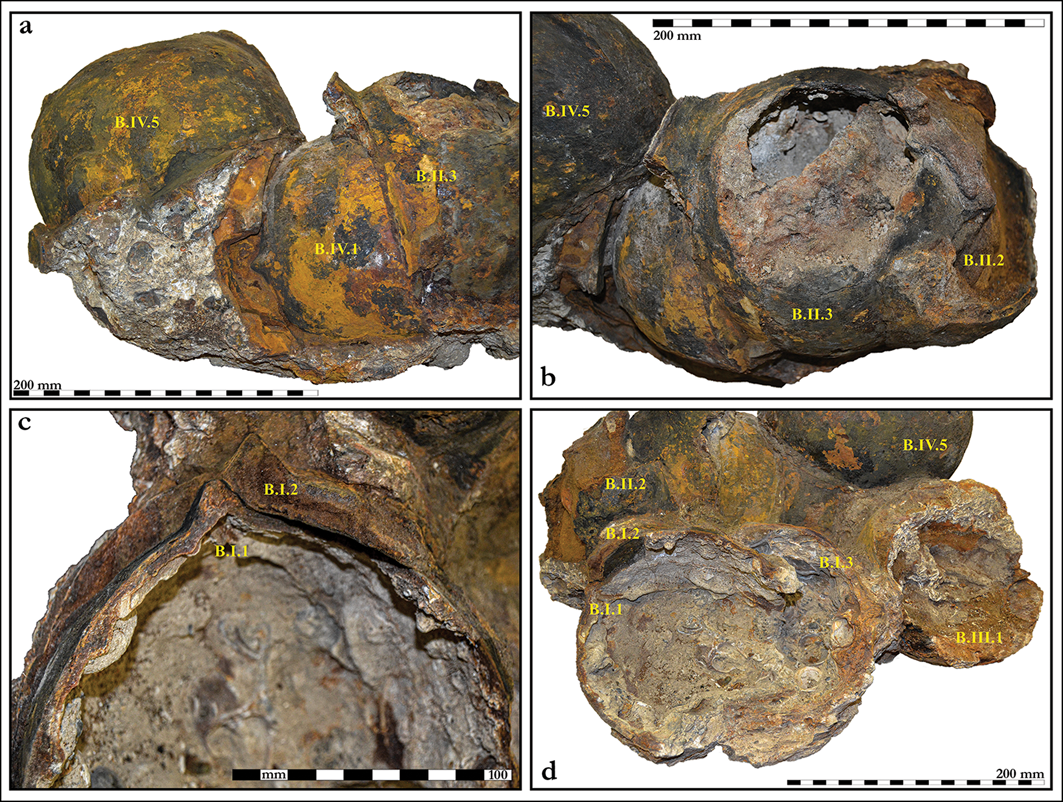
Medieval helmets found off Spain’s coast have overturned a long-standing archaeological assumption. For decades, a group of iron helmets recovered from the seabed near Benicarló, in eastern Spain, seemed to belong to the ancient Mediterranean world. They had been found in the same underwater zone as Roman anchor stocks, amphorae and bronze helmets, so the Roman connection appeared almost inevitable.
A new scientific study now moves the story forward by more than a thousand years.
The helmets, recovered in 1990 from the underwater site of Piedras de la Barbada off the coast of Castellón, are now identified as late medieval military equipment. Radiocarbon dating of textile linings preserved inside the corroded iron shells places most of them between the late 14th and early 15th centuries, a period when the Valencian coast faced piracy, raids, local defence needs and growing military pressure.
A Roman-looking seabed hid a medieval war story
The Benicarló helmets were long pulled into the orbit of antiquity because of the objects found around them. Roman maritime material from the same underwater area shaped the first interpretation. In archaeology, location often guides expectation.
But this case shows how misleading that can be.
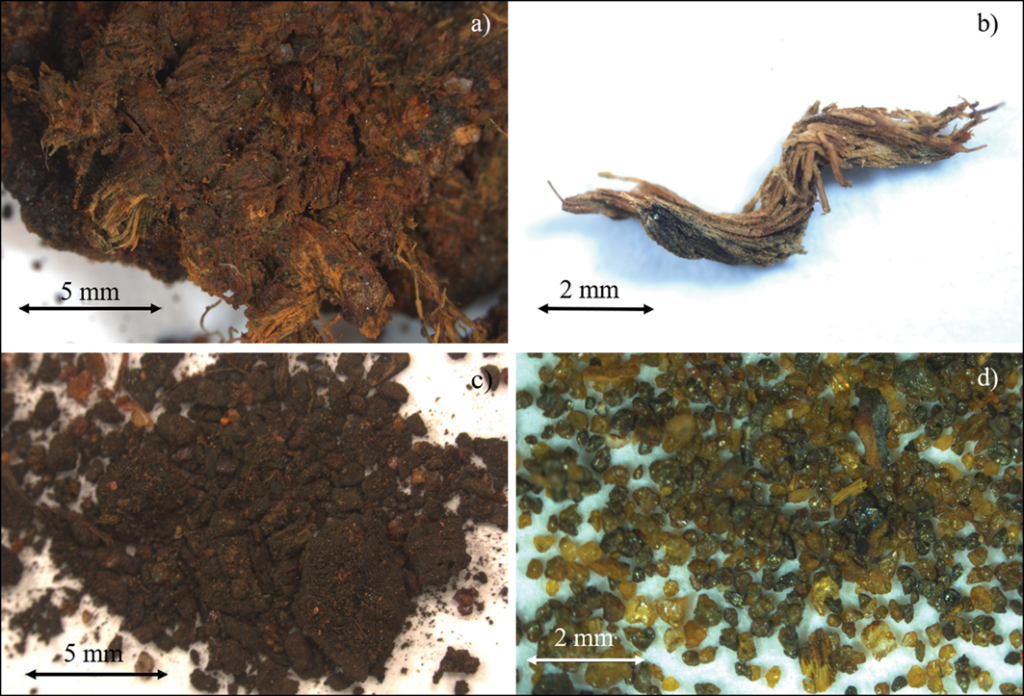
The helmets were not dated by their surroundings alone. The decisive evidence came from inside the metal. Preserved fragments of textile, still trapped within several helmet calottes, gave researchers a rare opportunity to date the objects directly.
That is what makes the discovery so unusual. Underwater iron artefacts almost never preserve organic material. Salt water, oxygen, microorganisms and corrosion usually destroy fabric long before it can be studied. In Benicarló, however, the sea did something unexpected. It sealed the evidence away.
The dating clue was hidden inside the helmets
The helmets had fused into dense concreted masses of iron, sediment and carbonate deposits. Inside these hardened layers, fragments of plant-fibre textile survived in positions that suggest they were once linings or padding. These were not decorative remains. They belonged to the practical inner structure of the helmets, the part that helped cushion the head beneath the iron shell.
Microscopic and spectroscopic analyses showed that the fabrics were made from plant bast fibres. They were woven in a simple tabby structure, using Z-twisted yarns. X-ray microtomography also revealed the internal sequence of the helmets: marine sediment on the outside, textile below it, then iron corrosion products, and finally the original metal surface.
That layered environment created a protective pocket. The corrosion and carbonate deposits, usually seen only as damage, helped isolate the textile from the open marine setting. What should have vanished became the strongest evidence.
Researchers dated five textile samples using accelerator mass spectrometry in two independent laboratories. Four samples produced a coherent late medieval range, mainly between the late 1300s and early 1400s. A fifth sample gave a later date, between the late 15th and early 17th centuries, but the study treats it as an outlier, probably caused by contamination or younger organic intrusion.
The conclusion is clear: these were not Roman helmets.
Practical armour from a dangerous coastline
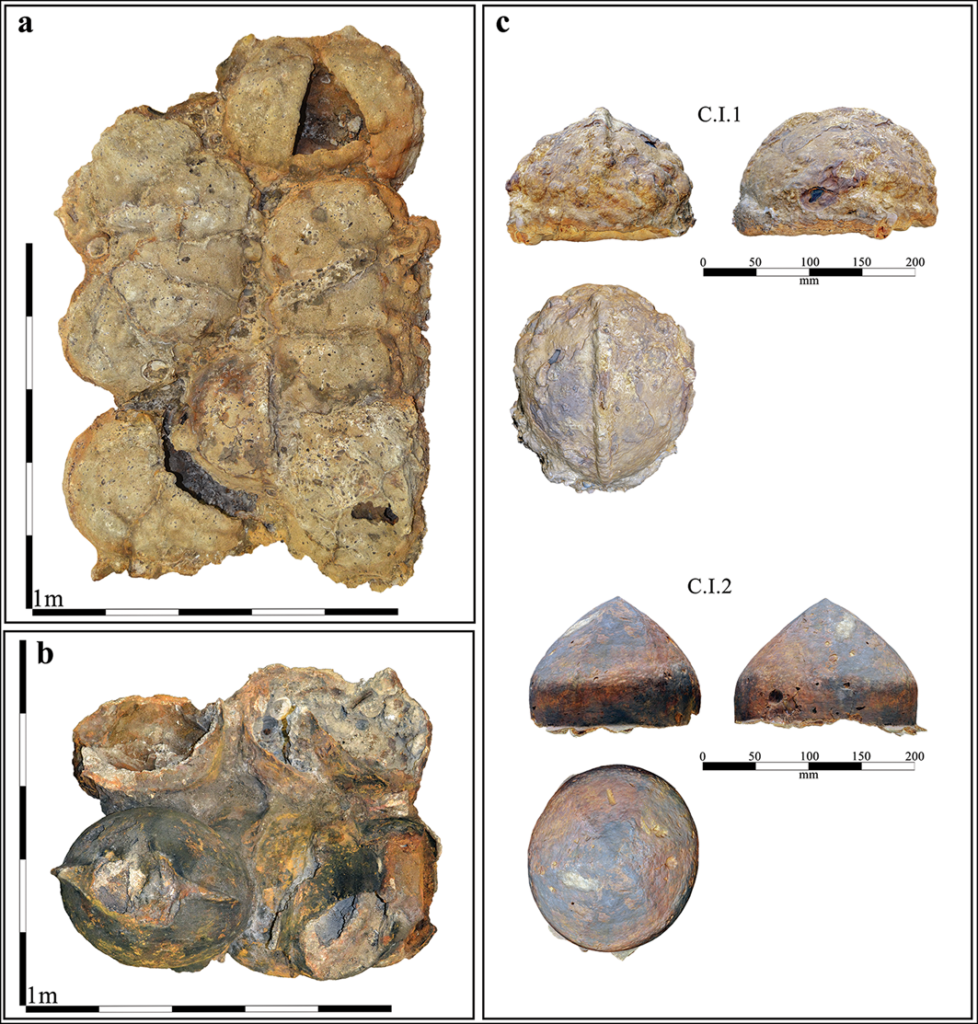
At least 43 helmets have been identified in the Benicarló assemblage, although the actual number may be higher. Some pieces remain locked inside concreted blocks, making a complete count difficult.
Their forms point to practical military use. Several are hemispherical iron calottes. Some carry longitudinal crests. One faceted, ogival example recalls late medieval kettle-hat traditions. The group does not suggest elite armour made for display. It looks more like equipment intended for soldiers who needed protection that was simple, durable and relatively affordable.
That fits the historical setting.
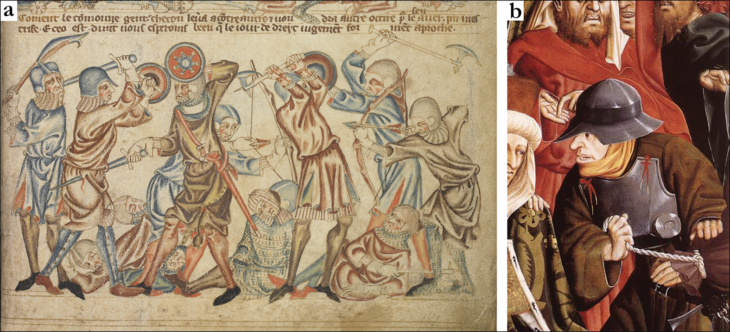
From the mid-14th century onward, the Valencian coast stood within a more unstable western Mediterranean. Maritime raids, piracy and local conflict placed pressure on coastal communities. Fortified settlements, watch systems and armed local forces became increasingly important. In such a world, helmets like these were not symbolic objects. They were working tools of defence.
The Benicarló helmets may have belonged to local militias, garrisons or soldiers connected with coastal security. They may also represent military equipment transported by sea, perhaps lost before reaching its destination. Their exact origin remains uncertain. They could have been made in regional Iberian workshops or circulated through wider Mediterranean trade and military supply networks.
Either way, they speak to a late medieval coast where war, commerce and insecurity often shared the same waters.
A soft fragment corrected the history of iron
The most striking part of the Benicarló discovery is not simply the redating. It is the way the redating happened.
Iron armour is usually studied through form, comparison and typology. Scholars look at shape, construction, known parallels and artistic depictions. In this case, the metal alone was not enough. The true chronology came from something softer, hidden and easily overlooked.
The textile lining changed the identity of the entire assemblage.
That makes the Benicarló helmets one of the most important underwater finds for the study of medieval weaponry in the western Mediterranean. They preserve not only iron shells, but also rare organic traces of how such helmets were actually worn. They also show how underwater archaeology can overturn old assumptions when scientific dating reaches beyond the object’s surface.
For years, the helmets seemed to belong to Rome because the seabed around them looked Roman. Now, the fabric inside them has told a different story.
The iron was made for war. The textile was made for comfort and protection. After six centuries under the sea, it was the hidden lining that carried the truth.
Frallicciardi M, Álvarez-Romero C, Doménech-Carbó MT, Graells i Fabregat R, Santoro AM. Radiocarbon dating and characterisation of textiles preserved in late medieval helmets from Benicarló (Castellón, Spain). Antiquity. Published online 2026:1-20. doi:10.15184/aqy.2026.10341
Cover Image Credit: Details of the overlapping helmets from different viewpoints. Frallicciardi M, et. al., 2026