
In a remote desert valley of the Sinai Peninsula, a single carved image is forcing historians to rethink how—and how early—states projected power beyond their borders. A rock inscription dating back nearly 5,000 years has now been identified as one of the earliest known visual displays of political domination, predating many of the symbolic tools later empires would make famous.
Decoded by Ludwig Morenz of the University of Bonn, the scene offers a stark, almost brutal message from the dawn of Egyptian expansion: authority was not only exercised—it was deliberately shown.
A Message Carved Into the Landscape
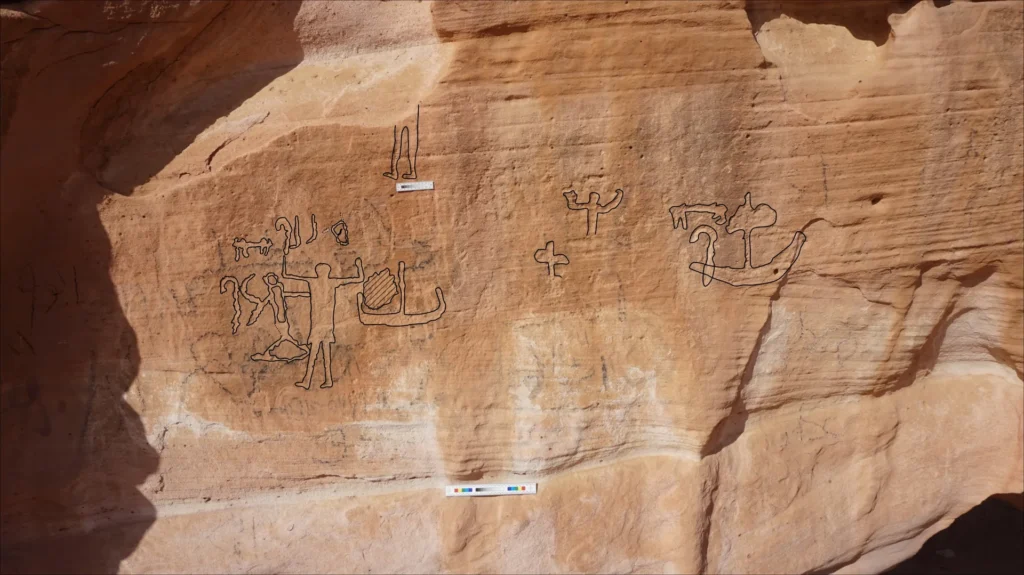
The inscription was found in Wadi Khamila, a dry valley in the southwestern Sinai, by antiquities inspector Mustafa Nour El-Din. Cut into a smooth, highly visible rock face, the image depicts a towering male figure with raised arms standing over a kneeling local individual pierced by an arrow.
There is little ambiguity in the composition. The dominant figure—interpreted as either an early Egyptian ruler or the god Min—occupies the entire visual field. The defeated figure is reduced, immobilized, and silent. This was not art meant to be subtle. It was meant to be understood at a glance.
Morenz describes the carving as an early “smiting scene,” a visual formula that would later become central to Egyptian royal ideology. What makes this example extraordinary is its date. Stylistic and iconographic analysis places it in the late fourth millennium BCE, pushing the origins of such imagery far earlier than previously confirmed.
Why Sinai Mattered So Early
For early Egypt, the Sinai Peninsula was not a marginal frontier. It was a prize. The region was rich in copper and turquoise, resources essential not only for tools but also for prestige, ritual, and symbolic power. Egyptian expeditions moved into the area long before formal imperial structures existed.
The local populations, by contrast, lived without centralized political systems or writing traditions. The imbalance was profound—and the inscription makes clear that Egypt understood this imbalance and exploited it.
“This was a landscape where authority had to be made visible,” Morenz argues. The carving functioned as a permanent warning, placed along movement routes and rest points, aimed at communities that could not answer imagery with texts of their own.
Part of a Wider Colonial Network
Until recently, Wadi Khamila was known mainly for much later Nabataean inscriptions, carved more than 3,000 years after this scene. The presence of such an early Egyptian image here came as a surprise.
Yet it no longer stands alone. Comparable early inscriptions are known from Wadi Ameyra and Wadi Maghara. Together, these sites trace what Morenz describes as a proto-colonial network—a chain of marked locations chosen for visibility, movement control, and symbolic dominance.
Notably, these rock faces attracted repeated attention across millennia. Later additions, including modern graffiti, show how certain places retain cultural gravity long after their original meaning fades.
Power Backed by the Divine
One of the most revealing aspects of the Wadi Khamila inscription is its religious framing. The dominant figure’s association with Min—protector of expeditions during the fourth and early third millennia BCE—was not incidental.
Religion, Morenz emphasizes, served as justification technology. By embedding domination within divine imagery, Egyptian authority was presented not merely as forceful, but as cosmically sanctioned. In later periods, other deities would assume similar roles, but the logic remained consistent.
Rethinking the Origins of Colonial Power
Early inscriptions in this part of Sinai are exceedingly rare, making the discovery a genuine turning point. Morenz, who is also affiliated with the Bonn Center for Dependency & Slavery Studies, sees the carving as a new baseline for studying early expansion, violence, and ideological control.
Further fieldwork is planned, and discussions with Egyptian authorities are already underway to ensure the site’s protection.
What emerges from Wadi Khamila is not just an ancient image, but a chillingly familiar strategy. Long before empires, flags, or written laws, power was carved into stone—meant to be seen, remembered, and feared.
Cover Image Credit: M. Nour El-Din/Umzeichnung: E. Kiesel