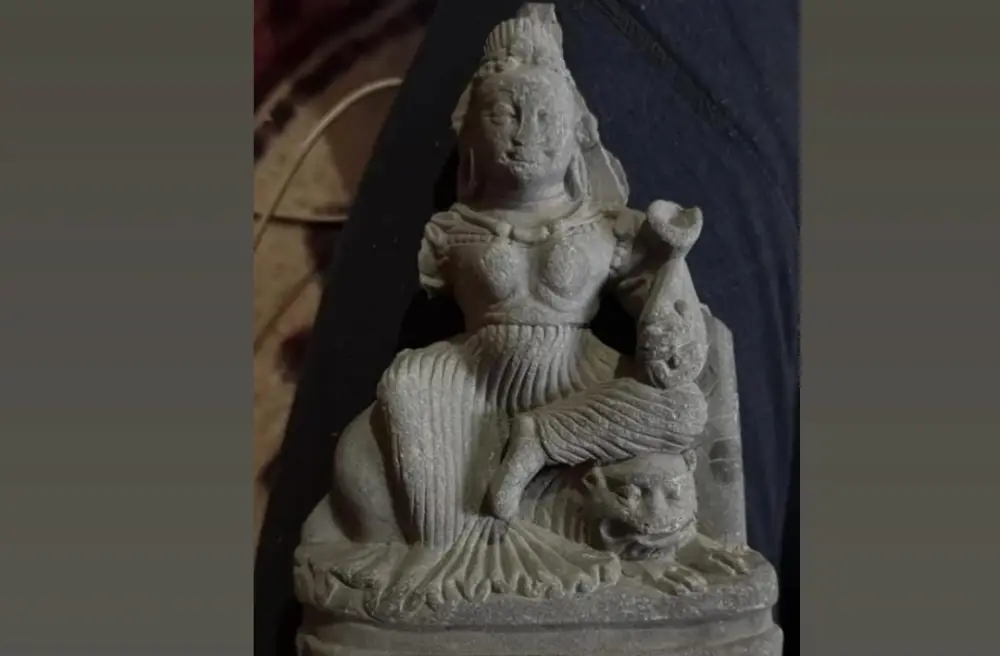
An ancient stone idol identified as the Hindu goddess Durga has been recovered from the Jhelum River, revealing a striking material trace of Kashmir’s deep and often hidden religious past. The sculpture was found along the Baramulla stretch of the river, partially embedded in silt, and immediately drew the attention of local authorities and heritage experts.
A chance discovery beneath the river’s surface
The idol reportedly surfaced when a local fisherman noticed a carved stone form protruding from the riverbed. Once retrieved, the figure was recognized as a representation of Durga, depicted in a commanding stance associated with protection and divine power. Despite prolonged exposure to water, the sculpture preserves clear iconographic features, suggesting skilled workmanship and considerable antiquity.
What makes the find particularly compelling is where it emerged. The Jhelum has long functioned as Kashmir’s main artery—economically, socially, and ritually. Its waters have repeatedly shifted course over centuries, a process that often carried away temples, shrines, and settlements, leaving their remains concealed beneath layers of sediment.
Early assessments point to an older sacred landscape
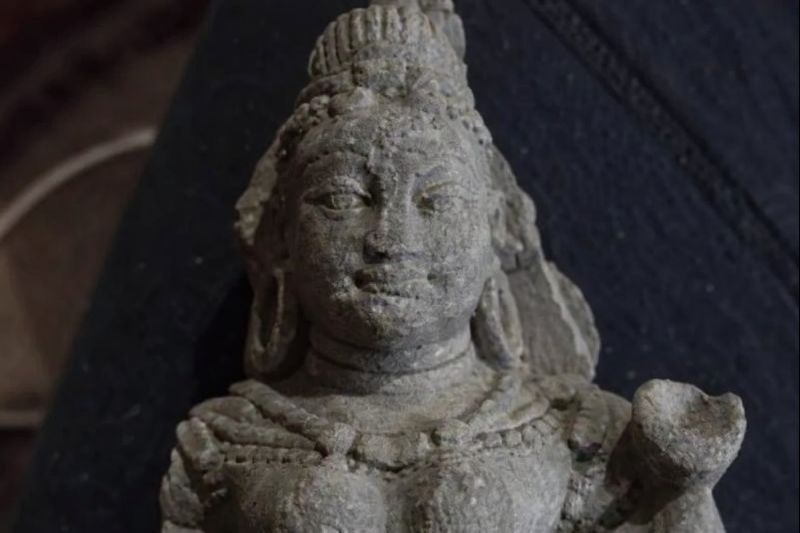
Although laboratory analysis is still pending, preliminary evaluations by archaeology officials indicate that the idol may date to the early medieval period, a time when Kashmir was an important center of Hindu philosophy, temple architecture, and stone sculpture. Durga imagery from this era often reflects a regional style that blends pan-Indian religious symbolism with local artistic conventions.
Experts emphasize that this is unlikely to be a recent object accidentally discarded into the river. Instead, the context suggests a much older displacement—possibly caused by flooding, erosion, or historical episodes of temple dismantling and material reuse.
Rivers as repositories of cultural memory
This discovery reinforces a growing understanding among archaeologists: Kashmir’s rivers are not only natural features, but archival spaces. Over the years, chance finds from riverbeds have yielded architectural fragments, ritual objects, and sculptural remains linked to forgotten sacred sites. Each recovery adds another fragment to the puzzle of how religious life was organized across the valley in earlier centuries.
The Durga idol, in this sense, is more than an isolated artifact. It points to a landscape once dense with shrines and devotional practices, many of which have vanished from the surface but endure beneath it.
Conservation and future display
Following its recovery, the sculpture was transferred to a secure facility under the supervision of regional archaeology and heritage authorities. The idol will undergo cleaning, documentation, and detailed stylistic and material analysis to establish a clearer chronology and provenance.
Officials have indicated that, once conservation work is complete, the artifact may be placed on public display in a regional museum—allowing it to move from the river’s depths back into public view, this time as a witness to Kashmir’s layered and complex religious history.
Cover Image: Ancient stone sculpture depicting the goddess Durga, recovered from the Jhelum River in Baramulla on December 26, 2025. Credit: KashmirLife