A Roman purse found in a fifth-century grave at Oudenburg in Belgium may preserve a rare glimpse of everyday life at the moment when Rome’s small change stopped being enough.
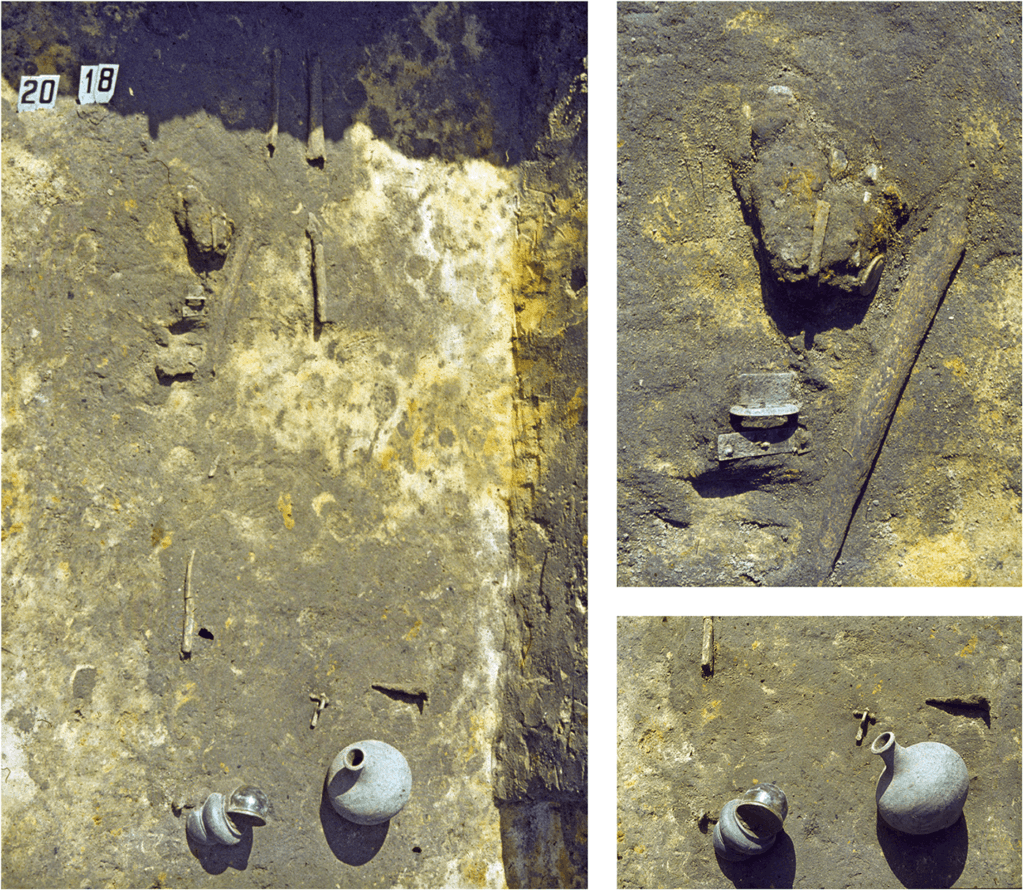
At first, the object did not look like much. It was a compact lump of corroded metal, earth and mineralized textile, recovered from Grave A-104 in one of the late Roman cemeteries linked to the coastal fort of Oudenburg. There was no gold, no silver hoard, no ceremonial treasure. But inside the purse were bronze coins, broken copper-alloy fragments, flints, an iron fire striker and other small metal pieces.
To modern eyes, some of it looks like scrap. To someone living on the edge of the Roman world around A.D. 400, it may have been portable value.
A Fort Community at the End of Roman Rule
Oudenburg stood on a strategic sand ridge near the North Sea coast in present-day West Flanders. During the Roman period, the area was close to tidal channels, marshes and coastal routes, making it an important military position in the northwestern provinces.
The fort was first established in the late second century and later rebuilt in stone. Under Constantine, it was reactivated as part of the wider coastal military system associated with the Saxon Shore, which protected vulnerable routes along the Channel and North Sea.
By the late fourth and early fifth centuries, however, Roman control in the region had weakened. Troops were withdrawn, imperial power fractured and local military communities had to adapt. Oudenburg did not vanish. People remained, lived with Roman symbols and buried their dead in ways that reveal both continuity and change.
Grave A-104 belonged to an individual buried with objects linked to male dress and late Roman military identity. A crossbow brooch, an ornamented belt set, a knife, glass and ceramic vessels, and the purse accompanied the body. The purse appears to have been attached to the belt, suggesting that its contents were not simply placed there for display. They may have been possessions regarded as useful in life.
Centuries-Old Coins in a Fifth-Century Purse
The latest coin in the purse was a small AE4 bronze coin of Valentinian II, minted at Arles between A.D. 388 and 402. That coin dates the burial to after A.D. 388, most likely between the late fourth century and around A.D. 430.
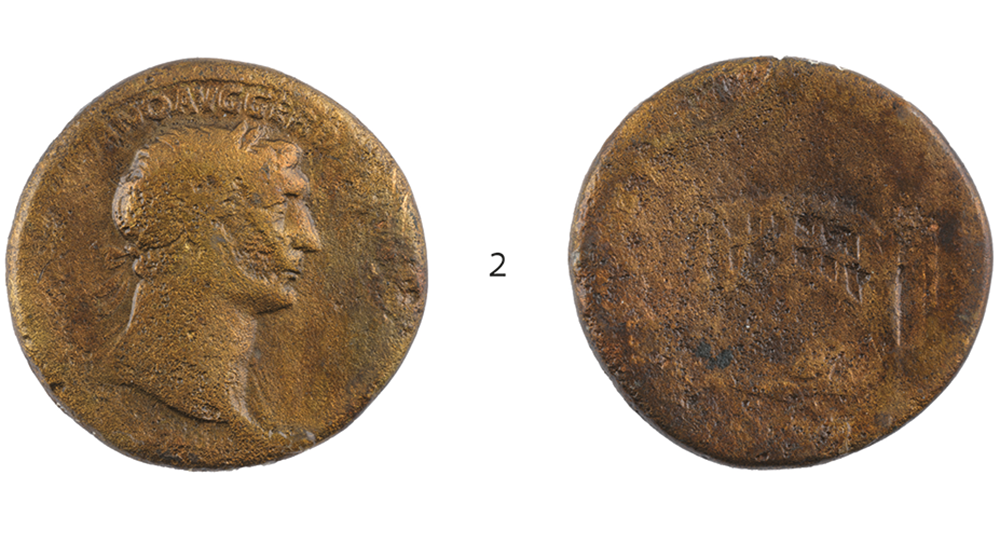
But the purse also held much older Roman coins. Among them were bronze coins of Trajan and Hadrian, minted in the second century A.D. In other words, coins more than 250 years old had ended up in a purse used during the twilight of Roman administration in northern Gaul.
That is what makes the find so interesting. Older coins in late Roman graves are often dismissed as residual objects, but the Oudenburg purse suggests something more deliberate. These coins were not stray pieces from disturbed soil. They appear to have formed part of the purse assemblage.
Their meaning may have been partly symbolic. Large bronze coins carried imperial portraits, and those images could still evoke Roman authority, memory or status in a frontier society where Roman, local and Germanic identities overlapped.
Yet the purse also points to a practical question: what happened when small bronze coins stopped circulating?
Broken Bronze and Everyday Exchange
Around A.D. 400, the regular supply of base-metal coinage to the northwestern Roman provinces broke down. Gold and silver remained part of official monetary life, but they were too valuable for ordinary transactions. People still needed low-value exchange. They still had to buy, sell, compensate and negotiate value.
The Oudenburg purse may show one solution.
Alongside the coins were fragments of copper-alloy objects, including pieces of brooches, belt fittings and other metal items. Archaeologists refer to this kind of material as Hackbronze, intentionally fragmented base metal that may have been valued for its material rather than its original function.

Many of these fragments were broken beyond repair. That makes them hard to explain as ordinary equipment. Instead, they may have been collected for reuse, remelting or exchange by weight.
The weight pattern strengthens that possibility. Researchers found that the coins alone came close to two Roman unciae, while the total assemblage of coins and base-metal fragments also appears to fit a meaningful weight structure. The evidence is not absolute. Missing pieces and burial conditions require caution. Still, the pattern suggests that the purse may have contained a carefully assembled quantity of bronze value.
A Small Object From a Changing Economy
The Oudenburg purse does not show a sudden collapse of Roman life. It shows something quieter and more revealing: adaptation.
A man buried with Roman military symbols carried old coins, broken bronze and practical tools. His world still looked Roman in many ways. The fort, the belt, the brooch and the imperial portraits all belonged to a familiar order. But inside his purse, that order had already changed.
Official coinage had become unreliable. Old coins were reused. Metal fragments may have gained value by weight. People found ways to keep exchange alive when the imperial supply of small money failed.
That is why this modest purse matters. It captures one of archaeology’s hardest stories to see, not the fall of an empire in a single dramatic moment, but the slow reinvention of daily life after Rome’s money began to run dry.
Flückiger A, Van Thienen V, Vanhoutte S. A Fifth-century Purse Assemblage with Coins and Hackbronze from Oudenburg Reconsidered. Britannia. Published online 2026:1-19. doi:10.1017/S0068113X26100695
Cover Image Credit: Flückiger A, et al., 2026