A prehistoric burial mound in Suffolk was repeatedly drawn back into human activity over thousands of years, eventually becoming the center of a Roman sanctuary filled with ritual deposits before the surrounding landscape was associated with medieval executions.
New research published in the journal Britannia traces the remarkable history of the site at Red Lodge, where archaeologists uncovered evidence spanning from the Neolithic period to the Middle Ages. At the center of that story is an Early Bronze Age monument that successive communities repeatedly reinterpreted rather than simply abandoning.
The excavations themselves took place in 2016 ahead of residential development, but the new study by Angus Forshaw of Archaeology South-East, University College London, brings together the archaeological evidence to reconstruct how the site changed over several millennia.
A Bronze Age monument that refused to disappear
The story begins with a large circular funerary monument built sometime between 2200 and 1600 BC, according to optically stimulated luminescence dating.
Although centuries of ploughing heavily reduced the mound and may also have erased any associated burial, its surrounding ring ditch survived. Measuring about 45 meters across, with sections reaching 6.2 meters wide and 1.8 meters deep, the monument would once have stood prominently above the relatively flat surrounding landscape.
Very little other Bronze Age activity appeared around it. Archaeologists believe this may have been deliberate, leaving the area around the mound relatively open and enhancing its visibility and ceremonial importance.
Even during the Iron Age, long after its original meaning may have been forgotten, people apparently still recognized the mound as a significant feature. A large fragment of an Iron Age pottery vessel recovered from the ring ditch may indicate that the monument continued to attract visitors or offerings.
Its most dramatic transformation, however, came under Roman rule.
Pig skulls, coins and a painted Roman shrine
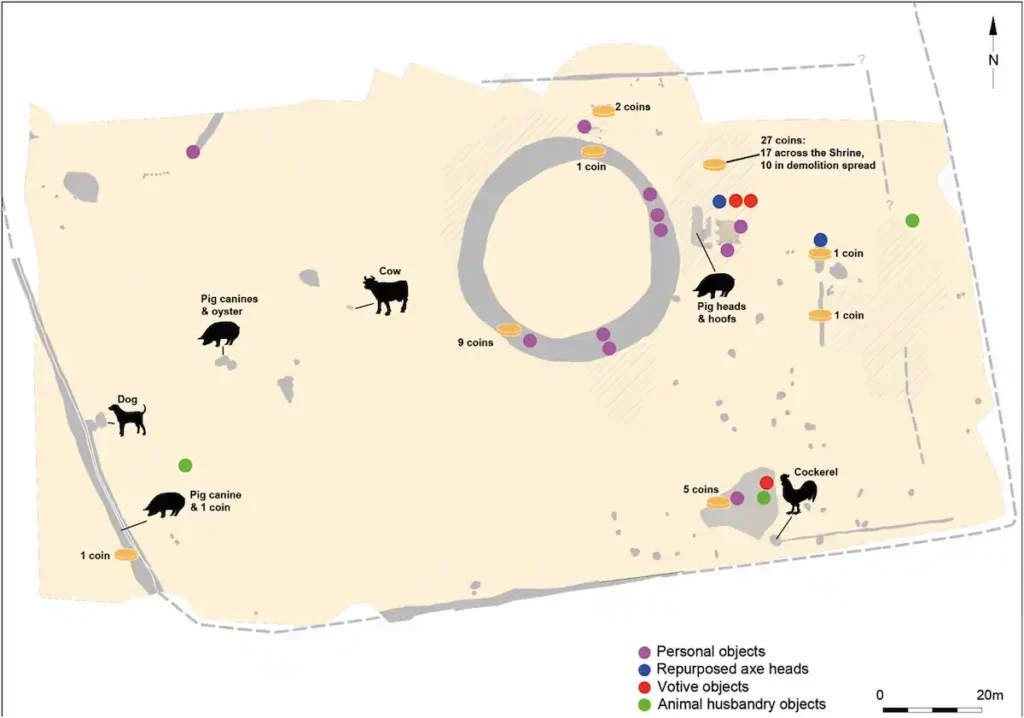
Beginning probably in the second century AD, the Romans enclosed the prehistoric mound within a large rectangular sacred precinct, or temenos, measuring roughly 200 by 160 meters.
Rather than removing the much older monument, they placed it close to the center of the new sanctuary. Archaeologists see this as strong evidence that the ancient mound itself had become part of the religious meaning of the site.
A small shrine was later constructed immediately east of the ring ditch. The roughly 5-by-4.5-meter building appears to have consisted of a single room with a gravel floor, timber and wattle-and-daub walls and a tiled roof.
It was far from plain. Excavators recovered about 48 kilograms of painted wall plaster, showing that parts of the shrine had been decorated in white, red, pink and green. Possible column settings inside the building may once have supported an altar or shelf carrying religious objects.
The discoveries beside the shrine provide an even clearer glimpse of what happened there.
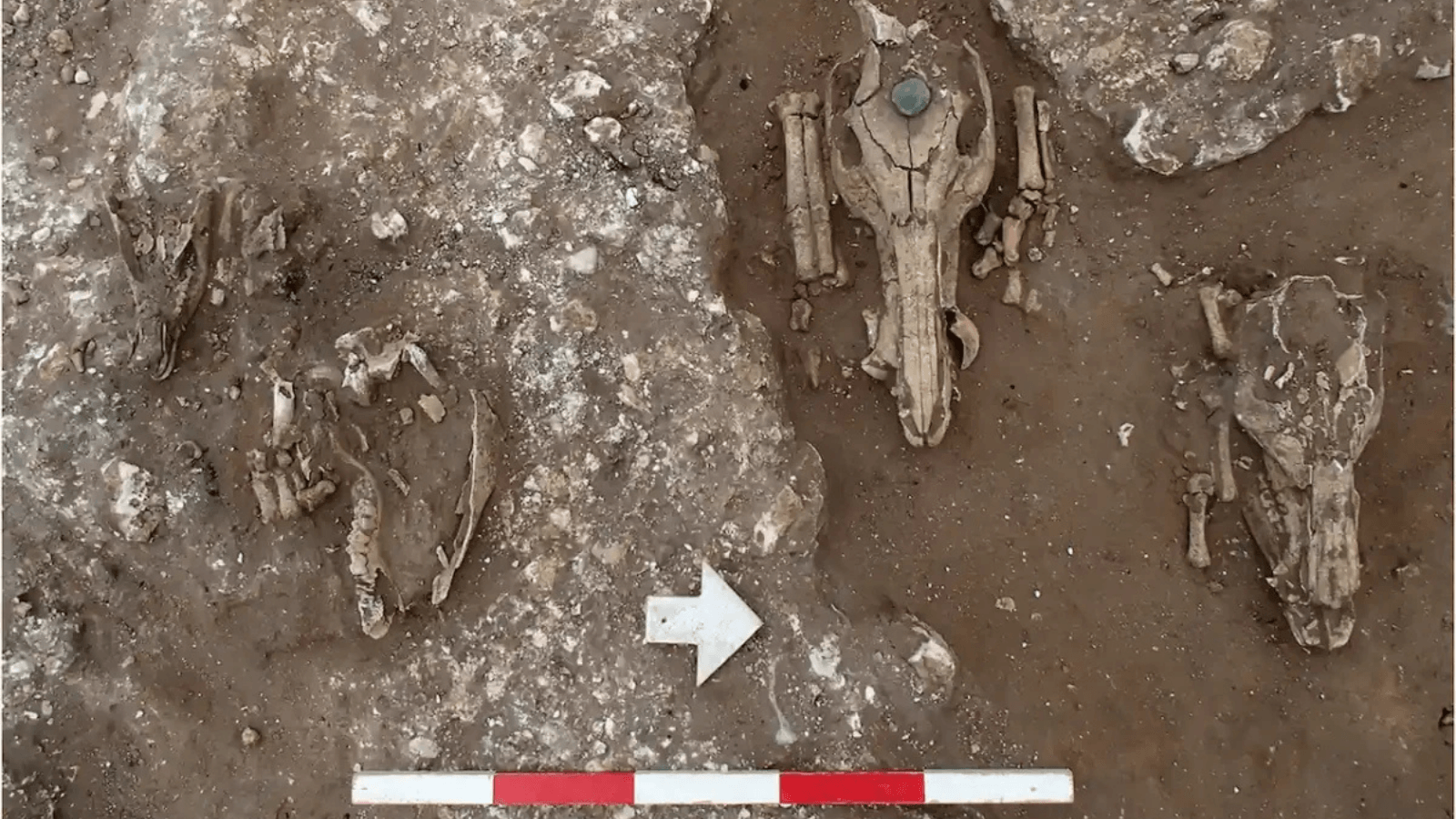
Archaeologists uncovered six unusual deposits containing pig skulls together with articulated leg bones, known as “head-and-hoof” deposits. The skulls had been deliberately positioned facing toward the shrine. On at least two of them, worshippers placed Roman coins directly on top of the skull.
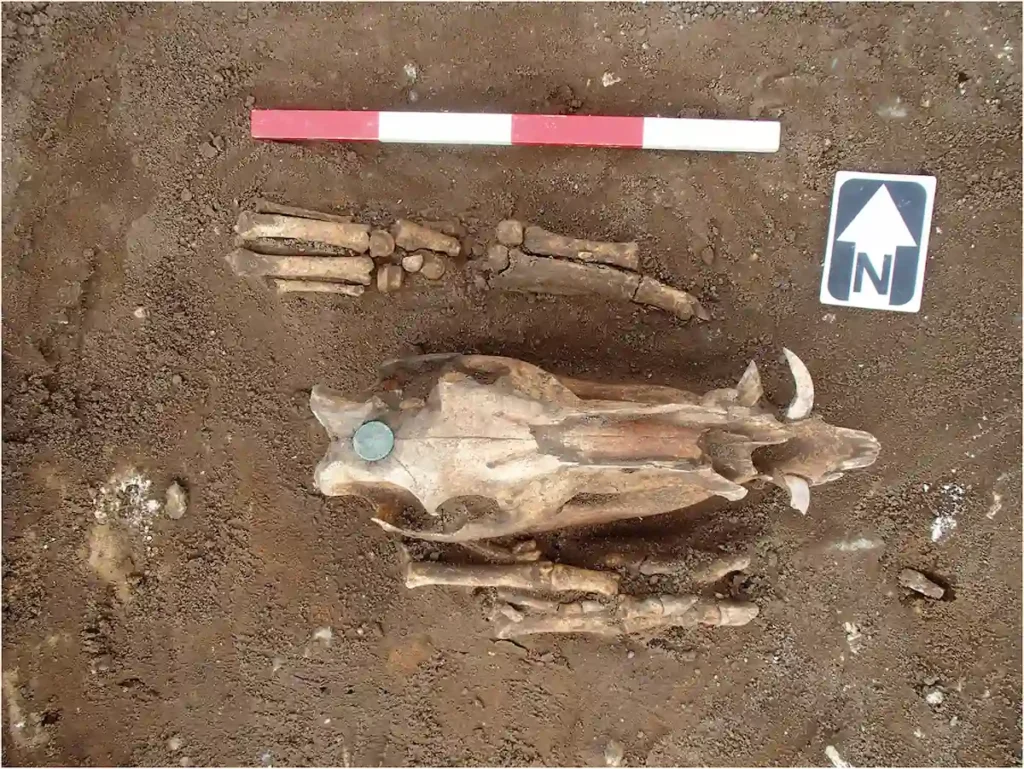
One was a sestertius of Emperor Antoninus Pius dated to AD 156–157, while another was a coin of Faustina dated to AD 142. Evidence suggests that some of the pits were reopened repeatedly as new ritual deposits were added.
Other parts of the sanctuary produced deliberately placed remains of a cockerel, cattle, a dog and horse, along with coins and other possible votive objects. A possible well, a pond or utilized natural hollow, and a flue interpreted as the remains of an oven were also identified within the enclosure, potentially connected with cleansing, food preparation or the ritual burning of offerings.
Exactly which god—or gods—people worshipped here remains unknown. The animal remains have parallels at Roman religious sites associated with deities including Mercury, Mithras and Silvanus, but the researchers stress that the Red Lodge evidence does not support identifying a single cult. The isolated rural sanctuary may instead have served several forms of local worship.
The religious complex continued operating into the fourth century before gradually falling out of use. The archaeological evidence does not reveal a clear sequence of abandonment or demolition, although many features appear to have infilled naturally over time.
From sacred ground to the gallows
Centuries later, the same prominent piece of landscape acquired another, much darker function.
A medieval document from 1238 refers to gallows in this vicinity, apparently positioned near the boundary between the lands of Freckenham and Herringswell. Ancient burial mounds were highly visible landmarks and were sometimes reused as boundary markers, meeting places and locations where justice was carried out.
The excavation produced one discovery that may connect Red Lodge directly with that history.
Inside the upper fill of the former Roman enclosure ditch, archaeologists found a man buried face down. He was approximately 25 to 35 years old, and radiocarbon dating placed his death between AD 1169 and 1266—almost exactly the period in which documentary sources locate the gallows.
There were no skeletal injuries that could prove he had been hanged, and archaeologists found no surviving structure belonging to the gallows. Researchers therefore describe his identification as an execution victim as a possibility rather than a certainty.
What is clearer is the extraordinary persistence of the place itself. A monument created for the dead in the Bronze Age became a focus of Roman worship more than a millennium later, before the same prominent ground was associated with punishment and execution in medieval England.
The people who encountered Red Lodge in these different periods almost certainly understood the landscape in very different ways. Yet the evidence suggests that, at widely separated moments across roughly three millennia the same prominent piece of ground repeatedly acquired new significance—first as a place for the dead, later as a focus of Roman worship, and finally as a landscape associated with medieval justice.