
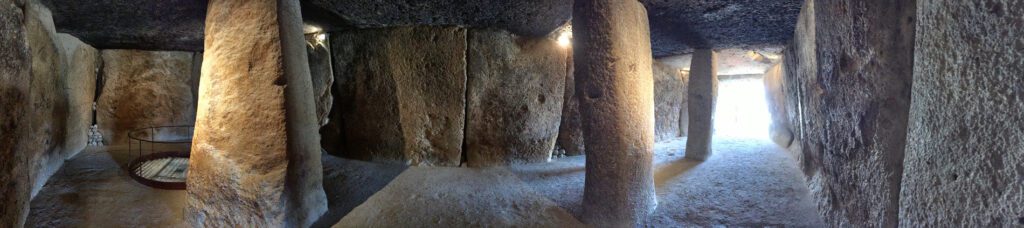
For most of its modern history, the Menga Dolmen has been treated as a closed chapter of European prehistory—a monumental relic frozen in the Neolithic past. New research now shows that this assumption is fundamentally wrong.
Far from being abandoned after antiquity, Menga was intentionally reclaimed as a sacred space during the Islamic Middle Ages, more than four thousand years after its construction. The discovery forces archaeologists to rethink how medieval communities in Iberia understood ancient monuments—and how deeply the past continued to shape religious landscapes.
When a Neolithic Monument Became a Medieval Burial Ground
The turning point came during excavations in the dolmen’s atrium, where archaeologists uncovered two human burials placed directly within the monument. Radiocarbon dating situates these interments between the 8th and 11th centuries CE, at a time when southern Iberia formed part of Al-Andalus.
At first glance, the graves appear modest: no grave goods, no markers, no signs of display. But their placement and orientation tell a very different story.
Both individuals were buried face down, with their heads turned to the right and their faces directed southeast—toward Mecca—consistent with Islamic funerary practice. Crucially, however, their bodies were also aligned with the prehistoric axis of the dolmen itself, a feature that had structured the monument’s design since the fourth millennium BCE.
This was not accidental reuse. It was a deliberate gesture.
An Alignment That Should Not Exist
Islamic cemeteries in medieval Iberia followed clear spatial conventions, yet they did not reference prehistoric architecture in this way. The decision to align these burials simultaneously with Mecca and with a Neolithic monument has no close parallel in the surrounding region.
The implication is stark: the monument was not perceived as a neutral ruin. It was treated as a meaningful, active presence in the landscape—one worthy of respect, engagement, and symbolic alignment.
To understand why, researchers turned to biology as much as archaeology.
Recovering a Life From Fragmented DNA
Ancient DNA rarely survives well in Mediterranean environments, and Menga proved especially hostile. Heat, soil chemistry, and microbial activity had reduced human DNA to less than one percent of the recovered material.
Using high-resolution enrichment methods targeting more than a million genetic markers, scientists were able to reconstruct the genome of one individual, designated Menga1. The second burial yielded DNA too degraded for reliable analysis.
Even this single genome, however, radically expands the story.

A Man Shaped by the Medieval Mediterranean
Genetically, Menga1 embodies the interconnected world of medieval Iberia.
His paternal lineage belongs to Y-chromosome haplogroup R-P312, common in western Europe and present in Iberia since prehistoric times. His maternal lineage, mitochondrial haplogroup V34a, also has deep European roots but shares distinctive mutations with present-day populations in North Africa.
Autosomal analysis reveals a striking mixture: roughly Iron Age Iberian ancestry combined with North African and Levantine genetic components. This pattern mirrors other Roman and early medieval individuals from Iberia and Italy, reflecting centuries of mobility driven by trade, empire, and—after 711 CE—the expansion of Islamic political networks.
Biologically, Menga1 was a product of the Mediterranean world. Culturally, his burial suggests something even more complex.
Why Return to Prehistoric Monuments?
Across Iberia and Portugal, scholars have documented sporadic Islamic-period burials inside prehistoric structures. At the Alberite I dolmen in Cádiz, dozens of individuals were interred in Islamic fashion centuries after the monument’s construction. Similar patterns appear in Chalcolithic enclosures reused by both Muslim and Christian communities.
Medieval Islamic texts often describe ancient ruins as places of latent power—sites associated with saints, ascetics, or spiritual retreat. In rural settings, such locations could retain sacred reputations that outlived religious change.
The researchers propose that Menga may have functioned as a marabout-like space: a monumental landmark imbued with sanctity, suitable for venerated burial or spiritual withdrawal. Its scale, visibility, and isolation outside medieval Antequera would have reinforced this role.
A Monument That Never Stopped Accumulating Meaning
What this study ultimately reveals is not just the biography of two medieval individuals, but the long afterlife of a monument.
Menga was not sealed off by time. It was repeatedly revisited, reinterpreted, and re-sacralized—by Bronze Age groups, Roman communities, and medieval Muslims alike. The Islamic burials aligned with its axis demonstrate a conscious recognition of deep time, a willingness to integrate ancient structures into new belief systems.
Published in Journal of Archaeological Science: Reports, the research shows how genetics, archaeology, and history can converge to expose the continuity of sacred landscapes.
Silva, M., García Sanjuán, L., Fichera, A., Oteo-García, G., Foody, M. G. B., Fernández Rodríguez, L. E., Navarrete Pendón, V., Bennison, A. K., Pala, M., Soares, P., Reich, D., Edwards, C. J., & Richards, M. B. (2026). Genetic and historical perspectives on the early medieval inhumations from the Menga dolmen, Antequera (Spain). Journal of Archaeological Science: Reports, 69, 105559. https://doi.org/10.1016/j.jasrep.2025.105559
Cover Image Credit: View inside from the entrance. Wikipedia Commons