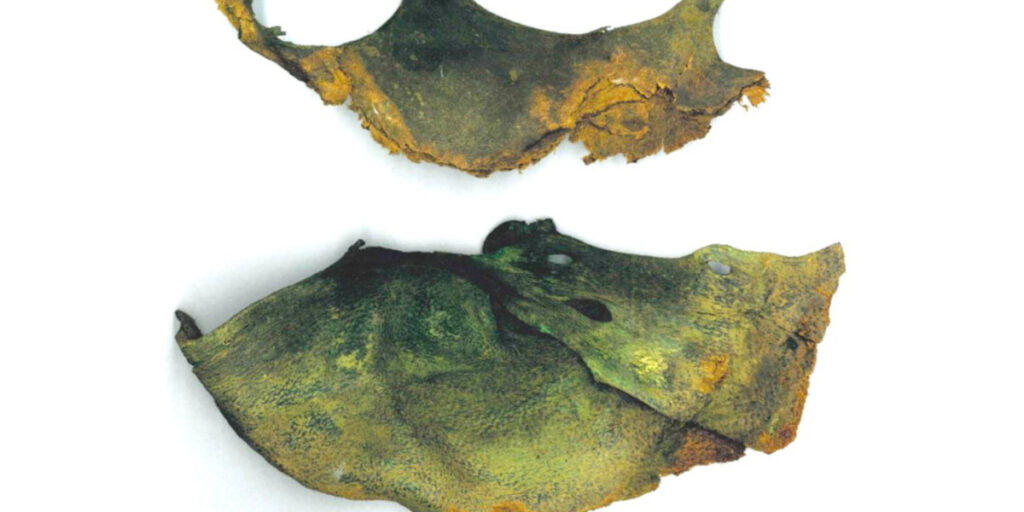
Leather fragments kept for decades in a Swedish museum under the label “bearskin” have been reidentified as something far rarer: the oldest known shoe remains from Sweden.
The fragments were excavated in 1943 from a large Iron Age cairn at Igelsta–Västerängen in Roslagen, eastern Uppland. They were long thought to be part of a bear pelt placed beneath a Roman bronze cauldron. A new study published in Fornvännen by Thomas Eriksson, Ylva Telldahl, and Maria Neijman now argues that the pieces are not pelt remains at all, but parts of a shoe dating to the Roman Iron Age, probably between the first and third centuries A.D.
The find is not new in the usual sense. No fresh excavation brought it to light. Its importance comes from a second look at material already in museum storage — and from what that second look reveals about craft, burial practice, and Roman-connected tastes in early Sweden.
A rich grave in eastern Uppland
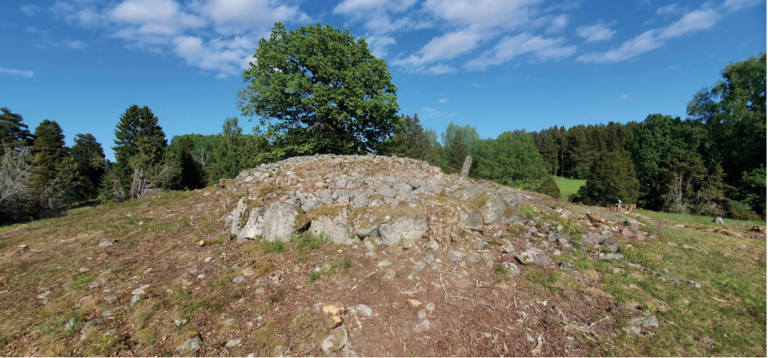
The leather fragments came from cairn A51, one of the most notable graves in the cemetery at Igelsta–Västerängen. The monument measured about 13 meters across and 1.5 meters high, making it a prominent feature in the burial landscape.
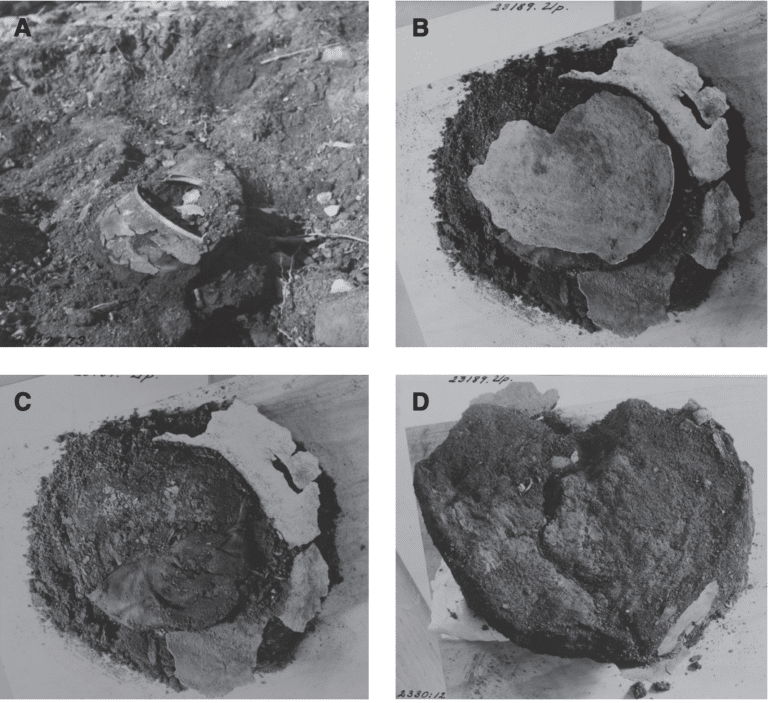
When archaeologist Harry Thålin excavated the cairn in 1943, he recorded an unusually rich assemblage. The grave contained a Roman Østland-type bronze cauldron, fittings from two drinking horns, a chain, cremated human bones, and unburnt animal bones. The leather fragments were found in a precise position: between the base of the cauldron and a wooden tray.
For many years, that setting seemed to support the bearskin interpretation. Bear pelts are known from high-status Scandinavian graves, usually through preserved claws. But the Igelsta material never fitted the explanation very well. No bear claws were found, and the shape of the leather pieces was difficult to reconcile with an ordinary hide.
When the fragments were re-examined at the National Historical Museum of Sweden in 2023, the old label began to fall apart.
Cut holes and wear marks changed the identification
The decisive clues were in the leather itself. Some pieces preserve cut openings, edge holes, and traces of strain. One fragment has large D-shaped cut-outs. Another has small holes along the edge, with signs of wear and tension.
These are not easy to explain as damage to a pelt. They make more sense as features of footwear: lacing holes, fastening points, and edges shaped by repeated use.
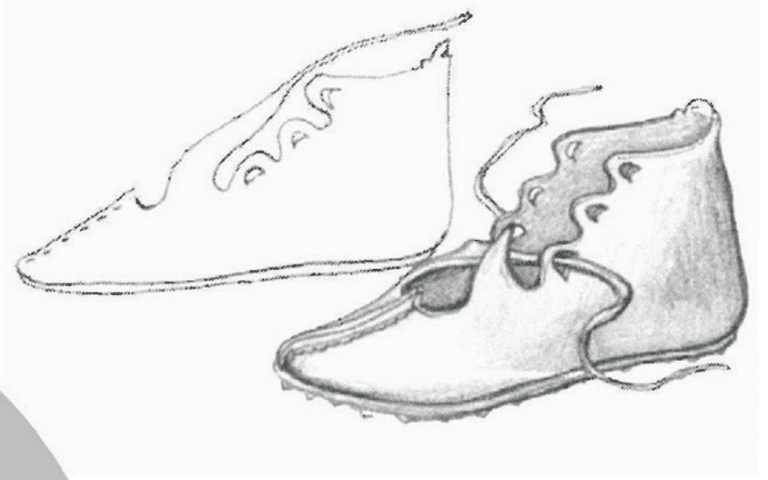
The researchers suggest that the shoe had Roman or Roman-provincial design features. Its closest parallels are not from Sweden, where preserved prehistoric footwear is almost absent, but from Roman-period material in regions such as Britain and Germany.
That does not mean the shoe was necessarily imported. The more interesting possibility is that it was made locally, while borrowing elements from Roman-style footwear. In other words, Roman influence may have reached Sweden not only through bronze vessels and other imported goods, but also through ideas about dress, status, and appearance.
A shoe placed under a Roman cauldron
The shoe was probably not a light sandal. The preserved fur and relatively closed construction suggest sturdier footwear, perhaps closer to a boot and better suited to a colder climate.
By the time it entered the grave, however, it had become more than a practical object. It was placed beneath a Roman bronze cauldron, in a burial monument already associated with wealth, ritual drinking, and contact beyond the local region.
The cauldron, drinking horn mounts, and other objects point to exchange networks linking eastern Sweden with the Baltic region, southern Scandinavia, Poland, and the Roman world. Gotland may have been one important point in that wider system. Within this setting, the shoe formed part of a carefully arranged deposit in which Roman-linked objects and local burial customs were brought together.
Radiocarbon dating also shows that the cairn had a longer history than a single burial event. Cremated human bones near the cauldron date to the Early Pre-Roman Iron Age, around 405–209 B.C. Unburnt sheep or goat bones found inside the cauldron belong to a later phase, closer to the Roman Iron Age artefacts.
This means the cauldron and shoe were added to an older burial monument. The later deposit may have marked a new burial, a cenotaph, or an offering connected with the dead. The study leaves those possibilities open rather than forcing one explanation.
Preserved by copper, hidden by an old label
Leather rarely survives in Swedish graves from this period. The Igelsta fragments were preserved because of their unusual micro-environment. Copper salts from the bronze cauldron helped protect the organic material, giving the leather a greenish color.
The same circumstance that preserved the shoe also helped keep its identity unclear. For decades, it remained a small and poorly understood part of a famous grave assemblage.
The older bearskin interpretation was not unreasonable for its time. But the new analysis shows how much information can still sit inside legacy museum collections, especially when organic finds were excavated long before modern conservation and analytical methods became routine.
The animal source of the leather remains uncertain. Earlier DNA testing did not support the bearskin interpretation, but the results were fragmentary. They suggested possible links to squirrel and canid families, such as dog or wolf. The researchers treat that evidence cautiously, and further work would be needed before the species can be identified securely.
Sweden’s oldest shoe and an older burial story
The Igelsta fragments are small, but their reinterpretation changes the history of footwear in Sweden. They push the record of known Swedish shoe remains back to the Roman Iron Age, long before the Viking Age.
They also give a sharper view of elite life in early Sweden. The grave was not simply a container for imported Roman objects. It was a place where older burial memory, local craft, ritual drinking, and foreign styles could be combined.
For almost 80 years, the shoe was present in the collection but absent from the story. Its rediscovery shows that archaeology does not always depend on finding something new in the ground. Sometimes the more difficult task is recognizing what was already there.
Eriksson, T., Telldahl, Y., & Neijman, M. (2026). A cairn in Roslagen with the oldest shoe in Sweden. Fornvännen, 121, 81–97. https://doi.org/10.66449/fornvn.v121i2.64004
Cover Image Credit: Leather fragments once identified as bearskin have now been recognised as parts of Sweden’s oldest known shoe. The Swedish History Museum.