
At first glance, the discovery looked ordinary — a shallow pit cut into the southern edge of a prehistoric ditch. But as archaeologists dug deeper near the village of Reinstedt in central Germany, the ground quite literally opened into something far more enigmatic: a narrow, curving underground passage that had remained hidden for centuries.
The tunnel was uncovered by archaeologists from the State Office for Heritage Management and Archaeology (LDA) during preliminary investigations ahead of a planned wind turbine project. What initially appeared to be part of a Neolithic landscape soon revealed traces of a much later and deeply mysterious underground structure.
A Neolithic Monument With a Medieval Secret
Credit: Landesamt für Denkmalpflege und Archäologie Sachsen-Anhalt, Ulf Petzschmann
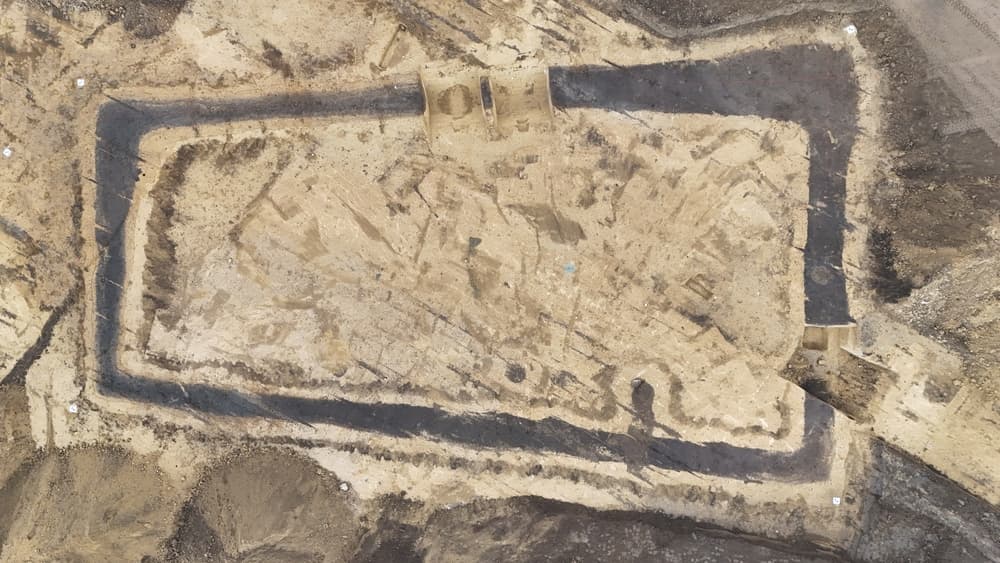
The excavation area is dominated by a trapezoidal ditch enclosure associated with the Baalberge culture, a late Neolithic community active in central Germany between roughly 4000 and 3150 BC. Such enclosures are usually interpreted as ceremonial or social focal points within early farming societies.
Yet the newly discovered tunnel does not belong to this Stone Age phase. Instead, pottery fragments recovered from the fill point to a construction date in the late Middle Ages — thousands of years after the ditch itself was dug.
This unexpected overlap of periods is what makes the find so striking.
From Burial Pit to Underground Passage
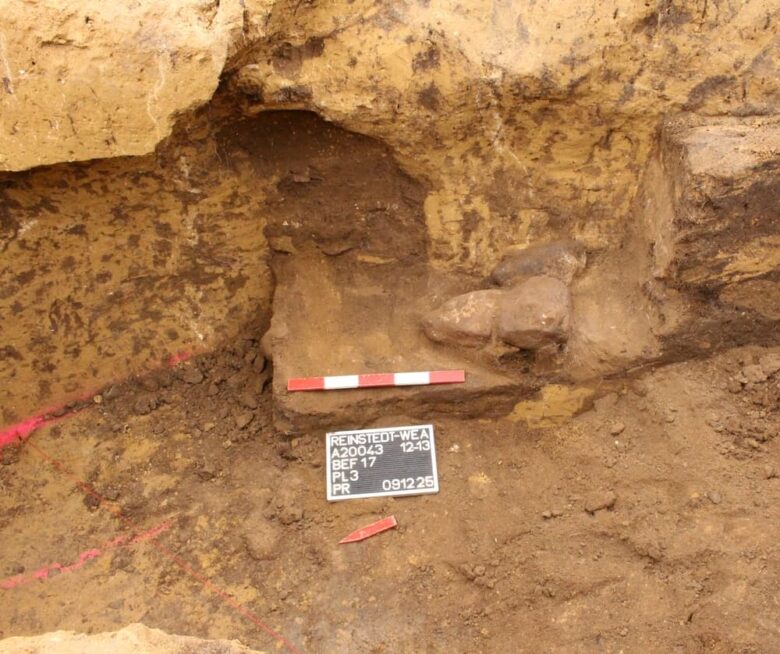
Archaeologists first encountered an oval pit around two meters long, capped by a large stone slab. At a glance, it resembled a disturbed grave. Closer inspection, however, told a different story. The fill sloped sharply downward, extending far deeper than a burial pit should.
As the sediment was removed layer by layer, a narrow passage emerged, curving northwest into the interior of the prehistoric enclosure. The tunnel measures between one and 1.25 meters in height and narrows to just 50–70 centimeters in width — dimensions that would have required anyone entering to crouch or crawl.
At its tightest point, a stack of large stones appeared to block the entrance, suggesting that the passage had been deliberately sealed.
Credit: Landesamt für Denkmalpflege und Archäologie Sachsen-Anhalt, Simon Meier
An Erdstall — Still Without a Clear Explanation
According to the LDA team, the structure can be identified as an Erdstall — a type of man-made underground tunnel system found across large parts of Europe, especially in regions with loess soil that is easy to excavate.
Despite decades of research, Erdstalls remain one of European archaeology’s enduring puzzles. Scholars have proposed a wide range of interpretations, including storage spaces, hiding places during times of danger, or settings for cultic or ritual activity. None has been definitively proven.
Inside the Reinstedt tunnel, archaeologists recovered a horseshoe, a fox skeleton, the bones of small mammals, and a distinct layer of charcoal at the base — finds that raise as many questions as they answer.
Avoidance, Memory, and the Landscape of Fear
One of the most intriguing aspects of the discovery lies not in the tunnel itself, but in its location. The Erdstall was cut directly into a site that may have retained symbolic meaning long after the Neolithic period.
As LDA archaeologists note, it is possible that the ancient enclosure was remembered locally as a pagan burial ground — a place avoided rather than inhabited. Such marginal spaces, steeped in unease or superstition, may have offered ideal concealment in the medieval imagination.
Why the tunnel was ultimately sealed, and whether it served a practical or symbolic function, remains unknown. What is clear is that the Reinstedt find adds a rare and valuable data point to the wider Erdstall debate.
Beneath a monument built by Europe’s first farmers, a medieval community carved out a hidden world — and then closed it forever.