

For more than a century, the American cowboy has been framed as a singular figure — white, solitary, and mythic. Archaeological research now unfolding in eastern Oregon tells a far more complex story. One in which Chinese immigrants were not outsiders on the frontier, but working cowboys, cooks, foremen, and ranch owners who helped define the culture of the American West.
Recent archaeological surveys have identified Chinese American activity at more than thirty historic ranches across eastern Oregon. Among them is the remarkably preserved Stewart Ranch, located in Grant County — a site that is quietly reshaping how historians understand ranching life in the late nineteenth and early twentieth centuries.
A Ranch That Time Forgot
Hidden within the rugged landscape of the Phillip W. Schneider Wildlife Area, Stewart Ranch can only be reached by long, unpaved roads. That isolation, archaeologists say, is precisely what saved it.
Much of the ranch remains structurally intact, largely untouched by modern redevelopment. According to Chelsea Rose, director of the Southern Oregon University Laboratory of Anthropology, the site offers an unusually direct window into daily ranch life a century ago.
“It genuinely feels like stepping backward in time,” Rose said. “Very few working ranches survive in this condition.”
In July 2025, a team of archaeologists, university students, and local volunteers spent a week excavating compacted soils around bunkhouses and work areas. The goal was not to search for spectacular artifacts, but to trace the overlooked lives of Chinese ranch workers whose stories rarely entered official records.
Chinese Cowboys in the Open — and Yet Invisible
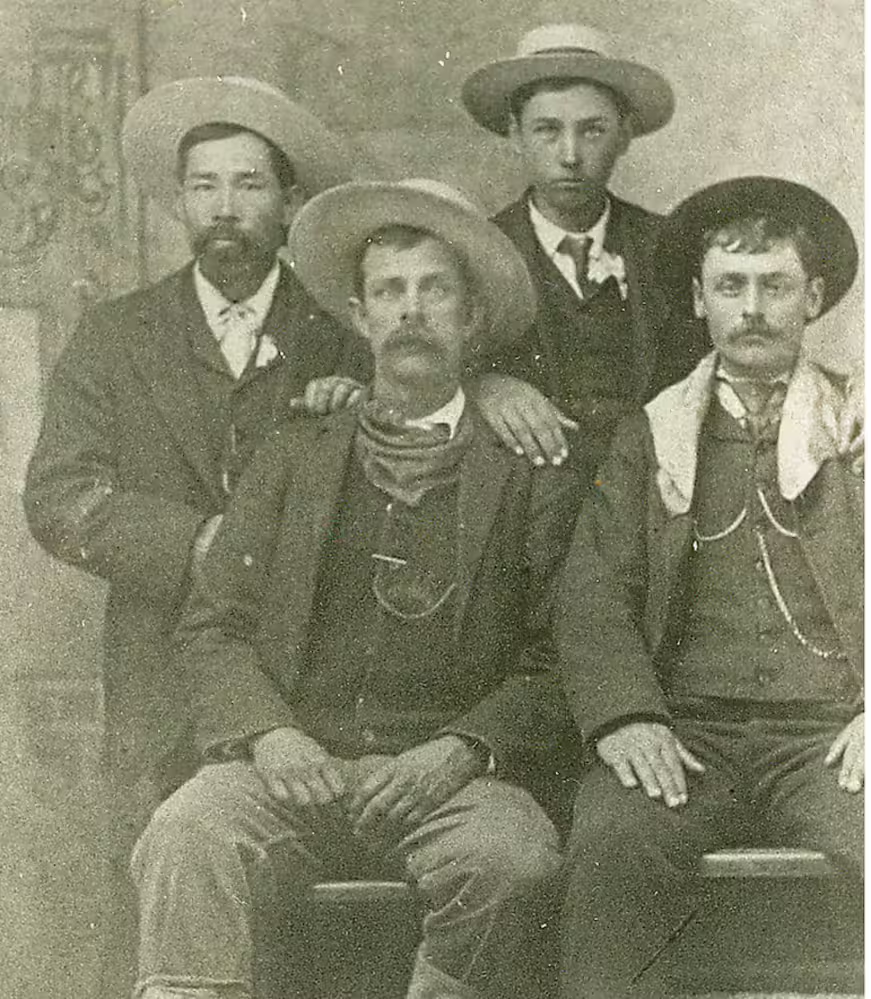
Among the names emerging from the research are Buckaroo Sam, Jim Lee, Fon Chung, Markee Tom, Hi Moon, and Tom Lim. These men worked as horsemen, cooks, sheepherders, foremen, and in some cases, ranch owners — roles traditionally excluded from popular images of Chinese immigrants in the American West.
Buckaroo Sam stands out as the most thoroughly documented. His 1935 obituary described him as “one of the best horsemen in eastern Oregon.” Known for his red handkerchief and exceptional roping skills, Sam operated fully within the buckaroo tradition — a regional cowboy culture shaped by California and Great Basin practices.
Jim Lee, by contrast, was remembered for his work in the ranch kitchen. Oral histories describe him as an exceptional cook, particularly admired for desserts. Archaeological findings now suggest a more practical culinary role as well, centered on stews and communal meals that sustained exhausted ranch crews.
What Daily Life Leaves Behind
The excavation did not produce gold or ornate objects. Instead, archaeologists recovered what daily labor leaves behind: buttons, jean rivets, broken ceramic dishes, glass bottle fragments, spent ammunition, and animal bones.
Zooarchaeologist Katie Johnson identified remains from cattle, deer, and sheep — evidence consistent with shared meals prepared for working hands.
“These materials show how people lived together,” Johnson explained. “They tell us about cooperation, routine, and survival — not status.”
Researchers stress that the absence of China-made goods should not be misread as absence of Chinese identity. Many of these men lived in Oregon for decades, purchasing supplies locally and adapting to regional material culture.
Undoing the Cowboy Myth
The Stewart Ranch findings are part of a broader historical correction. Scholars have long noted that up to one-quarter of cowboys in the American West were Black, and that cowboy culture itself draws heavily from Mexican vaquero traditions of the eighteenth century.
Chinese cowboys, however, were systematically erased. Exclusionary laws, racial violence, and barriers to property ownership prevented families from preserving written histories or passing stories across generations.
Artist and retired forester Dale Hom has worked to restore that visibility. His illustrated study, They Called Him… Buckaroo Sam, published in the Oregon Historical Quarterly, blends archival research with lived experience.
“The more we uncover,” Hom reflected, “the broader the definition of ‘cowboy’ becomes.”
The Oregon Chinese Diaspora Project
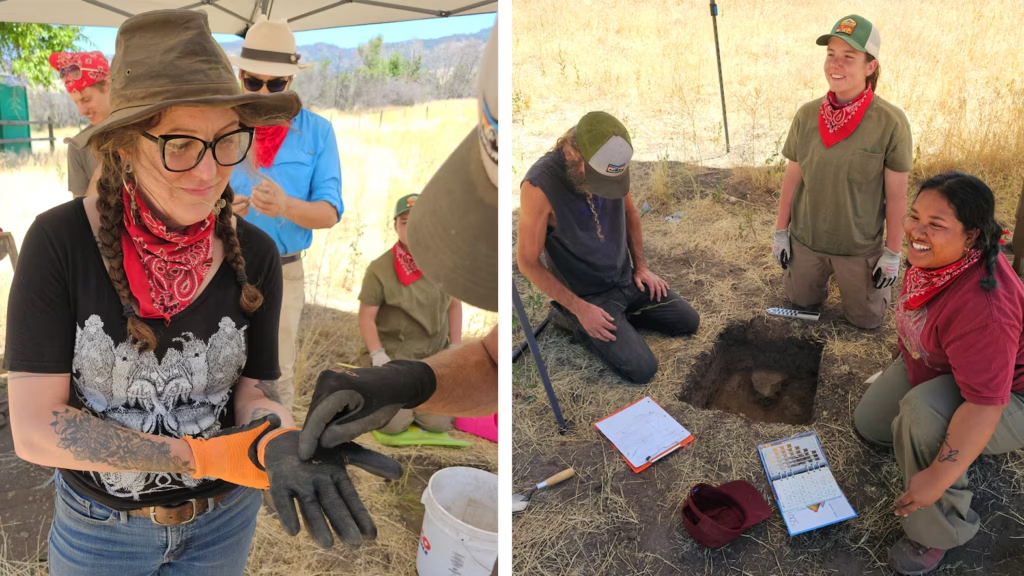
Stewart Ranch is only one site within the Oregon Chinese Diaspora Project, a grassroots collaboration aimed at documenting early Chinese American life in rural Oregon.
The project works closely with local institutions, including the Grant County Ranch and Rodeo Museum and the Kam Wah Chung State Heritage Site, linking archaeological evidence with oral histories and family archives.
The process is slow: artifacts must be cleaned, cataloged, and studied alongside historic newspapers, census records, and photographs. But the stakes are high.
In the late nineteenth century, Chinese Americans made up more than 40 percent of Grant County’s population. By 2020, fewer than one percent of residents reported Asian ancestry — a demographic collapse driven by decades of exclusion and discrimination.
A More Complete West
The individuals uncovered through archaeology were not transient figures. Jim Lee left his estate to a Catholic charity in Baker City. Buckaroo Sam spent his final years assisting a hotel-owning family in John Day after losing his home in a fire.
“These stories don’t replace existing ranch histories,” Rose emphasized. “They complete them.”
As archaeological evidence, community memory, and scholarship converge, the American West is slowly coming back into focus — not as a singular myth, but as a shared landscape shaped by many hands.
And within that landscape, Chinese cowboys are no longer footnotes. They are finally visible as what they always were: builders of the frontier itself.
Oregon Public Broadcasting (OPB)
Cover Image Credit: Southern Oregon University Laboratory of Anthropology; Kam Wah Chung State Heritage Site