

Archaeologists working at Hasankeyf have uncovered an object so rare that it has no known parallel in medieval archaeology.
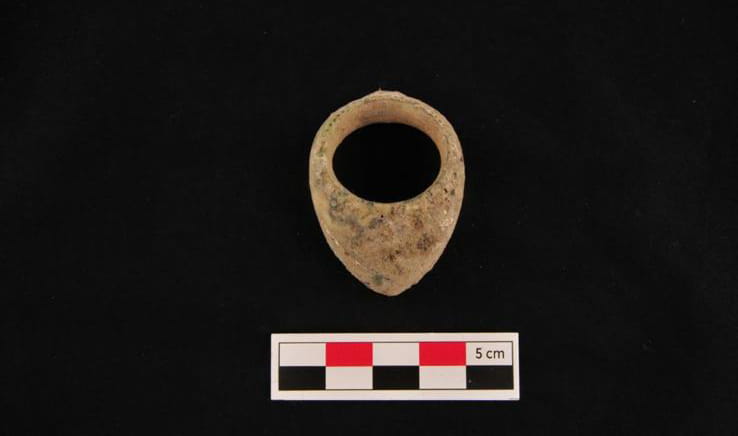
During the 2025 excavation season, a luxuriously decorated ivory archer’s ring (zihgir)—inlaid with pearls, silver, and turquoise—was discovered within the Great Palace complex, immediately raising questions about power, identity, and elite display in medieval Anatolia.
An unexpected find in the heart of a medieval palace
The artifact emerged from excavations in the southeastern corner of the Great Palace, at the junction of its structural walls—an area strongly associated with ceremonial and elite activity. The work is being carried out by a specialist team under the direction of Assoc. Prof. Dr. Zekai Erdal of Mardin Artuklu University.
Its palace context alone sets the find apart. Archer’s rings are typically utilitarian objects, closely tied to warfare and training. This example, however, tells a very different story.
Crafted not for battle, but for prestige
Carved from ivory, the ring displays extraordinary craftsmanship. Rows of tiny pearl inlays line both sides of the thumb guard. A round turquoise stone, set on a lozenge-shaped platform, dominates the outer surface. Around the finger opening, fine circular silver inlays form rhythmic bands, while diagonally arranged silver elements create triangular motifs along the body. At the center, a silver lozenge anchors the composition.
Such refinement leaves little doubt: this was not designed for the battlefield. It was designed to be seen.
The Artuqids and the culture of courtly display

The ring dates to the Artuqid period (12th–13th century), when the Artuqids ruled key cities in southeastern Anatolia and northern Mesopotamia. From capitals such as Hasankeyf and Mardin, the dynasty oversaw a flourishing court culture known for its architectural ambition, luxury metalwork, and elite patronage of the arts. Positioned between Byzantine, Islamic, and Anatolian traditions, Artuqid courts became hubs of cultural synthesis.
Objects like this zihgir offer rare material evidence of how power and status were visually articulated within those courts.

A symbol of rank, not a tool of war
The combination of ivory, pearls, silver, and turquoise—materials rarely, if ever, found together on archer’s rings—suggests ownership by a high-ranking member of the Artuqid elite, possibly even a dynastic figure. Researchers emphasize that the object’s symbolic value likely outweighed its functional purpose, transforming a military accessory into a statement of authority and refinement.
No parallels known
Comparative research has so far revealed no other pearl-inlaid archer’s rings in archaeological records or museum collections. This absence makes the Hasankeyf discovery genuinely unique, elevating it from an exceptional artifact to a landmark find in the study of medieval Islamic material culture.
For archaeologists, the ring is more than an exquisite object—it is a tangible reminder that medieval power was expressed not only through fortresses and armies, but also through finely crafted objects meant to dazzle, impress, and endure.
Cover Image: The pearl-inlaid ivory archer’s ring (zihgir) discovered during the 2025 excavations at the Great Palace in Hasankeyf, photographed in situ at the moment of discovery, highlighting its rare material and elite context.
Credit: General Directorate of Cultural Assets and Museums