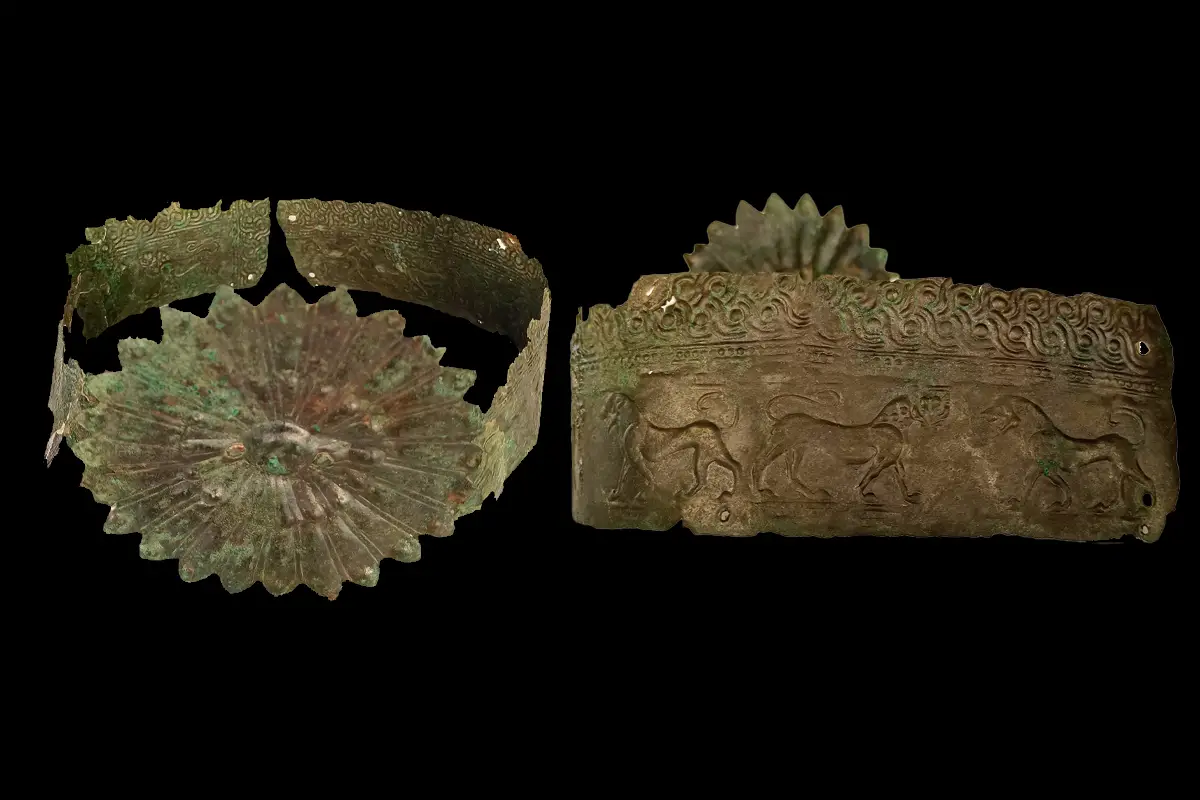
The quiet landscape north of Lake Kifisida has yielded one of the most evocative burials uncovered in central Greece in recent years. Archaeologists working for the Ephorate of Antiquities of Phthiotis and Evrytania have brought to light an Archaic-period cemetery in which a young noblewoman was interred with a richly decorated bronze diadem—deliberately placed on her head upside down.
The discovery emerged during rescue excavations ahead of the construction of a photovoltaic installation, in a zone that lies between ancient Akraiphia and the Sanctuary of Apollo Ptoos. What initially appeared to be routine mitigation work soon revealed a dense funerary landscape tied to an affluent rural community of the 7th and 6th centuries BC.
A Cemetery That Reflects Power and Wealth in Archaic Boeotia
Archaeologists have identified clusters of pit graves, tiled-roofed tombs, and burial pyres arranged in the area historically referred to on 19th-century maps as “Spitia–Katavothra.” The forty graves examined so far show consistent evidence of high-status individuals: carefully built architecture, quality materials, and grave assemblages that speak to hereditary privilege.
Architectural remains nearby indicate that the cemetery belonged to a fortified settlement. Together, the funerary and domestic finds sketch a picture of a community navigating the political transformations of the later Archaic period—an era when old models of kingship were collapsing and aristocratic families consolidated their authority.
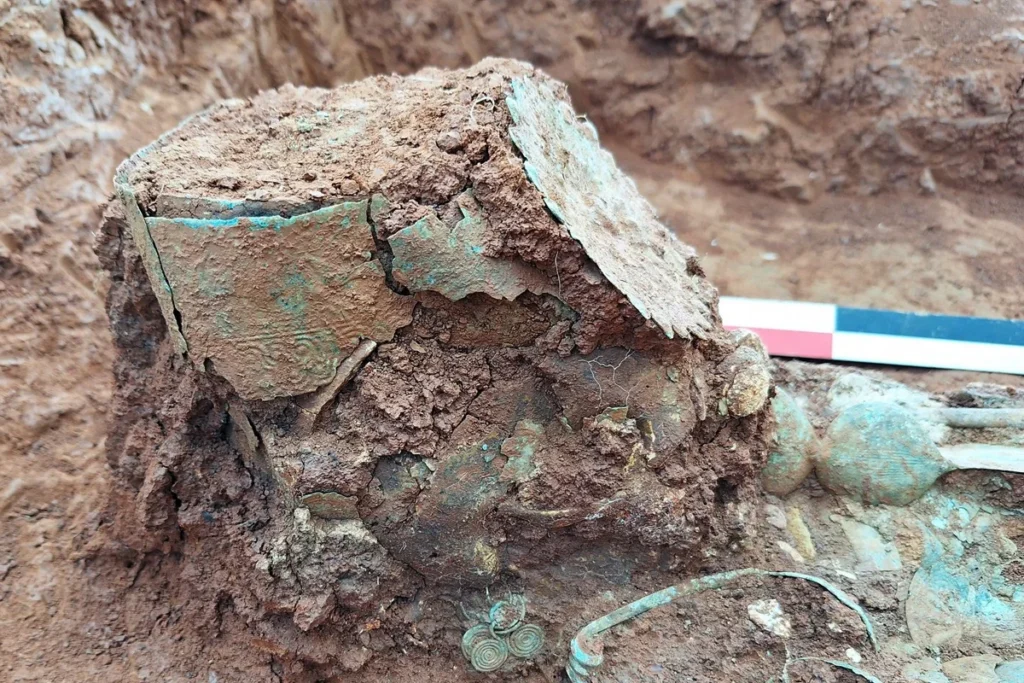
The “Lady with the Inverted Diadem”
Among the graves, one stands out for both its artistry and its symbolism. The burial of a woman aged approximately twenty to thirty years old contained an ornate bronze diadem embossed with a radiant rosette and pairs of heraldic lions arranged face to face. These motifs, long associated with royal power in the eastern Mediterranean, were executed with exceptional craftsmanship.
What intrigues researchers most is the diadem’s position. It had been placed on the woman’s head inverted, turning the lions upside down and positioning the battle ornament at the lower edge. Whether the inversion carried ritual significance or reflected a particular funerary custom remains uncertain, but it adds a layer of meaning to an already extraordinary object.
Her status is underscored by an array of luxury items: oversize Boeotian-style garment buckles covered in geometric horse decoration, a large vase-shaped pendant, finely carved beads of bone, ivory, and amber, laminated rosettes, copper earrings, a psellia bracelet, and spiral rings aligned along every finger joint. Each piece reflects a community connected to regional elite networks and skilled metalwork traditions.
A Second Woman Wearing a Bronze Diadem
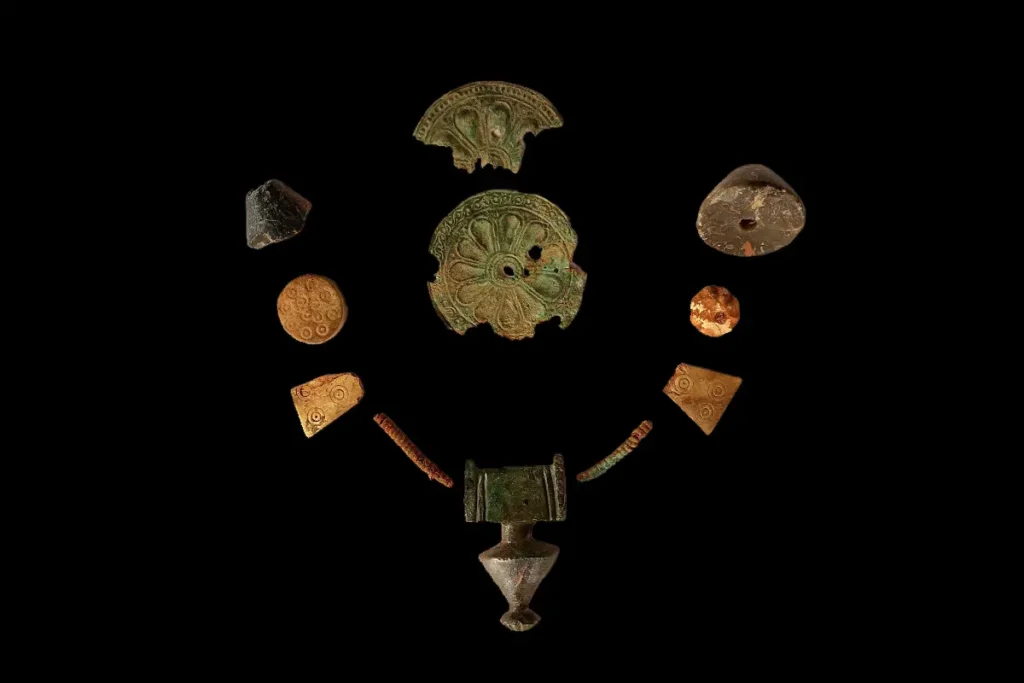
Just meters from the noblewoman’s grave, excavators uncovered the burial of another young woman adorned with a bronze diadem featuring rosettes, along with jewellery stylistically consistent with the first burial. The proximity and parallels suggest that both individuals belonged to a prominent lineage within the settlement.
Reassessing the Social Landscape of Archaic Greece
These burials illuminate a world in transition. The second half of the 7th century BC was marked by the rise of aristocratic clans whose authority depended not only on landholding but also on material expressions of prestige. The inverted diadem—symbolic, ornate, and unusual—adds a compelling new element to ongoing debates about identity, ritual, and political change in archaic-era Boeotia.
Cover Photo: The fully conserved bronze diadem from the Archaic-era noblewoman’s tomb near Lake Kifisida, showing its radiant rosette and heraldic lions in exquisite repoussé detail. The craftsmanship reflects elite status during the late 7th century BC. Source: Hellenic Ministry of Culture