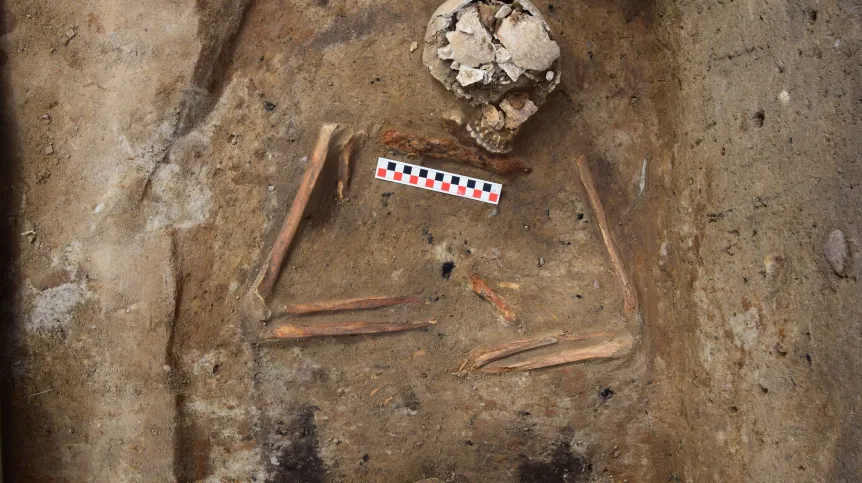
Archaeologists in northern Poland have uncovered a medieval grave near Dąbrówno that immediately stood out from the rest of the cemetery. Beneath the dead man’s neck lay a large iron knife, its blade facing upward. On his chest was a nail. Over the pelvis, researchers found a fragment of a ceramic vessel.
It is the kind of burial that easily attracts the label “anti-vampire.” Dr. Arkadiusz Koperkiewicz, who leads the excavation, is more cautious. Speaking to PAP, he said the grave should not be rushed into that category. The objects may point instead to a more uneasy world, Christian in form, but still touched by older customs, local fears and symbolic gestures around death.
A grave from the first Dąbrówno
The discovery was made at Stare Miasto, a village near Dąbrówno, where researchers from the University of Gdańsk are investigating the site of the town’s earliest settlement. Earlier surveys had already confirmed traces of medieval buildings on the high ground below Zamkowa Góra, near Lake Dąbrowa.
The cemetery dates to the 14th and 15th centuries. According to the researchers, it may contain the first generations of settlers, including local Prussian inhabitants who had entered the Christian world after the Teutonic conquest.
The burial ground has been partly damaged by ploughing, but surface finds had already helped archaeologists identify its age. The cemetery may also mark the area of a wooden church mentioned in historical sources, possibly destroyed during the war with the Teutonic Order in 1414.
Christian burial, unusual objects
Most of the graves followed medieval Christian practice. The dead were laid with their heads to the west, their hands crossed on the chest or pelvis. Some burials contained knives, fire steels, belt buckles and single coins from the first half of the 14th century.
One grave, however, was different.
The knife placed beneath the neck was not a small personal object casually left with the body. Its position, close to the throat and turned upward, gives the burial a striking character. The nail on the chest adds another layer of difficulty. Together with the pottery fragment over the pelvis, the objects seem deliberate.
For Dr. Koperkiewicz, the ceramic fragment is the easiest to explain. Similar fragments of broken vessels have been linked before with the funerary customs of Prussian neophytes, local converts to Christianity. Such an object may have carried a symbolic meaning, perhaps connected with human fragility and the shortness of life before God.
The iron objects are more ambiguous.
Not simply a “vampire grave”
Across medieval Europe, sharp iron objects sometimes appear in graves as apotropaic items, objects meant to protect the living or control the dead. Sickles, knives and other iron tools have often been discussed in connection with fears that a dead person might return.
Poland has produced famous examples of such burials. One of the best known is the 17th-century grave at Pień, where a young woman nicknamed “Zosia” was found with a sickle across her neck and a padlock on her toe.
The Dąbrówno grave is different in date, setting and meaning. Dr. Koperkiewicz does not rule out the survival of older Prussian habits, but he rejects a simple pagan or anti-vampire explanation. He compares it to later folk customs around death, such as covering mirrors or overturning chairs after someone dies. Such acts may look strange, but they do not automatically make a community pagan.
Old fears inside a Christian cemetery
The location matters. This was probably a church cemetery, a sacred space governed by Christian law. In the medieval mind, burying someone openly identified with evil in such a place would have been hard to accept.
By the 13th century, Prussian communities had agreed under the Treaty of Dzierzgoń, also known as the Treaty of Christburg, to abandon cremation and bury their dead in church cemeteries. Clergy later complained that old customs did not disappear at once. Still, by the 14th and 15th centuries, burial was firmly tied to church rules.
That makes the Stare Miasto grave more interesting, not less. It may record a moment when official Christian ritual and older ways of handling death met in the same burial. The knife, nail and pottery fragment may have marked the manner of death, helped the dead pass into the next world, or reflected anxiety about a soul that might not rest easily.
The grave is not a simple “vampire burial.” It is stranger than that. It shows how medieval people in the borderlands of the Teutonic Order could bury their dead according to Christian rules, while still reaching for older signs when death felt dangerous, uncertain or unfinished.
Cover Image: Unusual medieval grave discovered at Stare Miasto near Dąbrówno in northern Poland, where archaeologists found an iron knife beneath the neck and a nail on the chest. Credit: Kamil Niedźwiecki