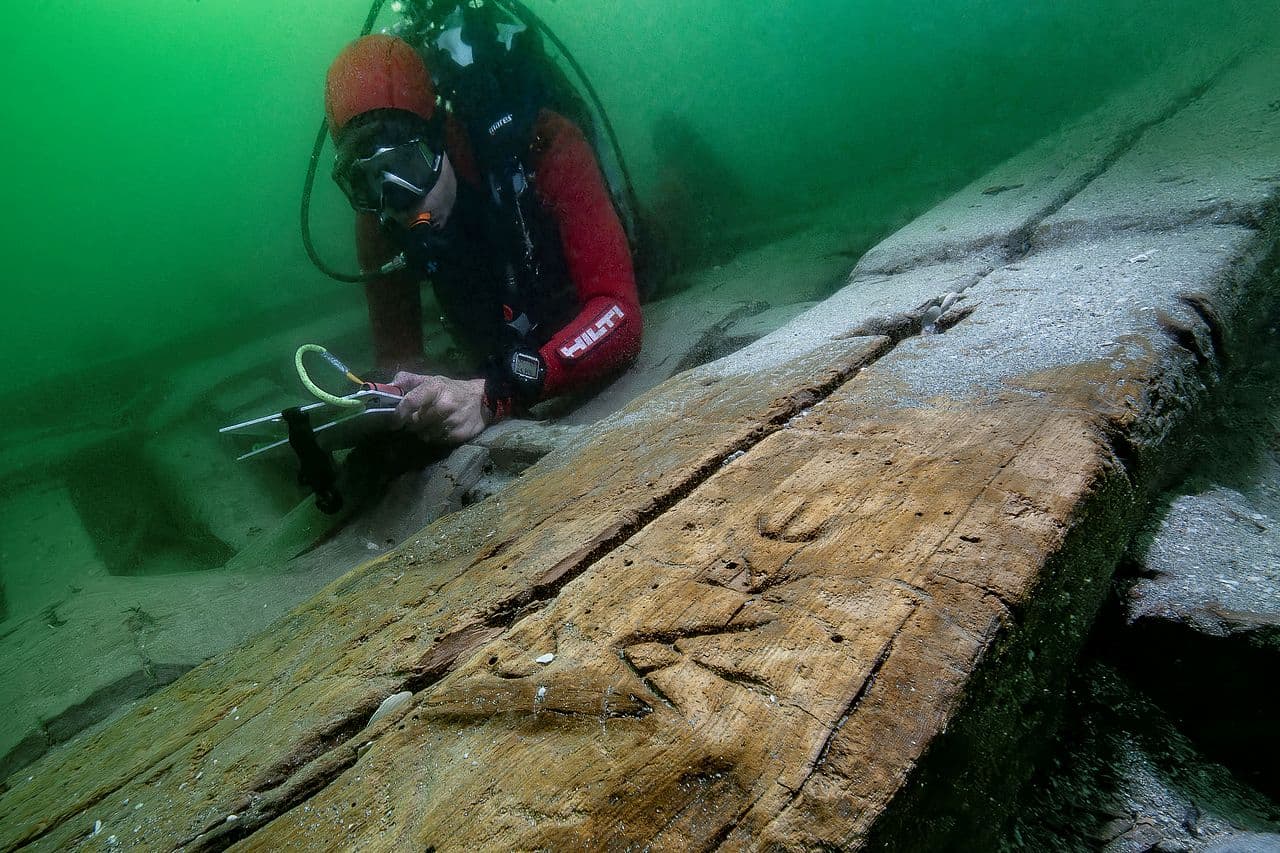
The waters off Alexandria’s ancient Portus Magnus have yielded an extraordinary surprise: the remarkably preserved hull of a luxurious thalamagos, a pleasure-and-ritual barge once used in the early Roman period. Resting beneath the silt of the submerged island of Antirhodos—once home to palaces and temples of the Ptolemies—the vessel has re-emerged as one of the most evocative maritime finds ever documented in Egypt.
Its timbers, sealed for nearly two millennia under Mediterranean sediments, reveal a story that blends elite leisure, religious ceremony, and a sudden, devastating end.
Archaeologists from the European Institute for Underwater Archaeology (IEASM), led by Franck Goddio, identified a 28-meter section of the hull in exceptional condition. Reconstructed dimensions suggest the barge originally stretched nearly 35 meters, its unusually broad central section designed to accommodate an expansive cabin—more a floating pavilion than a mere ship.
A Ship Built for Calm Waters—And for Ceremony
Unlike seagoing vessels of the period, the barge was constructed with a flat bottom and a sharply angled bow keel, ideal for navigating the shallow, protected waters of Alexandria’s harbor. The stern curved softly upward, allowing for stability and maneuverability during slow ceremonial voyages.

Inside the central longitudinal timber, archaeologists made a discovery that anchors the ship in time and place: Greek graffiti, etched casually by ancient hands. Paleographic analysis dates the inscriptions to the first half of the first century CE, the early decades of Roman Egypt. The use of Greek, combined with the architectural features, strongly suggests the barge was built in Alexandria’s own shipyards.
No trace of a sail system has been found, indicating that the vessel relied entirely on oars—meaning a large and coordinated crew would have powered its motion across the great harbor.
Echoes of Banquets, Rituals, and a Lost Waterfront Life
The geographer Strabo, who toured Alexandria shortly before the turn of the millennium, described sumptuous banquets held aboard cabin-fitted thalamagoi as they glided among lotus thickets and overhanging leaves. The archaeological context, however, points toward a more complex identity for this ship—perhaps one deeply entangled in ritual rather than recreation.
The wreck lies only steps from the submerged Temple of Isis on Antirhodos, excavated in earlier seasons by the same team. Goddio suggests a compelling hypothesis: the barge may have perished during the catastrophic destruction that struck the sanctuary around 50 CE, an event recorded in regional histories. If true, the vessel may not have belonged to a private elite at all, but to the ceremonial apparatus of the temple itself.
A Candidate for the Navigium Isidis
One ritual in particular emerges as a likely context. Each year, Alexandria hosted the Navigium Isidis, a grand aquatic procession honoring Isis as mistress of the seas. During the festival, a richly decorated ceremonial boat—representing the solar barque of the goddess—traveled from the Portus Magnus to the Osiris sanctuary at Canopus along the Canopic canal.
The newly discovered thalamagos fits the requirements of such a vessel: impressive dimensions, ample space for a shrine or image of the goddess, and the visual splendor expected of an imperial-era religious spectacle.
If confirmed, this would be the first archaeologically documented Navigium vessel from Roman Egypt.

A Wreck That Redraws the Cultural Map of Alexandria
For now, the barge is in the earliest stages of study, but its potential is enormous. The preserved wood, construction methods, and any organic remains trapped within the hull may transform our understanding of how ritual, engineering, and political power intersected in Roman Alexandria.
Thalamagoi have long appeared in ancient literature and art—from Strabo’s descriptions to the Nilotic mosaic of Palestrina, where a smaller version glides through a hunting scene on the Nile. Their most famous historical moment came when Cleopatra VII received Julius Caesar aboard a lavish barge in 47 BCE—an episode blending propaganda, seduction, and statecraft.
The Antirhodos ship, though likely more modest than Cleopatra’s legendary vessel, is the first physical representative of this tradition ever recovered. It anchors myth in material reality.
As researchers begin the meticulous analysis of its timbers, they hope to answer questions that have lingered for centuries: Where was it built? Whom did it serve? And what happened during its final voyage in the glittering, volatile harbor of Roman Alexandria?
Whatever the answers, this barge offers a rare archaeological window into a ceremonial world that—until now—floated only in the pages of ancient history.
Cover Image: The Greek inscriptions identified on the central keel timber date to the first half of the 1st century CE. Credit: Christoph Gerigk © Franck Goddio / Hilti Foundation
Source: Franck Goddio