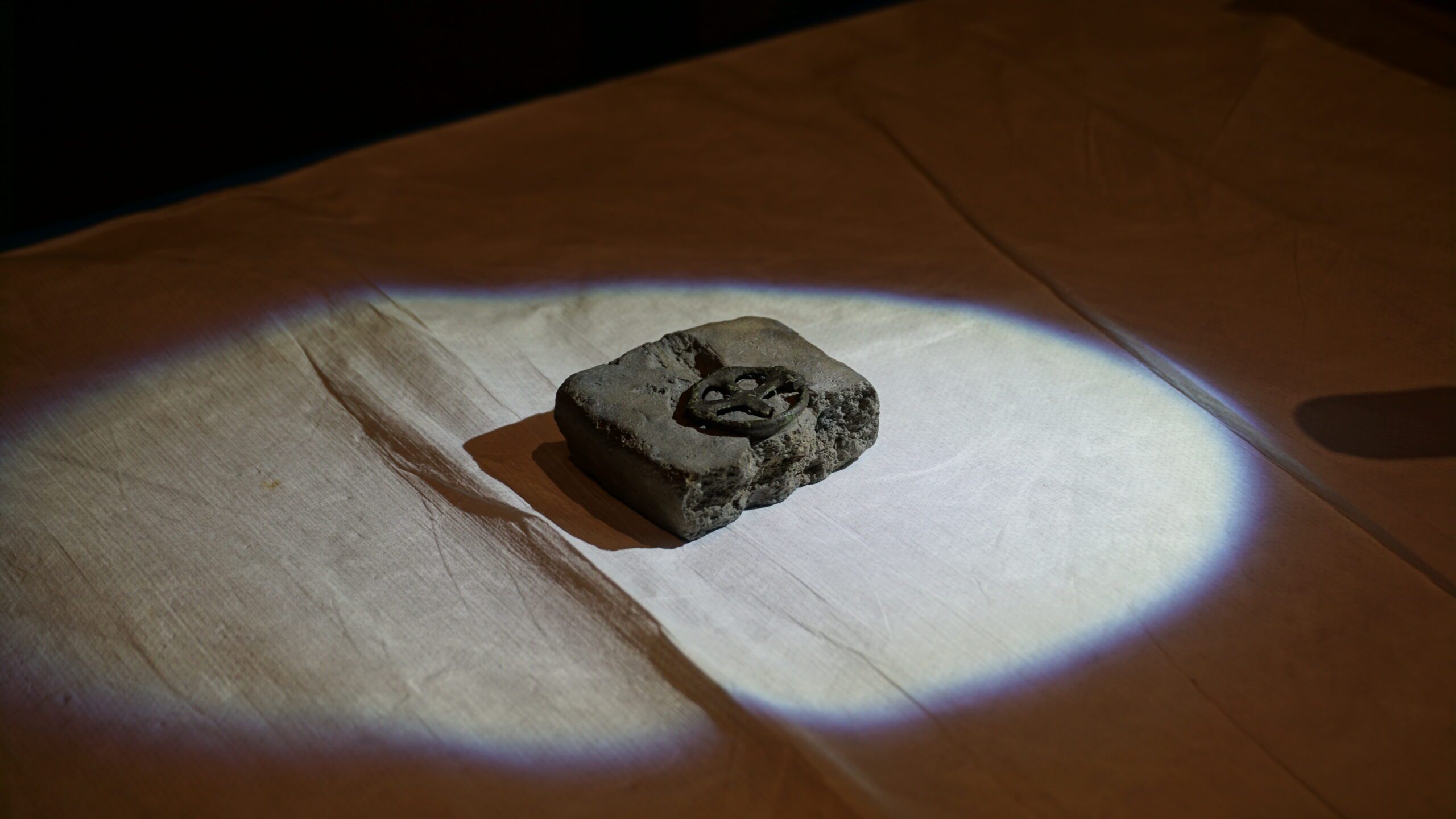
A modest bronze cross uncovered in western Brandenburg is prompting archaeologists to rethink how early Christianity spread across northeastern Germany during the early Middle Ages. Dating to the late 10th or early 11th century, the object is unremarkable in size—but extraordinary in what it reveals.
What makes the find exceptional is not merely its age, but a rare archaeological coincidence: the cross matches exactly a bronze casting mold excavated more than forty years ago in Berlin-Spandau. For the first time, an early medieval mold and its finished object have been reunited, separated for over a millennium.
A discovery that closes a 40-year gap
The cross was found in the Havelland region by Juliane Rangnow, a trained volunteer working under official authorization. Once the object reached specialists at the Brandenburg State Office for Heritage Management and Archaeological Museum, a remarkable realization followed.
Detailed measurements and restoration work showed that the cross fits perfectly into a bronze mold discovered in 1983 at a Slavic hillfort in Berlin-Spandau. Until now, that mold—long known to scholars—had never been linked to an actual finished artifact.
For medieval archaeology, such a match is exceptionally rare.
From theoretical evidence to physical proof

Often referred to in scholarship as the “Spandau Cross” mold, the artifact has long been considered one of the earliest material indicators of Christian symbolism between the Elbe and Oder rivers. Found near the remains of an early wooden church, it suggested local production of Christian objects—but lacked tangible confirmation.
The newly discovered cross provides that confirmation. It demonstrates that Christian symbols were not only present, but manufactured locally, likely in multiple copies, rather than imported as isolated prestige items.
Rethinking early Christianization east of the Elbe
The cross dates to a politically unstable period, when Slavic-inhabited regions of today’s Berlin and Brandenburg were increasingly influenced by the East Frankish Kingdom, the political entity that would later evolve into the Holy Roman Empire.
Archaeological evidence for early Christianization in this region has always been sparse. Most historical reconstructions rely on written sources, which emphasize resistance among —resistance that culminated in the Lutician uprising of 983. That revolt led to the collapse of Christian institutions in the area for more than a century.
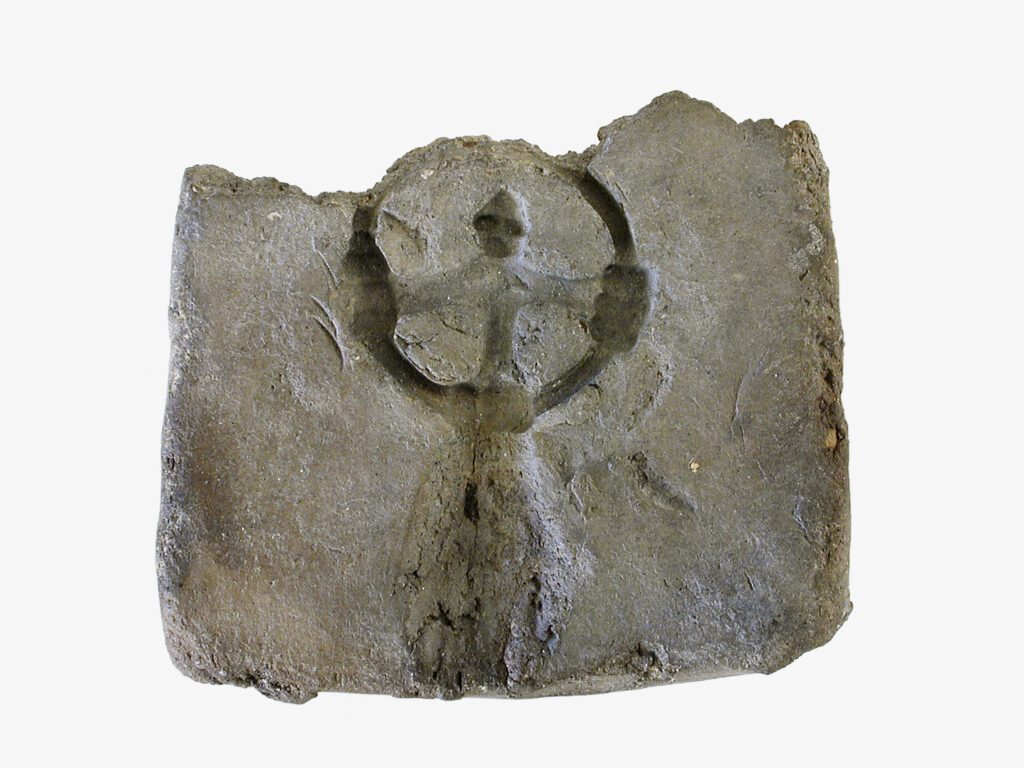
The Havelland cross complicates this narrative. According to Matthias Wemhoff, the existence of a reusable mold strongly suggests serial production and a wider circulation of Christian symbols than previously assumed—possibly serving a mobile population before the uprising disrupted ecclesiastical structures.
“Almost unheard of” in medieval archaeology
“This kind of match is virtually unheard of,” said Franz Schopper, stressing the importance of long-term documentation and cooperation between professionals and trained volunteers.
For archaeologists, the find is more than a curiosity. It represents a rare moment when decades of careful record-keeping suddenly converge, allowing a fragmented story to become whole.
Found by a volunteer, preserved by a system
The discovery site itself tells a broader story. Alongside the cross, archaeologists documented coins, gilded jewelry fragments, and iron weapons from the 10th and 11th centuries—evidence that the area was not a place of accidental loss, but sustained activity.
Brandenburg’s Minister of Culture, Manja Schüle, highlighted the discovery as a powerful example of how trained volunteers contribute to heritage protection. Today, Brandenburg works with around 350 certified volunteer archaeological conservators, all operating under strict legal and scientific frameworks.
A rare reunion on public display
From 24 January to 11 March 2026, the bronze cross and its original casting mold will be displayed together at the Archaeological State Museum Brandenburg. For visitors, it is a rare chance to see an early medieval production process—object and mold—reunited after more than a thousand years.
For researchers, the message is clear: even the smallest artifacts can carry disproportionate historical weight, especially when patience, documentation, and collaboration allow the past to speak with unexpected clarity.
Cover Image Credit: Brandenburg Ministry of Science, Research and Culture (Germany)