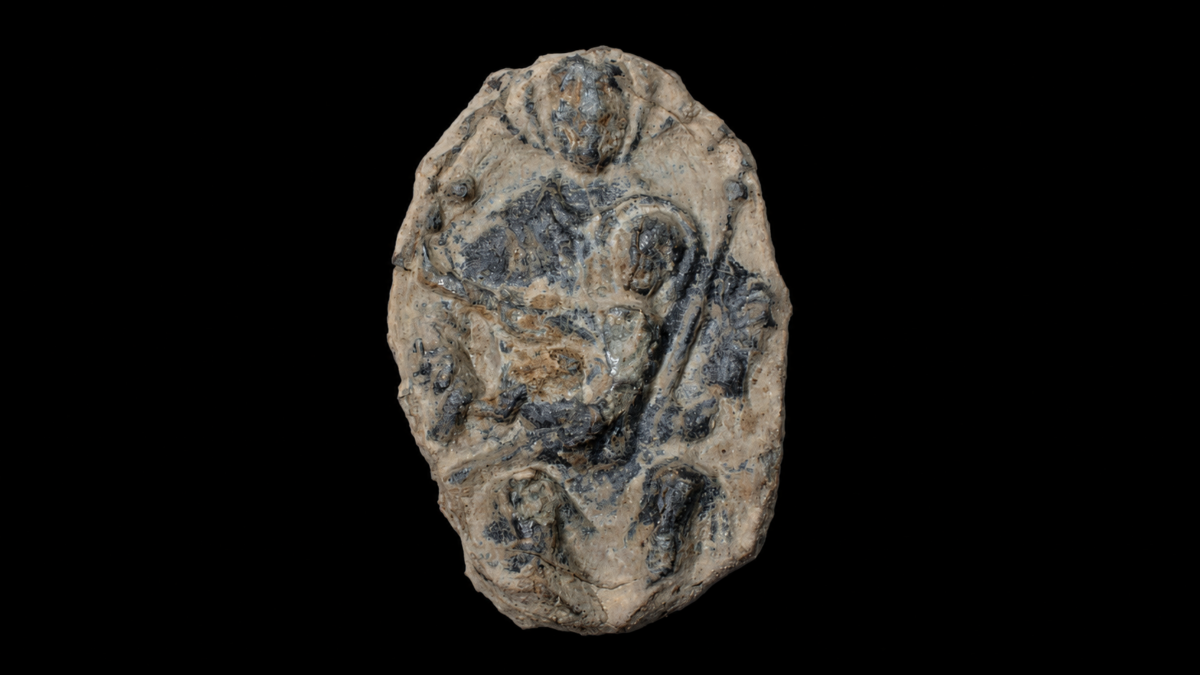
A medieval pilgrim badge found in a field in South-West Finland has been identified as part of one of the rarest known groups of devotional objects from the Baltic world. Only six or seven comparable Livonian badges are known from Europe, which makes the worn pewter fragment from Masku far more important than its small size suggests.
The object was discovered in 2016 by a metal detectorist at Juva Farm, north of the Maskunjoki River. The field lies about three kilometers northeast of Masku’s medieval church, in a landscape where Late Iron Age and medieval finds have already hinted at long human use.
At first, the badge does not look like much. It is broken, roughly almond-shaped, and measures only about 3 by 2 centimeters. Its edges are damaged. Its surface is worn. But on the front, enough of the relief survives to show the Virgin Mary seated with the Christ Child on her lap. On the back, the remains of a fastening pin show that it was once worn, probably on clothing, a hat, or a pilgrim’s bag.
One small detail changed the story
Visa Immonen of the University of Bergen identifies the Masku object as a Livonian pilgrim badge in a study published in Fornvännen: Journal of Swedish Antiquarian Research.
The clue is not the general image of Mary and Christ, which was common in medieval devotional art. It is the position of Mary’s sceptre.
The badge first resembles pilgrim badges from Rocamadour in France, one of medieval Europe’s major Marian pilgrimage centers. Rocamadour badges also show the Virgin and Child and often have a similar almond-shaped form. But in those examples, Mary usually holds a lily-topped sceptre on her right side.
On the Masku badge, the sceptre appears on her left.
That small reversal places the Finnish fragment closer to a rare Livonian group. These badges carried the Latin inscription “SIGNVM S MARIE IN LIVONIA REMISSIONIS PECCATORVM,” meaning “The sign of St Mary for the forgiveness of sins in Livonia.” In the Livonian type, Mary holds the lily sceptre in the crook of her left arm, while the Christ Child carries a Greek cross.
The Masku badge is incomplete, but its surviving features are enough to connect it with this small Baltic group.
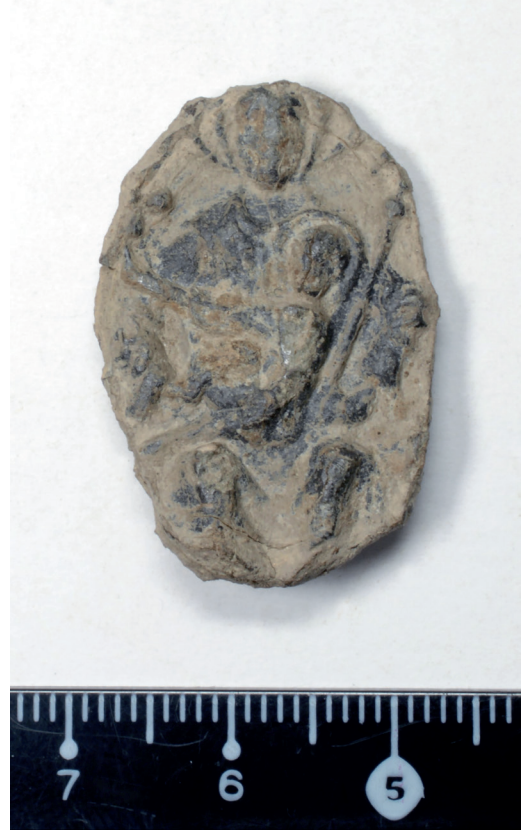
41582:1). Size c. 3 x 2 x 0.6 cm. Photo: the Archaeological Collections, Finnish Heritage Agency. Credit: Immonen, V. (2026)
A rare object from the medieval Baltic
Livonian pilgrim badges are not common finds. Apart from the Masku example, only a handful have been recorded. Two come from Latvia, one from Sweden, and four from Germany. They have been found in places such as Kuldīga, Riga, Lödöse, Kiel, the area near Lübeck, and Wismar.
Together, they trace a narrow medieval world of movement around the Baltic Sea. These objects may have travelled with pilgrims, clerics, merchants, or people whose journeys mixed faith with trade and family ties.
The known Livonian badges are generally dated to the late 13th or early 14th century. The Masku find likely belongs to the same period.
For Finland, this is what makes the object unusually valuable. It gives a rare physical trace of contact between South-West Finland and the religious networks of medieval Livonia. Masku was not an isolated parish at the edge of Europe. It belonged to a wider northern world shaped by churches, river valleys, sea routes, and pilgrimage.
The Riga connection
The inscription on Livonian badges does not name a single shrine. It refers broadly to Livonia, the medieval region around present-day Latvia and Estonia. Still, Riga remains the strongest candidate for the place behind the badges.
Riga’s cathedral was dedicated to the Virgin Mary and was known in medieval sources as St Mary’s Church. Written records also mention pilgrim journeys from the Nordic countries to Riga. A badge invoking St Mary in Livonia fits that setting closely.
There may be an even older visual story behind the design. Scholars have suggested that the Livonian badges may have been inspired by Rocamadour models, perhaps even cast from a Rocamadour badge used as a model. If so, the Masku fragment carries more than one journey: a French Marian image adapted in Livonia, then carried north into Finland.
The mystery remains in the field
The findspot is still difficult to explain.
The Maskunjoki River Valley was densely populated in the Late Iron Age and the Middle Ages. Masku itself appears in written sources in the early 13th century and became one of Finland’s old and wealthy medieval parishes.
Juva Farm, however, leaves fewer traces. Although the field has produced several Late Iron Age and medieval finds, no clear archaeological site has yet been identified there or nearby. In written records, Juva appears only once during the Middle Ages, in a 1416 donation linked to Turku Cathedral.
That leaves the badge with a secure identity but an uncertain journey.
Was it lost by a local pilgrim returning from Livonia? Did it arrive through trade or clerical contact? Was it dropped near an activity area that has not yet been found?
For now, the small pewter badge adds Finland to the rare map of Livonian pilgrim badges. The object is damaged and modest, but its route across the medieval Baltic remains one of the most interesting parts of the story.
Immonen, V. (2026). A Livonian pilgrim badge from Masku, South-West Finland. Fornvännen: Journal of Swedish Antiquarian Research, 121(2), 148–150. https://doi.org/10.66449/fornvn.v121i2.64011
Cover Image Credit: Archaeological Collections, Finnish Heritage Agency. Immonen, V. (2026)