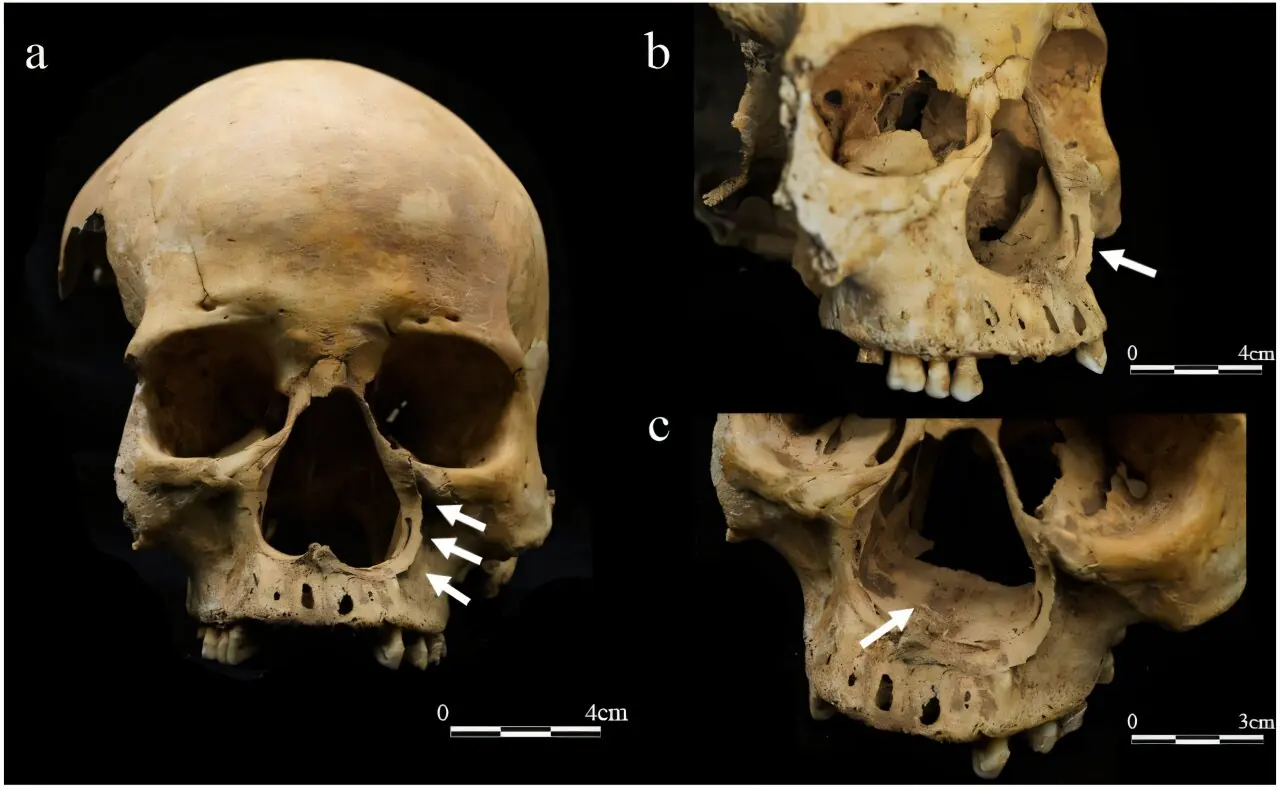
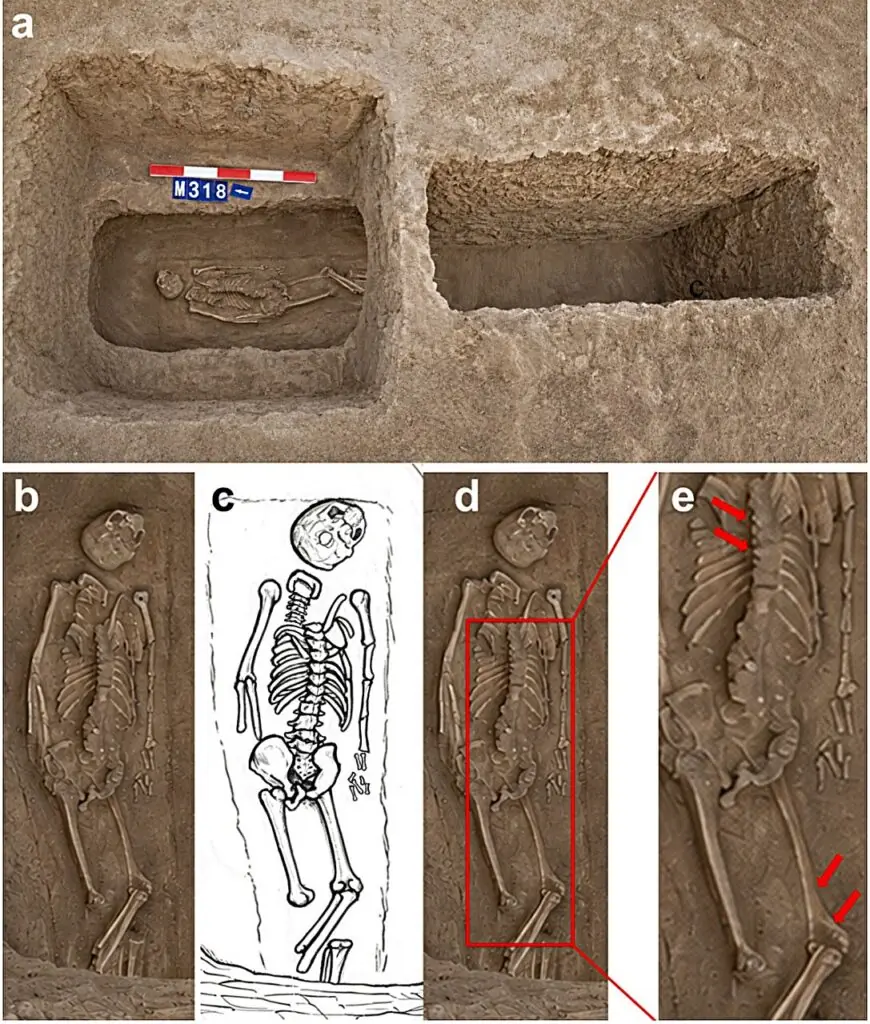
When archaeologists excavated a medieval cemetery in central China, one burial immediately stood apart. The woman had been placed face down, and the bones around her nose showed evidence of a severe injury unlike anything found among the cemetery’s other graves.
A new study suggests that the damage was neither accidental nor caused after death. Instead, the woman may provide the first reported skeletal evidence from China of nasal amputation used as a judicial punishment—a practice described in historical texts but rarely identified in the archaeological record.
The remains were discovered in 2019 at the Sanzhiyuan Cemetery in Sanmenxia, Henan Province. Of the 213 historical burials excavated at the site, the grave designated M318 was the only one containing a person buried in a prone, or face-down, position.
She was also the only individual showing this form of facial damage.
A punishment written on the face
Analysis of the skull and pelvis indicated that the woman was approximately 40 to 45 years old when she died. Radiocarbon dating placed her burial between 1298 and 1404, a period spanning the final decades of the Yuan dynasty and the beginning of the Ming dynasty.
Researchers led by Yawei Zhou of Zhengzhou University examined her skull using computed tomography. The high-resolution scans revealed that parts of the nasal bones and several delicate structures inside the nasal cavity were missing.
The pattern of damage was unusually precise. The surrounding facial bones showed no comparable fractures, and the woman’s front teeth remained intact—details that made a fall, violent blow or other accidental injury less convincing as an explanation.
The researchers concluded that the damage was most consistent with the deliberate removal of the external nose. In their assessment, punitive nasal amputation is the most likely explanation, although the woman’s identity and the circumstances surrounding the injury remain unknown.
Cutting off the nose was intended to do more than cause immediate physical pain. Because the resulting disfigurement could not easily be concealed, the punishment permanently marked the person subjected to it.
Chinese historical texts describe nasal amputation among a wider group of corporal punishments imposed for certain offenses. These written accounts demonstrate that the practice was known, but they cannot reveal how frequently it was applied or exactly how the procedure was carried out.
The woman from grave M318 may offer a rare physical trace of that legal tradition.
She survived for years
The most revealing evidence was not simply that part of the woman’s nose had been removed. It was that she survived.
New bone growth had formed around the damaged area, while the edges of the injury showed extensive healing. According to the researchers, this indicates that the amputation occurred well before her death and that she may have lived for several years afterward.
Surviving such a procedure would likely have required the bleeding to be controlled and the wound protected from serious infection. The healing therefore raises another question: who cared for her after the injury?
The study cannot establish whether she received treatment from a medical practitioner, relatives or other members of her community. Yet the extensive healing shows that her life continued long after the injury. Other archaeological evidence from China suggests that visible facial differences did not always lead to exclusion: a teenager with a cleft lip buried during the Qing dynasty appears to have lived with the care and acceptance of his community. Whether the woman from Sanzhiyuan received similar support, however, remains unknown.
Chemical analysis of her bones provided a few additional clues. Her diet relied heavily on millet and contained relatively little animal protein, while her grave was modestly furnished. Together, these details suggest that she was probably a commoner rather than a member of the wealthy elite.
Her face-down burial may also have carried meaning. Although prone burials can have different explanations depending on the period and culture, the position is particularly striking at Sanzhiyuan because no one else in the cemetery was buried in the same manner.
The combination of facial mutilation and an exceptional burial posture suggests that the stigma surrounding the woman may have followed her into death. Without an inscription or written record connected directly to the grave, however, that interpretation cannot be proved.
A compelling case, but not a final verdict
The researchers acknowledge that no surviving evidence identifies the woman or records a sentence imposed against her. It is therefore impossible to demonstrate beyond doubt that a court ordered the removal of her nose.
Other causes of facial disfigurement, including interpersonal violence or an undocumented medical intervention, cannot be ruled out entirely. Yet the location and precision of the damage, the absence of injuries elsewhere on the face and historical descriptions of nasal amputation make punishment the strongest interpretation currently available.
This is what makes the woman from grave M318 important. Historical sources tell us what authorities claimed or were permitted to do, while her skeleton may reveal what one person endured.
Seven centuries later, her name and the circumstances behind the injury remain lost. What survives is the physical record of a disfigurement that would have remained visible for life—and evidence that, despite it, she lived for years afterward.
Cover Image: The skull of the woman buried at Sanzhiyuan Cemetery. Arrows indicate damage around the nasal opening that researchers interpret as possible evidence of punitive nasal amputation. Credit: Zhou et al., Journal of Archaeological Science: Reports (2026).