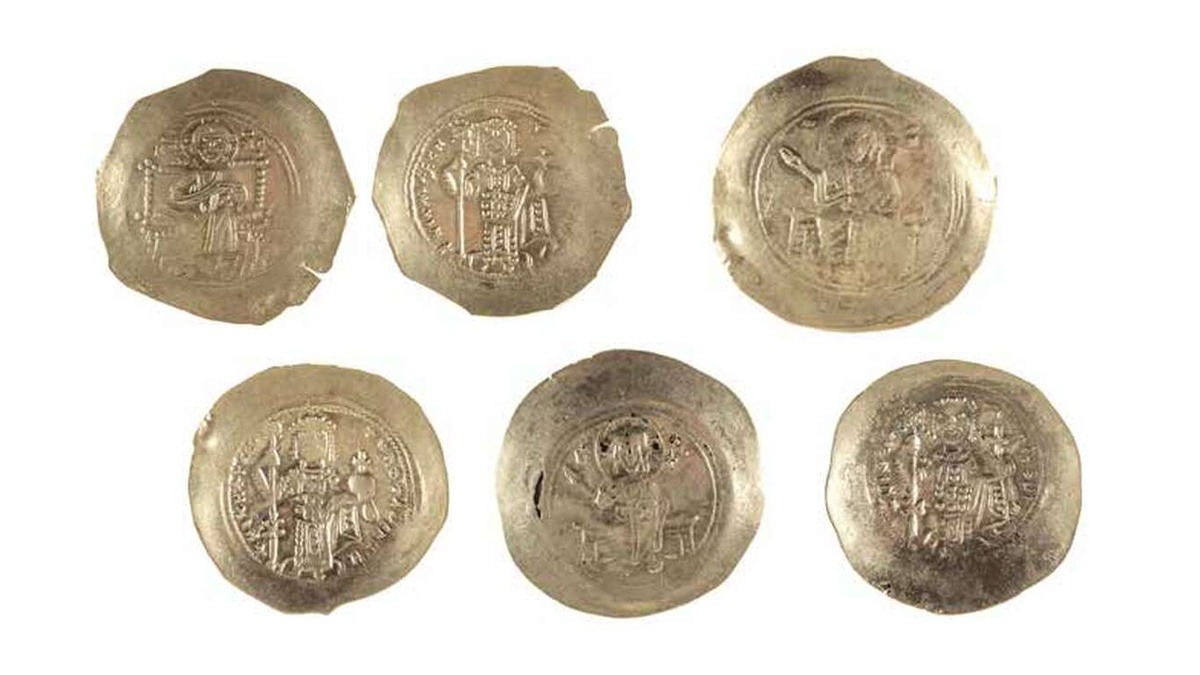
A hoard discovered during construction work in northwestern Bulgaria may originally have contained as many as 600 Byzantine gold coins. Instead of being reported to archaeologists, however, the find was concealed and divided among the workers who uncovered it.
Only 150 coins remained together. They were recovered by Bulgarian authorities as part of a collection reportedly being prepared for illegal export and later entered the National Historical Museum in Sofia. Among them was an extraordinary coin whose gold surface concealed a copper core.
The hoard was found sometime in the 1980s in the Kaleto district of Vidin. Its precise discovery date and original archaeological context remain unknown, largely because the coins were dispersed soon after they came out of the ground.
According to Bulgarian numismatist Vladimir Penchev, whose study provides the most detailed examination of the surviving group, one of the workers sold his share to a person involved in the illegal antiquities trade in Sofia. Authorities seized those coins along with other antiquities before they could leave Bulgaria.
Every Surviving Coin Came from the Same Reign
All 150 coins are histamena nomismata issued under the Byzantine emperor Nikephoros III Botaneiates, who ruled from 1078 to 1081. Not one of the surviving examples belongs to another emperor.
That uniformity is unusual. A family fortune accumulated over several decades would ordinarily be expected to contain coins issued under different rulers. The Vidin group instead appears to have been assembled within a relatively limited period.
Penchev estimates that the recovered coins may represent only one-third or one-quarter of the original deposit. If that reconstruction is correct, the complete hoard could have contained approximately 450 to 600 coins. Because most of the find was dispersed, however, its true size can no longer be established.
Even in its incomplete state, the group is the largest collective find of coins issued by Nikephoros III preserved in a Bulgarian museum. Had the hoard remained intact, it could have provided far more information about the movement of large payments across the Byzantine Balkans.
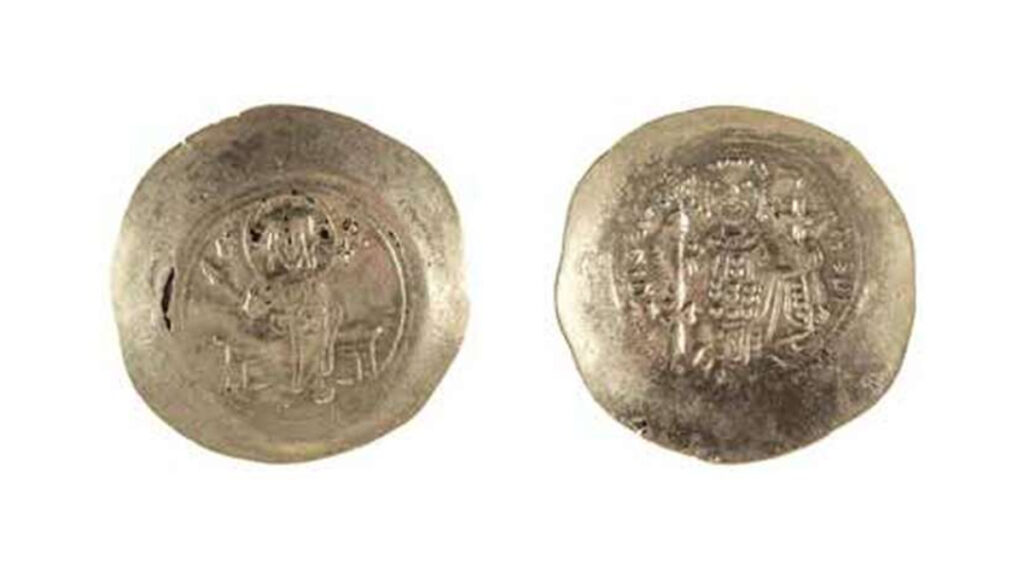
Each coin depicts Christ seated on a throne, holding the Gospels and raising his right hand in blessing. The reverse shows Nikephoros III in ceremonial dress, carrying a labarum and a cross-bearing globe.
Gold from an Empire in Crisis
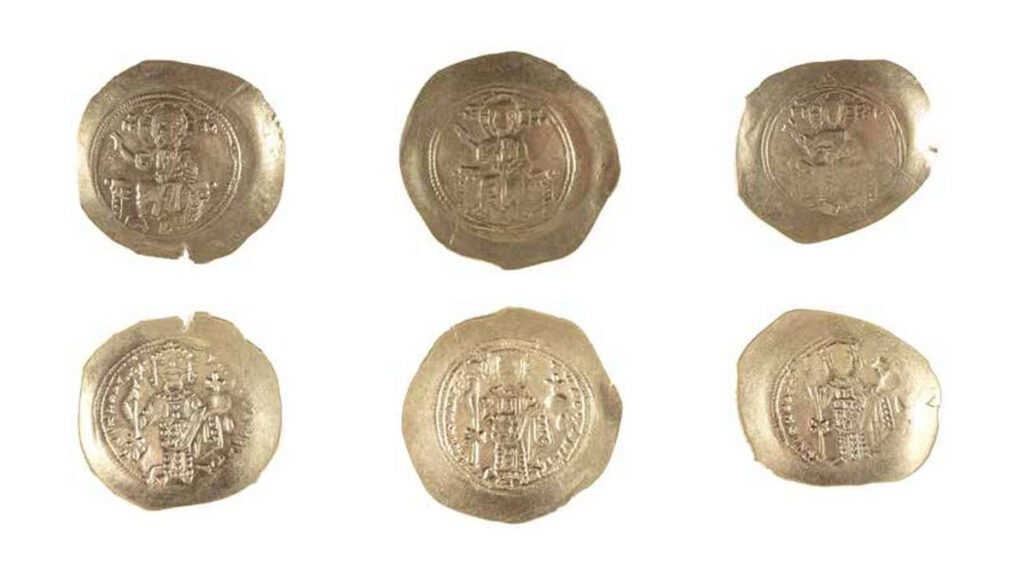
The Vidin coins belong to a period when the celebrated stability of Byzantine gold was rapidly collapsing. Their pale yellow color reflects a dramatic reduction in the amount of precious metal used at the imperial mint.
Earlier eleventh-century Byzantine coins could contain between 20 and 22 carats of gold. By the reign of Nikephoros III, the figure had fallen to approximately 8.5–9.5 carats. Silver and copper made up much of the remaining alloy, leaving some coins brittle enough to crack during minting.
Several examples were clipped around their edges, allowing small amounts of metal to be removed without making the coins immediately unusable. Others carry deep marks apparently made by people biting them, possibly in an attempt to test whether they were really gold.
Twenty-four coins also bear symbols scratched into their surfaces with fine blades. Similar marks on other Byzantine gold coins have been associated with money changers who inspected currency in Constantinople and other major commercial centers.
These traces suggest that the coins had circulated before they reached Vidin. They had passed through different hands, been examined and sometimes physically tested rather than travelling directly from the mint to their final hiding place.
One coin shows why such suspicion may have been justified. Catalogued as number 123 in Penchev’s study, it was made with a copper core covered by a thick gold layer. Corrosion eventually broke through the outer shell, exposing the less valuable metal beneath.
Weighing 3.78 grams, the coin might easily be dismissed as the work of a private counterfeiter. Penchev’s analysis of its style and inscriptions instead suggests that it was probably produced at the official imperial mint in Constantinople.
The technique may have been used during shortages of precious metal, including for payments sent beyond the empire’s central regions. Curiously, this particular coin shows no sign of having been bitten. The people who accepted it may never have realized what lay beneath its gold surface.
Why Was the Money Sent to Vidin?
The unusual composition of the hoard may offer a clue to its purpose. Since all 150 surviving coins were issued under a single emperor, Penchev proposes that they could have formed part of a substantial state payment sent from the imperial treasury in Constantinople.
Medieval Vidin, then known as Bdin, occupied a strategically important position on the Danube. After the Byzantine emperor Basil II captured the city in 1003, it remained a fortified center on the empire’s northwestern frontier.
The money may have reached Bdin early in the reign of Alexios I Komnenos, when the Byzantine Empire was mobilizing troops and resources against the Norman advance in the Balkans. It could have been intended for soldiers, officials or defensive preparations, although no surviving evidence identifies its recipient or explains why it was eventually buried.
The missing portion prevents researchers from testing the theory fully. There is no way to determine whether every lost coin also belonged to Nikephoros III or whether the complete hoard contained additional rulers and denominations.
What remains nevertheless provides an unusually human record of Byzantine money in circulation. The coins were clipped, inspected by money changers and perhaps tested with teeth before reaching the Danube frontier. Nearly nine centuries later, they were divided once again—this time among the workers who found them.
Only 150 were recovered. The remaining coins, and much of the history they carried, may never be found.
Cover Image: Gold coins from the Vidin hoard, all issued during the reign of Byzantine emperor Nikephoros III Botaneiates. Credit: Vladimir Penchev / National Historical Museum, Sofia, via Numismatics, Sigillography and Epigraphy 19 (2023).