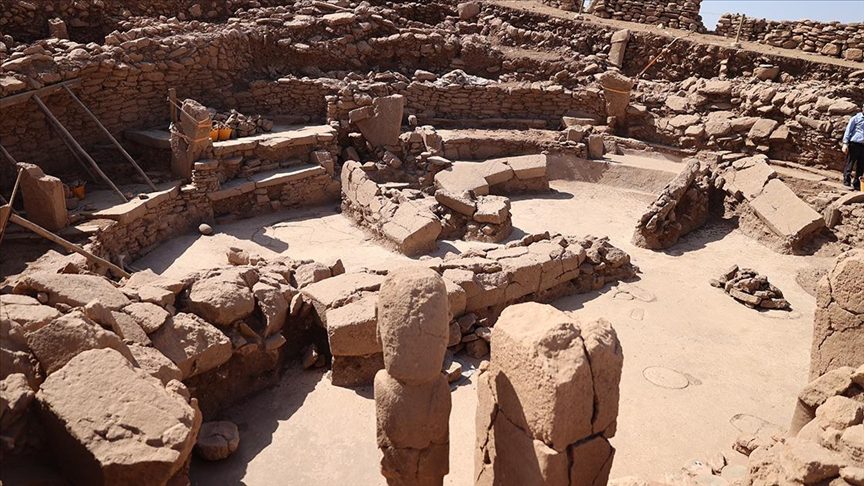
Under the sharp light of the Şanlıurfa plateau, archaeologists at Karahantepe have revealed a structure unlike anything previously documented in the early Neolithic world: a circular, amphitheater-like gathering space carved directly into bedrock, lined with tiers of stone benches and flanked by human heads sculpted into its walls. The discovery pushes the boundaries of what scholars thought they knew about the earliest settled communities and their ability to create shared social spaces more than 11,000 years ago.
Early impressions from the excavation team suggest a place built not only to impress, but to bring people together—a design choice that resonates across millennia. And yet, this curved architectural form predates the classical amphitheater by thousands of years.
A Deep Look Into a Community in Transition
Karahantepe sits within the Taş Tepeler region, the cluster of early monumental sites that includes the globally known Göbeklitepe. But the story emerging here is distinctly its own. According to excavation director Prof. Dr. Necmi Karul, the community that inhabited Karahantepe experienced a long arc of change, beginning around 9400 BCE and continuing for roughly fourteen centuries. Across that span, architecture shifted from intimate circular rooms to more formal rectangular buildings—an evolution that mirrors the social transformations of people settling permanently for the first time.
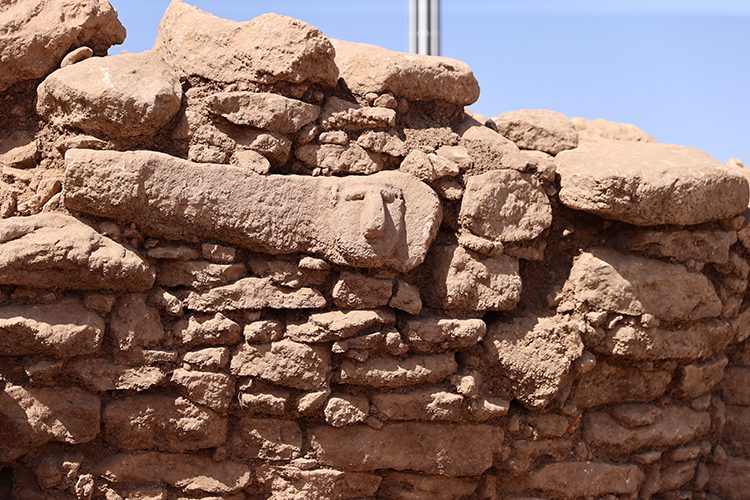
The newly uncovered structure marks a dramatic moment in that development. The entire floor is carved into limestone, and against its curving interior walls are sculpted human faces, their expressions intentionally abstracted yet unmistakably anthropomorphic. Several seated human statues were found resting on the floor, positioned as if meant to preside over activities taking place in the center.
These elements reveal a symbolic world in transition. Where wild animals dominated the iconography of nearby Göbeklitepe, Karahantepe shows something new: humans entering the stage of their own symbolic universe, visually claiming a place within their built environment.
A Space Designed for Gathering
The interior layout strengthens that interpretation. Three broad, arcing rows—more stone terraces than seats—rise gently toward the back of the room. Their shape directs attention inward, toward a prominent sculpture at the center. The design feels purposeful: a place where a group would watch, listen, or participate in something shared.
Karul and his team emphasize that the structure should not be read through later religious categories. Instead, it reflects the emerging needs of early settled life: coordination, cooperation, collective identity. In this sense, the building was likely a social engine, a space where stories were told, norms were negotiated, or rituals were enacted in ways that bound the community together.
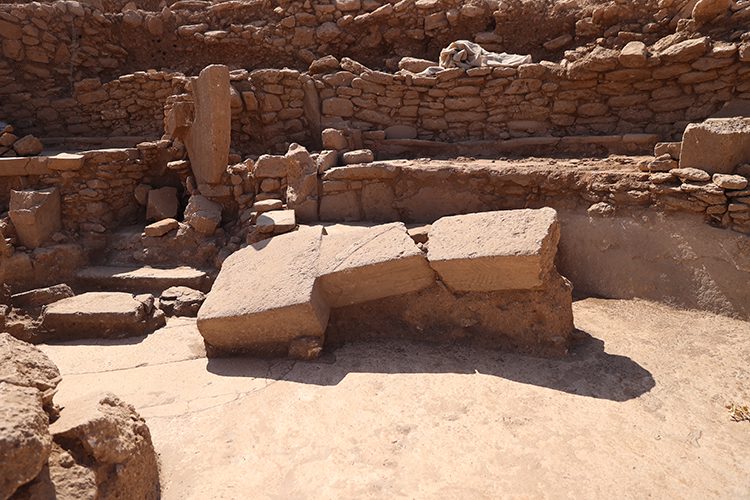
It offers a rare moment in deep time where architecture becomes a lens into the emotional and social fabric of a society still testing the limits of permanent living.
A Site That Rewrites Expectations
Karahantepe’s bedrock-carved architecture surpasses that of Göbeklitepe in scale and interconnectedness. Its corridors, chambers, and monumental rooms point to a highly organized community capable of sustained construction efforts and coordinated symbolic expression.
Perhaps most striking is the concentration of human imagery. Nowhere else in the early Neolithic Near East has such a cluster of sculpted faces been identified. Together, they mark Karahantepe as a site where the idea of “community”—as a lived and visualized concept—first took recognizable form.
Toward a New Understanding of Human Beginnings
As restoration progresses and standing elements are re-erected, Karahantepe is emerging as one of the defining archaeological sites of the 21st century. The amphitheater-like building, with its quiet semicircle of benches and its watchful human sculptures, stands as an early blueprint for something deeply familiar: the instinct to gather, to witness, to belong.
Long before cities or writing, the people here carved a space where community itself could take shape—literally and symbolically—into the stone beneath their feet.
Cover Photo: Eşber Ayaydın/AA