

A still-faced sculpture with a sealed mouth, unfamiliar stone portraits carved in the hills, and a double-sided bead that seems to look in two directions at once—Turkey’s Taş Tepeler region has entered a new phase of archaeological intrigue. In Şanlıurfa this week, the Ministry of Culture and Tourism introduced a set of discoveries that not only expand the known artistic vocabulary of the Pre-Pottery Neolithic but complicate long-held assumptions about ritual life in one of the world’s earliest monumental landscapes.
The announcement, delivered during the project’s fifth-year briefing at the Karahantepe Visitor Center, highlights thirty previously unknown objects recovered across several sites. Although they span different materials and techniques, the finds appear united by an undercurrent of symbolism that is still only partially understood.
A Still Face from Sayburç that Evokes the Threshold of Death
Among the most unsettling new pieces is a figurine unearthed at Sayburç bearing what researchers describe as a “mouth sewn shut.” The sculpture, only a few centimeters tall, emits a composed stillness that belies its miniature scale. Archaeologists working at the site suggest that the piece may represent a deceased individual or an ancestral figure invoked through controlled silence.
Some scholars have already begun referring to it as a “death mask,” emphasizing how sharply it stands apart within the broader Taş Tepeler corpus. Its discovery further reinforces Sayburç as a center of unconventional ritual expression during the early Neolithic.
A Hidden Human at Göbeklitepe
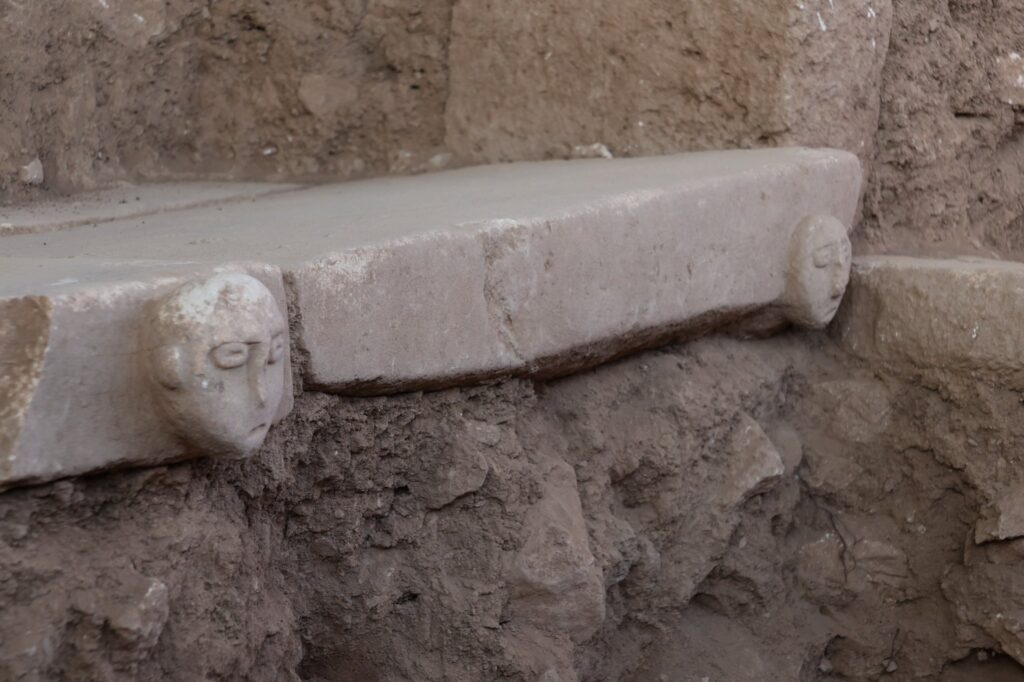
Göbeklitepe, the site that redefined global understandings of early monumentality, also yielded an unexpected addition. Excavators revealed a finely carved human figurine deliberately embedded within the inner face of Structure D’s wall.
The placement suggests that it served a dedicatory function, perhaps inserted as a silent witness to the ceremonies performed within the sanctuary. Its craftsmanship aligns with the refined aesthetic associated with Göbeklitepe’s earliest occupation layers, dating it to more than eleven millennia ago.
Sefertepe’s New Faces Challenge the Known Artistic Vocabulary

Sefertepe delivered some of the season’s most visually striking revelations. Two carved stone faces—one rendered in pronounced high relief, the other in a shallower, more restrained technique—break decisively from the sculptural traditions documented at Göbeklitepe, Karahantepe, and Sayburç.
Archaeologists note that their proportions, surface treatment, and overall expression introduce an entirely new stylistic horizon. These differences hint that Sefertepe’s communities cultivated their own artistic identity, even while participating in the broader Taş Tepeler cultural sphere.
A second object from the site, a small black serpentine bead carved with two opposing faces, deepens the mystery. Its double-sided design invites interpretations linked to duality, transformation, or protective symbolism. In a region where portable objects often carried ritual roles, this bead stands out as unusually conceptually complex.
A Landscape of Early Ritual Innovation Continues to Expand
The Taş Tepeler initiative now encompasses more than a dozen mound and hilltop settlements across Şanlıurfa, forming one of the largest coordinated archaeological programs in modern Turkey. Each field season adds pieces to a puzzle that grows more intricate rather than more complete.
The newly unveiled objects—silent faces, hidden figurines, and symbols carved into stone—underscore how the communities of the Pre-Pottery Neolithic crafted a world rich in metaphor, ritual meaning, and artistic experimentation. Their intentions, however, remain just beyond reach, prompting scholars to ask new questions about how early societies expressed identity and interacted with the forces they believed shaped life and death.