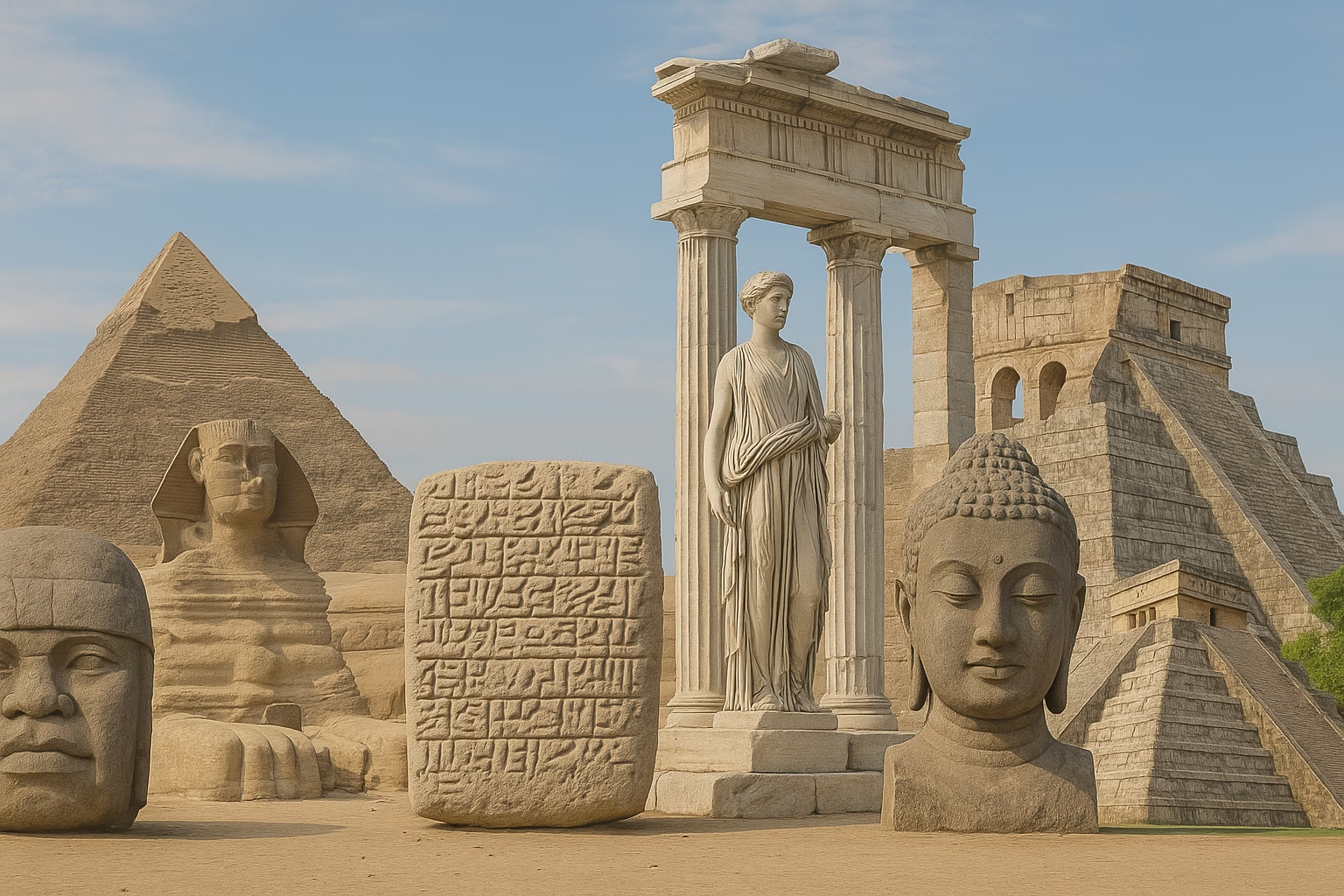
Ancient history marks the moment when humanity began to record its own story — not only through artifacts and ruins, but through written words. It begins with the invention of writing and extends roughly to the collapse of the Western Roman Empire in A.D. 476.
However, this timeline is not universal. In Mesopotamia and Egypt, “ancient” began much earlier than in Europe, while in other regions — from China to Mesoamerica — different forms of early literacy defined their own historical beginnings.
Where It All Began
Writing first appeared in Mesopotamia around the late 4th millennium B.C., among the Sumerian city-states. Initially developed for counting and trade, cuneiform signs soon evolved into the earliest instruments of historical recordkeeping.
Around the same time, other civilizations — Egypt with its hieroglyphs, India with early Brahmi scripts, and China with logograms — also created independent writing systems.
This was the moment when prehistory, a world without words, gave way to the first age of self-awareness in human culture.
The Broad Timeline of Ancient History
Scholars generally divide ancient history into three overlapping phases:
- Early Antiquity (ca. 3500–1200 B.C.) – Sumer, Akkad, Egypt’s Old Kingdom, the Hittites, and the Minoans.
- Classical Antiquity (ca. 1200 B.C.–A.D. 476) – Greece, Persia, the Hellenistic kingdoms, and the Roman Empire.
- Late Antiquity (3rd–7th centuries A.D.) – The decline of Rome, the rise of Byzantium, and the birth of Christianity and early Islam.
Yet this chronology is not limited to the Mediterranean world. While Greece and Rome dominated the western narrative, India’s Maurya and Gupta Empires, China’s Zhou and Han Dynasties, and the Chavín and Moche cultures of the Andes were flourishing within their own “ancient histories.”
Why Ancient History Matters
This era saw the rise of urban life, law, science, philosophy, and organized religion. The first city plans, astronomical records, and codified legal systems appeared.
Texts such as the Code of Hammurabi, Egyptian pyramid texts, Homer’s epics, and Chinese bamboo annals are not merely chronicles of events — they are reflections of how early humans understood themselves and the world.
Modern scholarship treats ancient history as a synthesis of textual evidence and archaeology. Neither alone is sufficient; written sources gain credibility only when supported by stratigraphy, artifacts, and environmental data.
What Ancient History Is Not
- It is not limited to Greece and Rome. That narrow view stems from 19th-century Eurocentrism.
- It is not prehistory. Prehistory belongs to the time before writing; ancient history begins when words are inscribed.
- It did not abruptly end in 476. The fall of Rome marked a transformation, not a disappearance. Ancient ideas persisted in Byzantine, Persian, and early Islamic civilizations.
Why 476 A.D. Became the Symbolic Endpoint
In that year, the Germanic general Odoacer deposed the last Western Roman emperor, Romulus Augustulus. Historians adopted this date as a convenient marker for the end of the classical world.
Yet the Eastern Roman Empire — Byzantium — continued for nearly a thousand years. Thus, 476 represents a symbolic transition, not the extinction of antiquity.
A Global Heritage
Today, ancient history is studied as a global phenomenon. It encompasses Mesopotamia, Egypt, Anatolia, Iran, the Mediterranean, Africa, South and East Asia, and the Americas.
Across these regions, early societies shared common pursuits: measuring time, recording knowledge, worshipping gods, and organizing power. The diversity of their expressions defines the richness of the ancient world.
In Essence
Ancient history is humanity’s first conscious archive. It marks the birth of written memory — when the human voice, once confined to myth and song, began to live on in ink and clay.
From cuneiform tablets to Roman chronicles, this era represents the foundation upon which every later civilization built its sense of identity and time.