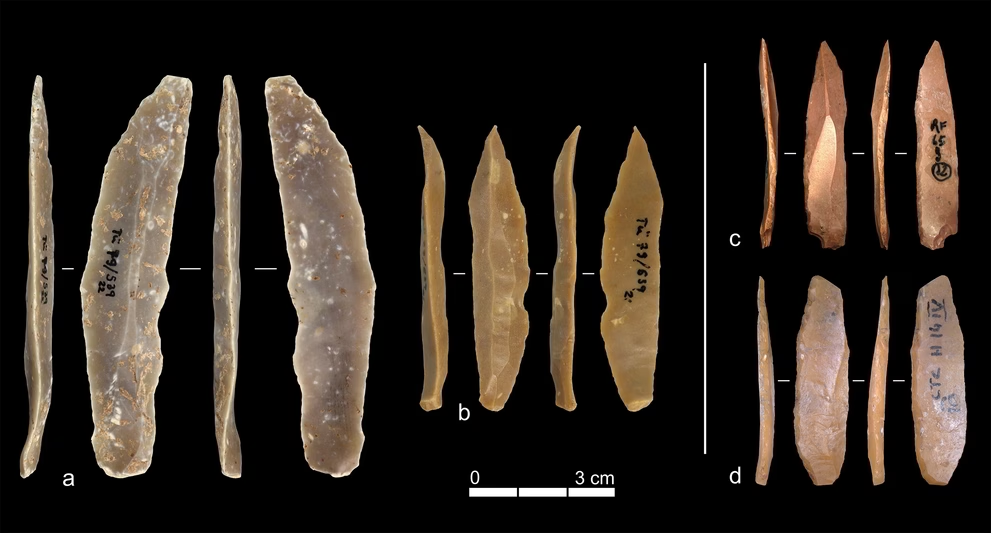
A groundbreaking study has revealed that Europe’s earliest modern humans developed their own stone tool technologies 42,000 years ago — independently of the Near East.
Researchers from the University of Tübingen and the University of Arizona argue that these early toolmakers were innovators, not imitators, challenging the long-held view that technological advances in Europe were imported from the Levant.
Published in the Journal of Human Evolution, the study redefines one of prehistory’s most critical transitions — the rise of the Proto-Aurignacian culture, often seen as the dawn of modern human behavior in Europe.
Independent Paths of Innovation
For decades, archaeologists assumed that the Proto-Aurignacian tradition in Europe was derived from the Ahmarian culture of the Near East. Both produced narrow blades and bladelets, leading many to believe they shared a common origin.
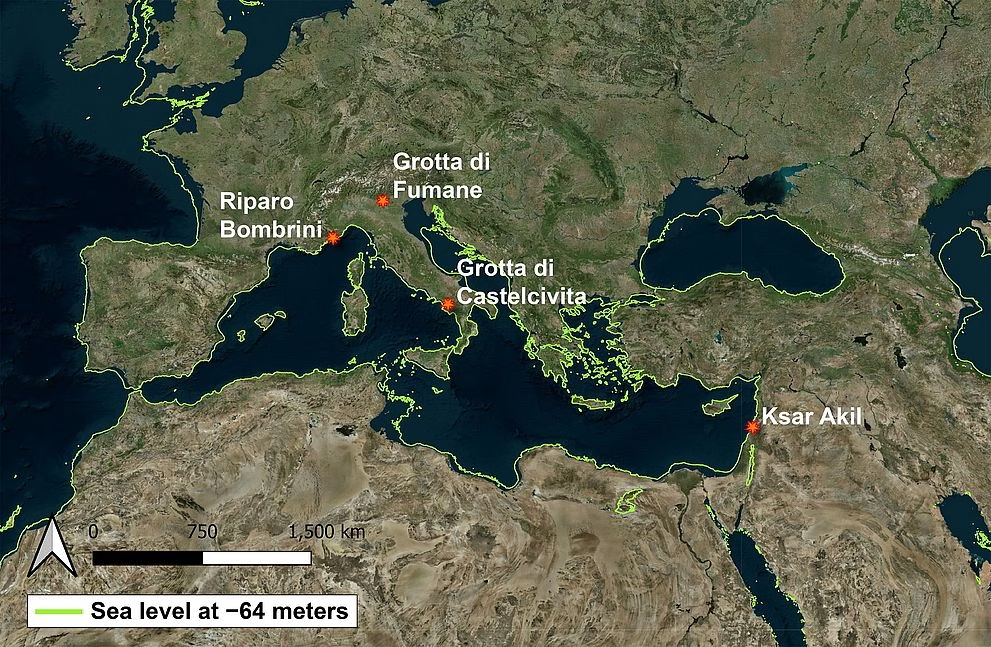
But Dr. Armando Falcucci (Tübingen) and Prof. Steven L. Kuhn (Arizona) tested this assumption with the first quantitative comparison of its kind. They analyzed thousands of stone artifacts from Italy and Lebanon — including material from Grotta di Fumane, Riparo Bombrini, Grotta di Castelcivita, and Ksar Akil near Beirut.
Using multivariate statistics, they reconstructed every stage of the manufacturing process: how stone cores were shaped, flakes removed, and blades retouched.
The results were clear.
“Superficially, the tools look similar,” said Kuhn. “But the technological logic behind them is entirely different.”
Two Cultures, Two Logics
While Ahmarian toolmakers in the Levant produced large blades through bidirectional reduction, their European counterparts favored unidirectional production of smaller bladelets — components of complex projectile systems for precision hunting.
Both groups miniaturized their tools over time, yet they did so along separate technological trajectories.
“The data show that European foragers developed their own projectile technologies rather than adopting them from Near Eastern migrants,” said Falcucci.
This finding undermines long-standing “diffusionist” models that portray Europe as merely the endpoint of innovations spreading westward from Africa and the Near East. Instead, it suggests a multi-centered evolution of technology and culture during the Upper Paleolithic.
A More Complex Prehistoric Map
The Proto-Aurignacian period — around 42,000 years ago — marks the beginning of Europe’s modern human culture. Until recently, scholars assumed this transformation came through migration.
Yet, fossil and genetic discoveries now show that Homo sapiens were already dispersed across Eurasia by at least 60,000 years ago, interacting with Neanderthals and Denisovans. In this context, technological similarities between regions likely reflect parallel innovation, not simple inheritance.
“Our results reinforce the idea that cultural change cannot be reduced to migration alone,” said Falcucci. “Innovation and adaptation within local populations were equally powerful engines of progress.”
Falcucci, A., & Kuhn, S. L. (2025). Ex Oriente Lux? A quantitative comparison between northern Ahmarian and Protoaurignacian. Journal of Human Evolution. Advance online publication. https://doi.org/10.1016/j.jhevol.2025.103744
Cover Image Credit: Examples of stone artifacts from the Ahmarian levels at Ksar Akil (a, b) and the Proto-Aurignacian layers at Grotta di Fumane (c) and Grotta di Castelcivita (d). Although the finished tools appear similar, Falcucci and Kuhn found that the technological methods used to produce them were markedly different. Panels a and b are from the lithic collection of the University of Tübingen; panel c is adapted from Falcucci et al. (2022), and panel d from Falcucci et al. (2024).