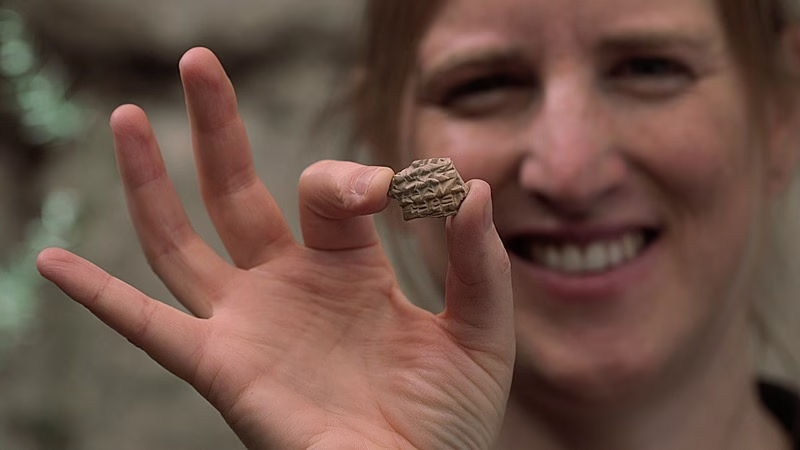
Archaeologists in Jerusalem have made a discovery that could reshape our understanding of the city’s ancient political landscape: a 2,700-year-old pottery fragment bearing an Assyrian inscription — the first of its kind ever found in Jerusalem.
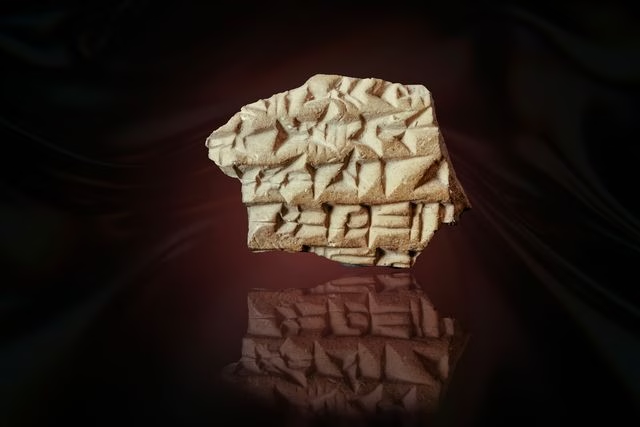
Written in Akkadian cuneiform, the text appears to record a royal communication between the Assyrian Empire and the Kingdom of Judah, shedding new light on the complex diplomacy of the First Temple period.
A Tiny Fragment With a Monumental Message
The artifact, unearthed near the Western Wall by a team from the Israel Antiquities Authority (IAA) and the City of David Foundation, measures barely 2.5 centimeters across. Despite its size, researchers say it once sealed an official message or shipment sent from Assyria to Jerusalem sometime in the late 8th or early 7th century BCE.
During soil sifting operations led by Dr. Ayala Silberstein of the IAA, field archaeologist Moria Cohen spotted what first appeared to be a decorative mark:
“I thought it was just a pattern,” she said. “Then I realized it was cuneiform — and I screamed. It’s overwhelming to hold something no one has touched for nearly three millennia.”
Deciphering a Royal Seal
Assyriologists Dr. Philip Vukosavović, Dr. Peter Zilberg and Dr. Anat Cohen-Weinberger identified the fragment as part of a royal bulla — a clay seal used to secure correspondence. The surviving lines mention a “chariot officer” and reference the first day of the month of Av as a deadline for payment or tribute, implying a message of political or administrative urgency.
“The inscription likely documents an issue of delayed tribute,” explained the team. “It may date to the reign of King Sennacherib, when Jerusalem’s ruler Hezekiah briefly rebelled against Assyrian control — an event described in II Kings 18:7.”
Made in Assyria, Sent to Jerusalem
Laboratory analysis confirmed that the clay was not local. According to Dr. Cohen-Weinberger, petrographic and chemical tests revealed minerals originating in the Tigris basin, home to the Assyrian capitals of Nineveh, Ashur, and Nimrud.
“This was manufactured in Assyria and sent to Jerusalem,” she said. “It’s the first tangible proof of administrative contact between the two kingdoms.”
Rewriting Jerusalem’s Political Role
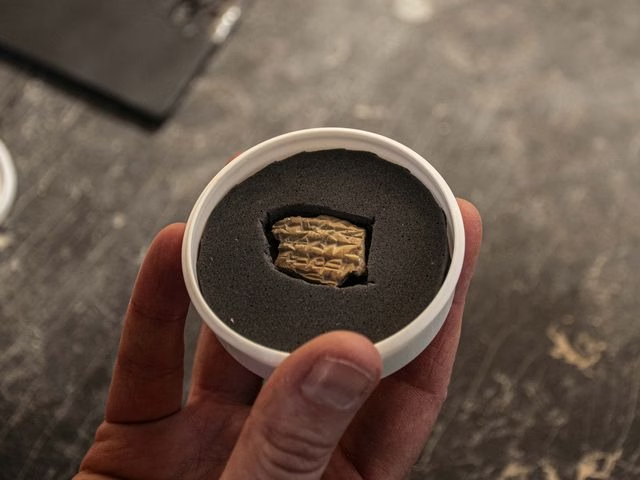
The bulla was found in sediment washed into a Second Temple-period drainage channel, likely collapsed from an older First Temple structure on the slope facing the Temple Mount — one of the closest excavation points ever explored near the sacred precinct.
For historians, the implications are profound. Jerusalem, often seen as a provincial hill town, now emerges as an active participant in the geopolitical web of the ancient Near East. The find confirms that Judah was engaged in direct correspondence with the imperial center of Assyria.
“This tiny piece of clay carries the weight of empire,” said Dr. Silberstein. “It reminds us that history can hinge on fragments — and that diplomacy, even in antiquity, was written in clay.”
Public Presentation
The Israel Antiquities Authority will unveil the artifact during a special conference in Jerusalem, also streamed live worldwide, offering the public a first look at this remarkable link between the kings of Assyria and Judah.