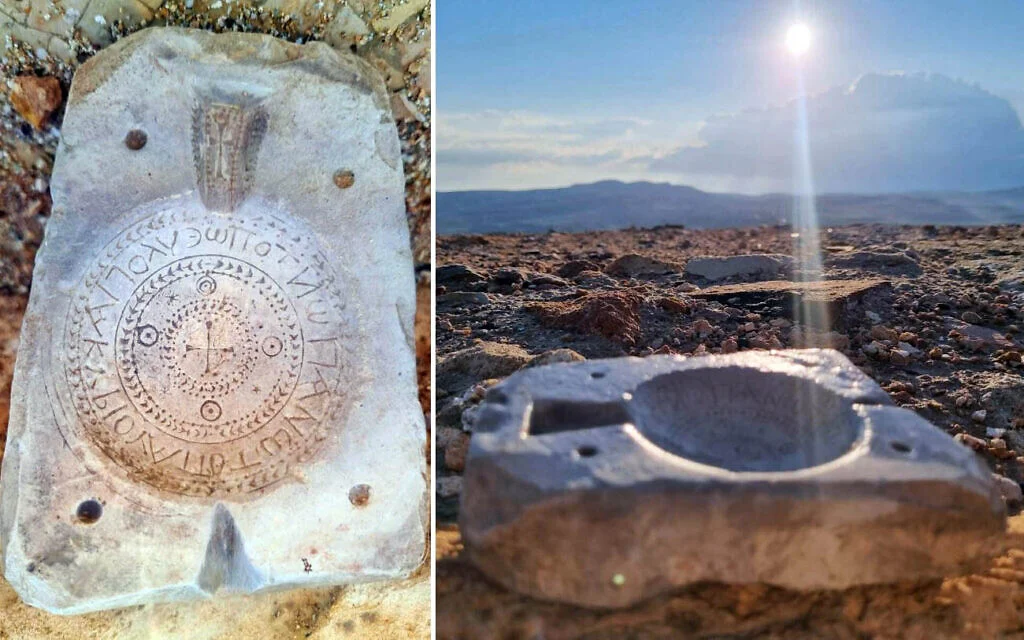
Archaeologists working at Hyrcania, a remote hilltop complex in the Judean Desert, have uncovered a rare limestone mold that once produced small pilgrimage flasks more than 1,400 years ago. The discovery offers unusually direct evidence for how Christian pilgrimage functioned not only as a spiritual journey, but also as a localized craft economy during Late Antiquity.
The find was made by a team from the Hebrew University of Jerusalem and first brought to wider attention through reporting by The Times of Israel. At its core, the artifact is modest in size. In its implications, it is anything but.
A mold designed for portable blessings
The object consists of a two-part limestone mold used to cast small vessels known as ampullae. These flasks, widely associated with Christian pilgrimage, were designed to hold oil, water, or soil taken from holy places. The Hyrcania mold is decorated with a finely carved cross and bears a Greek inscription translated as “Lord’s blessing from the holy places,” leaving little doubt about its devotional purpose.
Dating to the 6th–7th centuries CE, the mold belongs to a period when pilgrimage to the Holy Land reached an unprecedented scale within the Byzantine Empire. Rather than being imported, the object demonstrates that such souvenirs were produced locally, likely near the very monasteries pilgrims visited.
From fortress to monastery
Hyrcania itself has a layered history. Originally founded as a fortified site during the Hasmonean period and later rebuilt under Herod the Great, it was abandoned before being repurposed in the 5th century CE as a Christian monastery. Historical sources link this monastic revival to Saint Sabas, one of the most influential figures of desert monasticism.
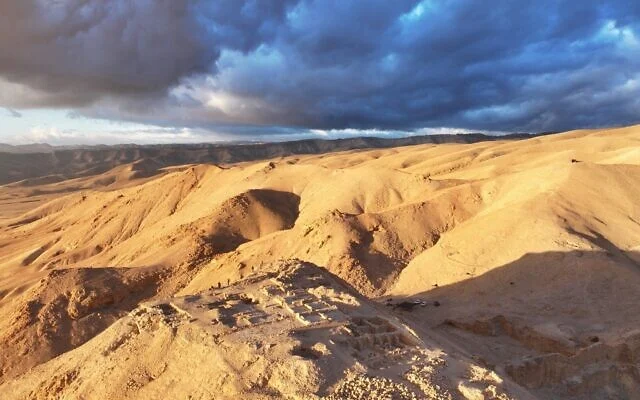
Its location, east of Jerusalem and overlooking steep ravines, reflects a deliberate balance between isolation and access. The Judean Desert offered spiritual seclusion, yet monasteries like Hyrcania remained connected to pilgrimage routes linking Jerusalem, Bethlehem, and major desert foundations such as Mar Saba.
Pilgrimage as economy, not only devotion
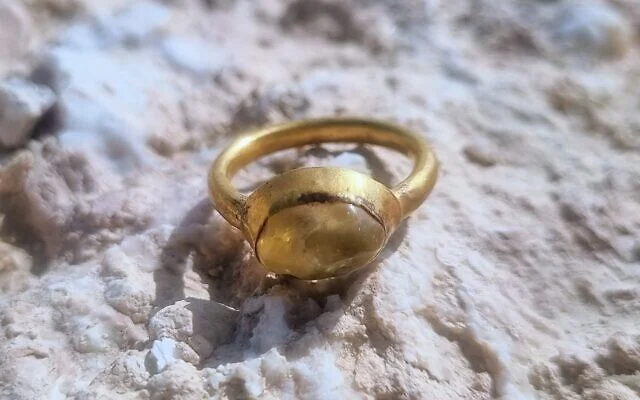
The mold was uncovered alongside gold coins, a gold ring, inscription fragments, and the lid of a stone reliquary. Together, these finds allow archaeologists to reconstruct aspects of daily life within the monastery and the steady presence of visitors passing through.
According to excavation directors Dr. Oren Gutfeld and Michal Haber, the mold represents clear evidence of a “flourishing Christian pilgrimage industry.” Pilgrims did not simply pass through desert monasteries; they interacted economically with them. Food, lodging, manuscripts, and devotional objects formed part of a wider system in which faith and commerce were tightly interwoven.
The ampullae produced here were not casual keepsakes. Once filled and sealed, they became portable tokens of sanctity, carried back to distant regions of the Mediterranean. Archaeological parallels found as far away as northern Italy help explain how artistic motifs and inscriptions linked to the Holy Land circulated so widely.
A desert network with global reach
The Judean Desert may appear austere, but during the Byzantine period it was densely embedded in regional and transregional networks. Its monasteries functioned as spiritual landmarks, economic hubs, and points of cultural transmission. Objects like the Hyrcania mold make these connections visible in a way that texts alone rarely do.
They also help explain why identical or closely related pilgrimage flasks appear across Europe and the Near East. Each object traces a journey outward from the desert, mapping the movement of belief through material culture.
Rescue archaeology and a fragile site
Current excavations at Hyrcania form part of a broader salvage initiative aimed at documenting and protecting the site after decades of looting and erosion. Conducted in cooperation with Israel’s Civil Administration Archaeology Unit, the project combines emergency intervention with long-term research.
While conservation and analysis are still ongoing, the early results underscore Hyrcania’s importance not only for Byzantine monastic history, but also for understanding how sacred landscapes sustained everyday economies.
In a region where cliffs, caves, and ancient paths still define the terrain, the limestone mold adds a human dimension to the story. It captures a moment when faith, craftsmanship, and travel converged, turning the Judean Desert into one of the most influential pilgrimage zones of Late Antiquity.
This report is based on research findings presented by the Hebrew University of Jerusalem and coverage originally reported by The Times of Israel.
Credit: Michal Haber / Institute of Archaeology, Hebrew University of Jerusalem