
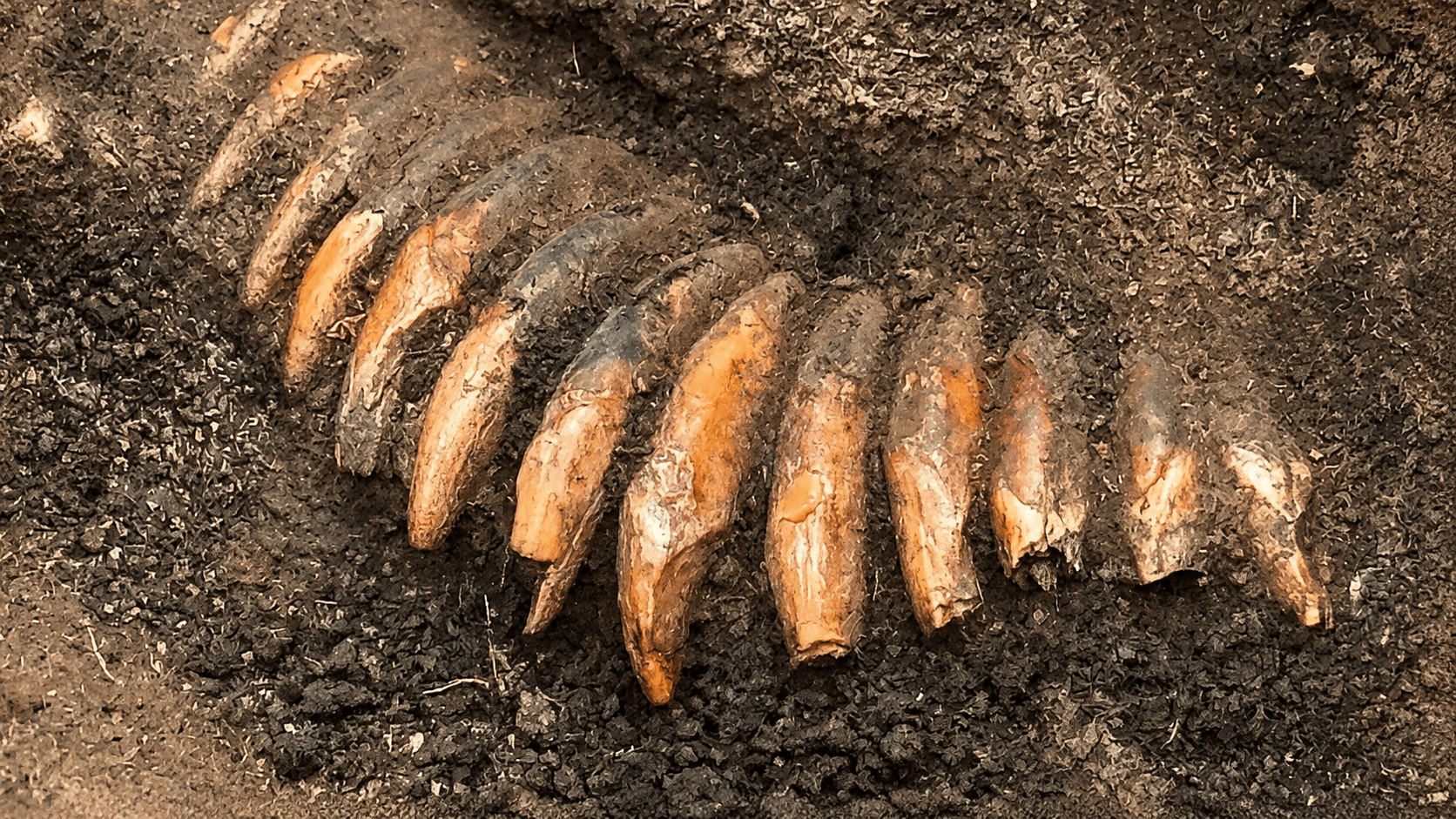
Archaeologists preparing to close an excavation near Wrocław, Poland, noticed a circular mark in the soil that did not belong to the 1,600-year-old cemetery they had been investigating. At its center, they uncovered 42 carefully arranged teeth, each drilled through the root to form a necklace approximately 5,000 years ago.
Beneath the necklace, the excavation revealed a far more complex burial: the nearly complete skeleton of an adult man, fragments of two additional human skulls, amber and bone beads, flint tools and a chipped stone battle axe.
Researchers believe the four-meter-wide structure near the village of Żórawina may be among the first burial mounds of its period identified around Wrocław. Its contents could also provide new evidence about communities associated with the Corded Ware cultural horizon in Lower Silesia.
A burial mound hidden beneath a later cemetery
The site near Żórawina had long been known as a cemetery dating to the end of the Roman influence period and the beginning of the Migration Period, around the fourth and early fifth centuries AD. Excavations are directed by Professor Tomasz Gralak of the Institute of Archaeology at the University of Wrocław, with researchers, students and volunteers participating in the work.
The prehistoric burial was discovered just as the team began clearing the site at the end of the season. According to Wroclaw Medical University, anthropologist and anatomist Dr. Paweł Dąbrowski said the excavators noticed a circular outline measuring approximately four meters across and began investigating it.
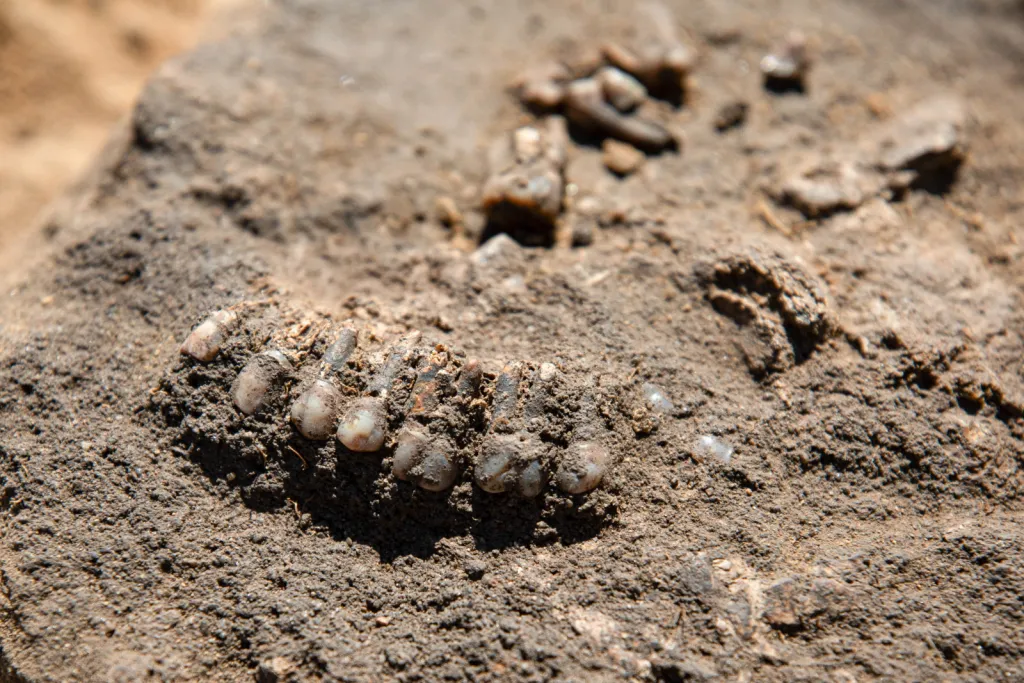
The central chamber first exposed a carefully ordered group of well-preserved teeth. Closer inspection showed that holes had been bored through every root. Although the cord that once held them together had disappeared, their position indicated that they had formed a substantial necklace.
Most appear to be incisors and canine teeth from large mammals. Based on their visible characteristics, Dąbrowski suspects that they came from animals including canids, possibly wolves, as well as bears and hoofed mammals. The possibility that some are human teeth has not been ruled out, but DNA analysis will be required to identify their origins securely.
A man and two additional skulls lay below
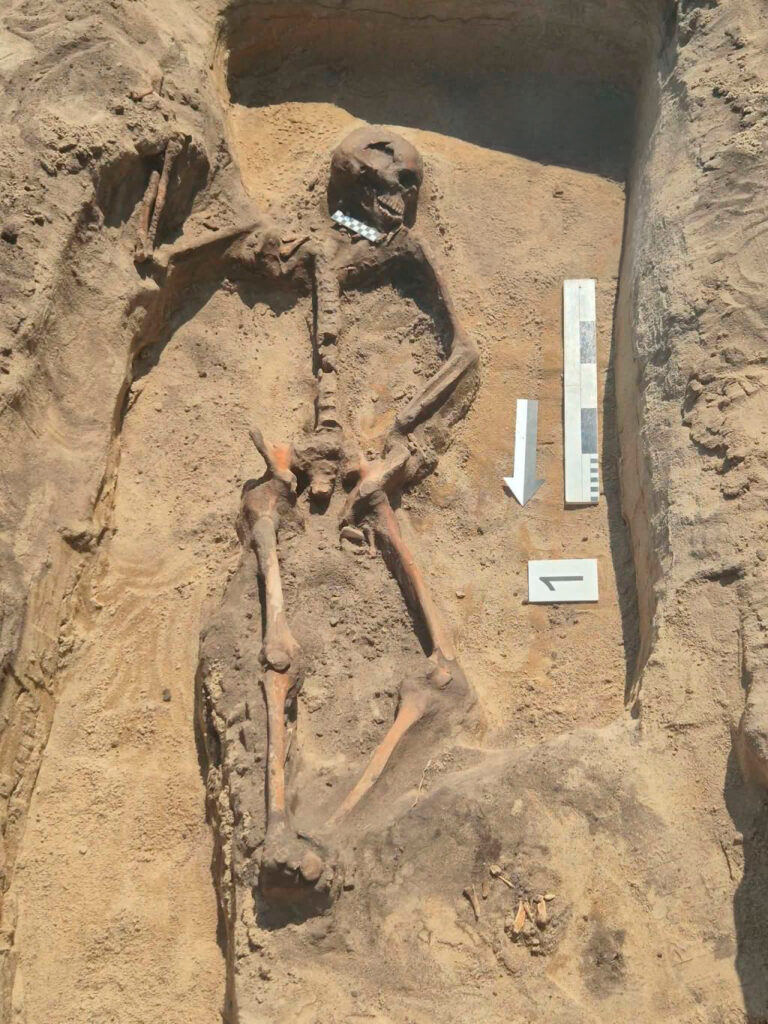
In the next layer of the central chamber, archaeologists encountered the nearly complete skeleton of an adult man, who may have been the person for whom the necklace was made or deposited.
The grave also contained bone discs, amber beads, a small flint projectile point and an object interpreted as a flint knife. A large stone axe made from serpentinite lay beside the man, while fragments of two other adult human skulls were found close to the necklace.
The burial goods suggest that the man may have held a prominent position within his community. Researchers have cautiously proposed that he could have been a hunter, warrior, family leader or clan patriarch, although none of these interpretations has yet been confirmed.
The additional skulls present another unresolved question. They may have been deposited as offerings, but researchers do not yet know whether the heads were deliberately removed or whether the remains reached the grave through a different funerary practice. Anthropological examination will search for cut marks and other possible evidence of intentional decapitation.
A used battle axe points to around 2900 BC
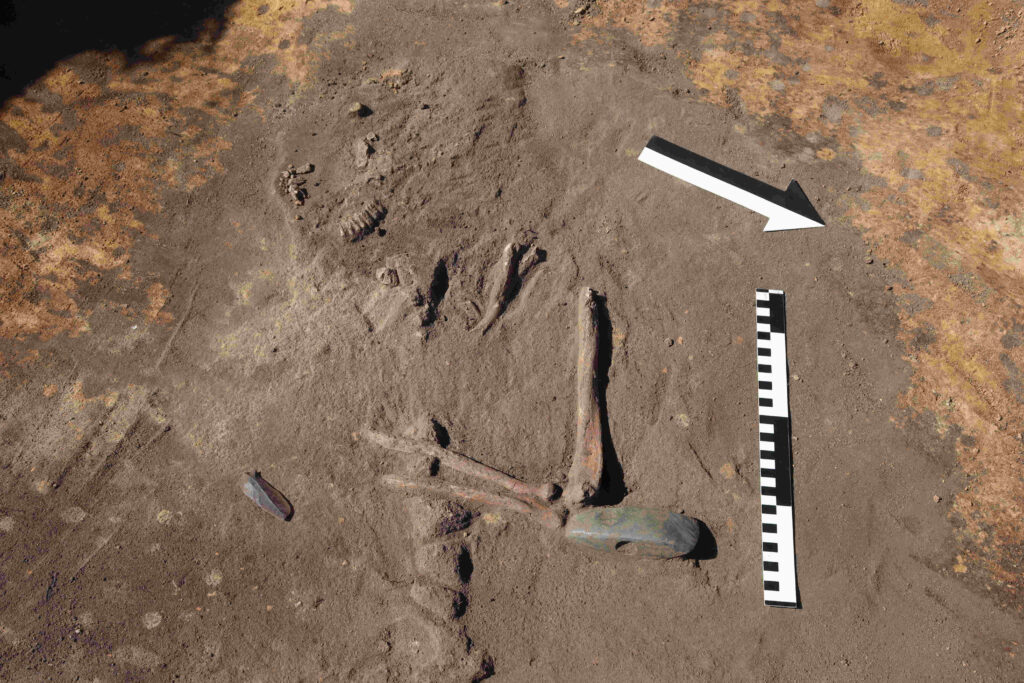
The strongest indication of the burial’s age currently comes from the serpentinite axe. Its form suggests a date around 2900 BC, placing the grave near the beginning of the third millennium BC and within the period associated with the emergence of Corded Ware communities.
The axe had already been used before it entered the grave. Its edge is slightly chipped and bears evidence of use, leading researchers to think that it may have served in combat or hunting before being placed beside the dead man.
The dating remains preliminary. Samples from each set of human remains will undergo radiocarbon analysis to determine whether the man and the two skulls belong to the same period. The results should establish whether the assemblage represents a single burial event or a more complicated sequence of funerary activity.
The mound is several thousand years older than the surrounding cemetery that brought archaeologists to the site. Rather than belonging to the late antique landscape under investigation, it preserves evidence of a much earlier community occupying the same area.
A second prehistoric mound was found only kilometers away
The Żórawina grave was not the only prehistoric burial recently uncovered near Wrocław. Just a few kilometers away at Iwiny, a team conducting rescue excavations discovered a comparable mound containing a skeleton, two axes, flint objects and amber ornaments. Another mound found there reportedly held calf bones, possibly deposited as an animal offering.
Researchers plan to examine material from Żórawina and Iwiny together. The proximity and broadly similar age of the discoveries raise the possibility that they belonged to a wider funerary landscape rather than representing isolated graves.
Both sites may preserve evidence of communities connected with the Corded Ware phenomenon, which spread across large parts of Europe during the third millennium BC. This movement formed part of a broader period of population mobility also reflected in roughly contemporary Yamnaya burials found farther southeast in Europe. Researchers have suggested that the people buried near Wrocław could have belonged to groups moving westward over several generations, but grave goods alone cannot establish their geographical origins.
Strontium isotope measurements taken from the human and animal teeth could show whether the individuals buried at Żórawina grew up locally or arrived from another region. DNA analysis will examine possible biological relationships among the dead and identify the species represented in the necklace, including whether any of its 42 components are human.
Radiocarbon dating will first establish whether the man and the two additional skulls were placed in the mound during the same period. Combined with evidence from the nearby Iwiny burials, the results could show whether these graves represent an isolated episode or the first trace of a previously unrecognized Corded Ware funerary landscape near Wrocław.