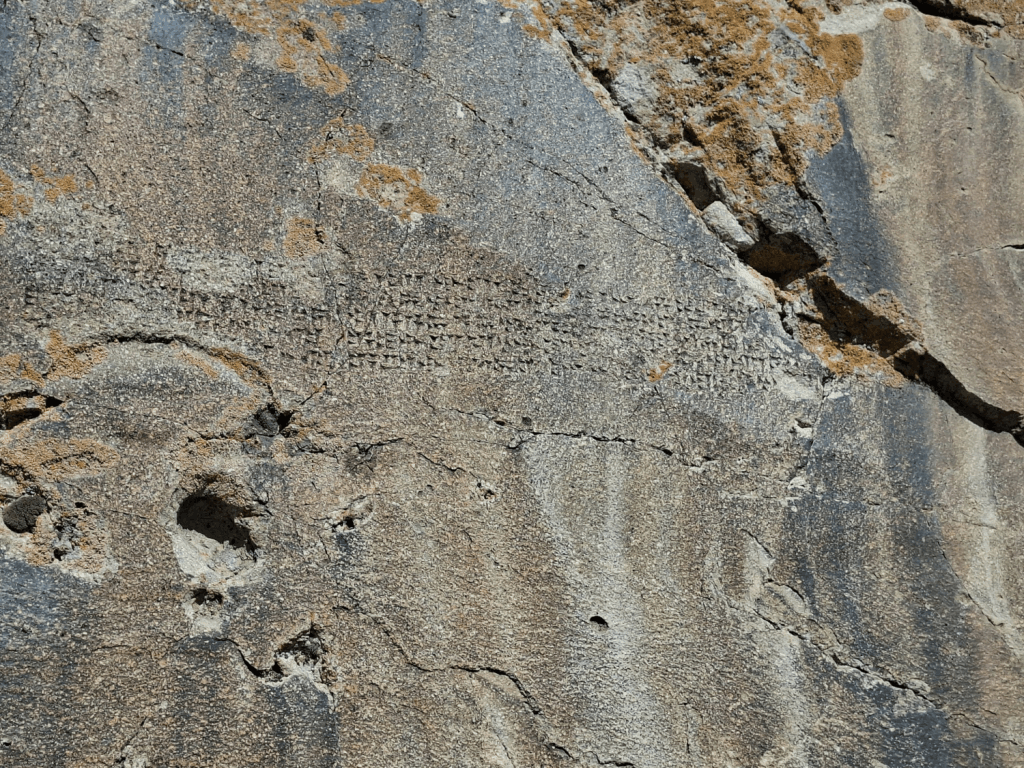
A 2,800-year-old Urartian royal inscription that had eluded researchers for decades has been relocated on a rock face in Azerbaijan’s Nakhchivan region, restoring one of the South Caucasus’s rare Iron Age cuneiform texts to its original setting.
The inscription, carved in the Ilandagh area, names the Urartian rulers Ishpuini and Menua and refers to conquered lands, ritual offerings, and the god Haldi, the central deity of the Urartian state cult. The Institute of Archaeology and Anthropology of the Azerbaijan National Academy of Sciences describes it as the first known written example linked to Urartian culture found in Azerbaijan.
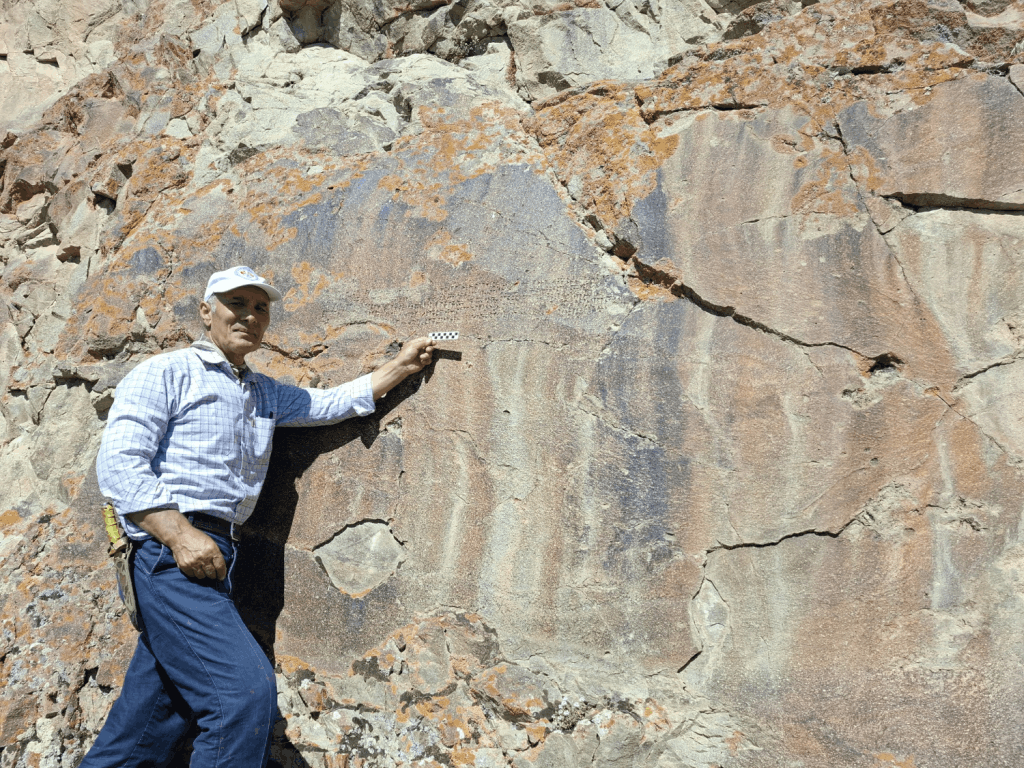
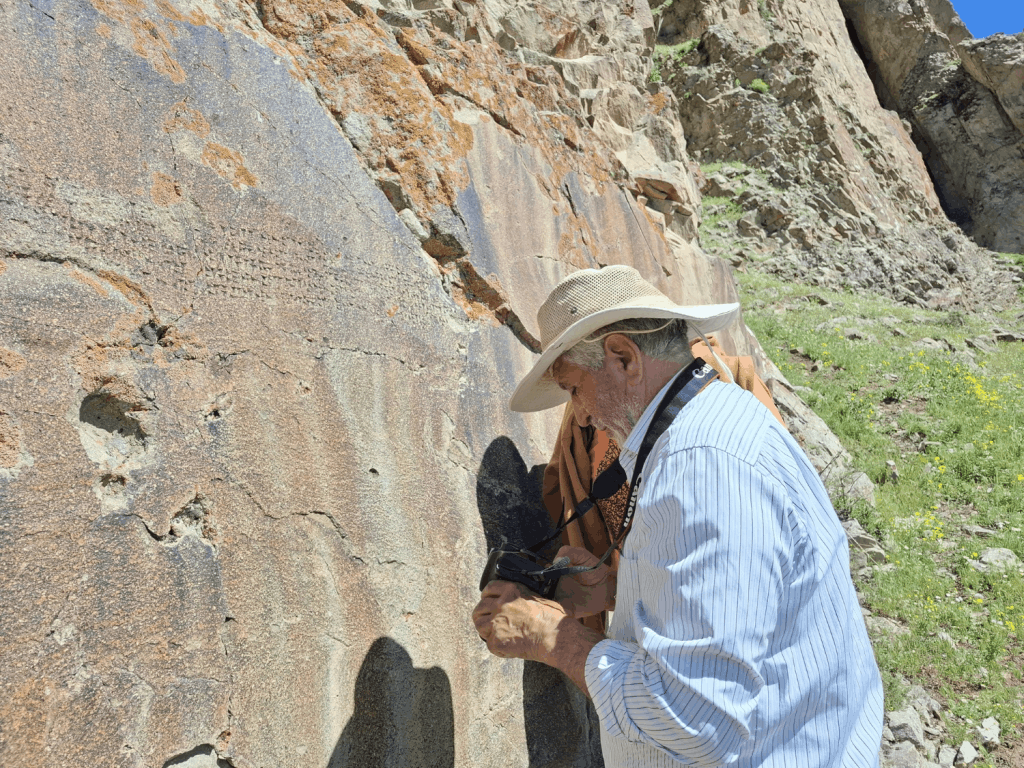
The site was identified by Professor Vali Bakhshaliyev, deputy director for scientific affairs at the Institute of History, Ethnography and Archaeology of the Nakhchivan Branch of ANAS; Associate Professor Bahlul Ibrahimli, head of the Kharaba-Gilan archaeological expedition; and researcher Huseyn Jafarov.
The inscription itself was not unknown. It had been recorded in the late 1980s and later entered academic literature, but its precise location was not clearly indicated. For years, researchers attempted to find the monument again without success. Its relocation now gives scholars the chance to study the text where it was originally carved.
A known text returns to its rock face
The words had been known for years. What was missing was the place itself: the rock, the slope, the route, and the ancient setting in which the message was meant to be seen.
That distinction matters. A copied inscription can preserve names, titles, and events. But when the original location is found, the text can be read together with the surrounding terrain and nearby archaeological traces. It may help researchers understand why this particular point in the Ilandagh area was chosen and how it related to routes, borders, or ritual activity in the Iron Age.
The inscription belongs to the world of Urartu, a kingdom centered around Lake Van that became one of the strongest states of the early first millennium BCE. From its core in eastern Anatolia, Urartu extended influence across parts of the South Caucasus and northwestern Iran. Its kings left cuneiform inscriptions on cliffs, fortresses, stelae, and building stones, often presenting military action and construction as acts carried out under divine authority.
The Ilandagh text fits that tradition. It is short, but it speaks with the formal voice of a state that wanted its victories remembered in stone.
Two Urartian kings named in stone
The inscription praises Ishpuini, son of Sarduri I, and Menua, son of Ishpuini. Their names place the text in a crucial phase of Urartian history, when the kingdom was expanding, organizing its institutions, and giving sharper form to its religious identity.
Ishpuini is closely linked with the rise of Haldi as the supreme god of Urartu. Under his rule, the kingdom’s religious language became more defined, and Haldi moved to the center of state ideology. Menua, his son and successor, continued this momentum through military campaigns, fortresses, inscriptions, and major building works.
Their appearance together on a rock in Nakhchivan is significant. It suggests that this region was not merely a distant borderland in the Urartian world. It was a zone where conquest, ritual, and written authority were important enough to be fixed into the mountain itself.
Conquest, ritual and the god Haldi
According to the existing translation, the inscription says that, under the protection of Haldi, Ishpuini and Menua conquered the city of Arshini and its land. It also refers to the land of Aniani, which was taken and destroyed. The text then mentions the erection of a stele for Haldi and a ritual performed in the land of Puluadi, involving offerings to Haldi and to the god’s wife.
This formula is characteristic of Urartian royal inscriptions. Military success is not described as a purely human achievement. It is placed under the authority of the divine.
Haldi stood at the center of this worldview. He was associated with victory, kingship, and the legitimacy of the Urartian state. In many Urartian texts, royal action begins under his protection, as if conquest had to be sanctioned by the god before it could become part of history.
The Ilandagh inscription therefore preserves more than a record of a campaign. It shows how Urartian rulers presented their control over contested regions, combining warfare, religion, and written memory in a single carved text.
A rare witness from ancient Azerbaijan
The secure identification of the Ilandagh inscription may help clarify the ancient history of Nakhchivan and the wider Araxes region during the Iron Age. It gives researchers a firmer starting point for understanding how far Urartian authority, ritual practice, and written culture reached into this part of the South Caucasus.
Now that the monument’s exact location has been identified, it can be examined with modern methods. Detailed photography, 3D documentation, epigraphic study, and renewed field survey could help refine earlier readings and assess the condition of the carved signs.
For decades, the inscription existed mainly as a known but geographically uncertain scholarly reference. Now it has been tied back to its original rock face.
The identification of the Ilandagh site turns the text from an isolated inscription into a monument that can once more be studied in relation to the mountain, the route, and the ancient frontier where it was carved nearly 2,800 years ago.