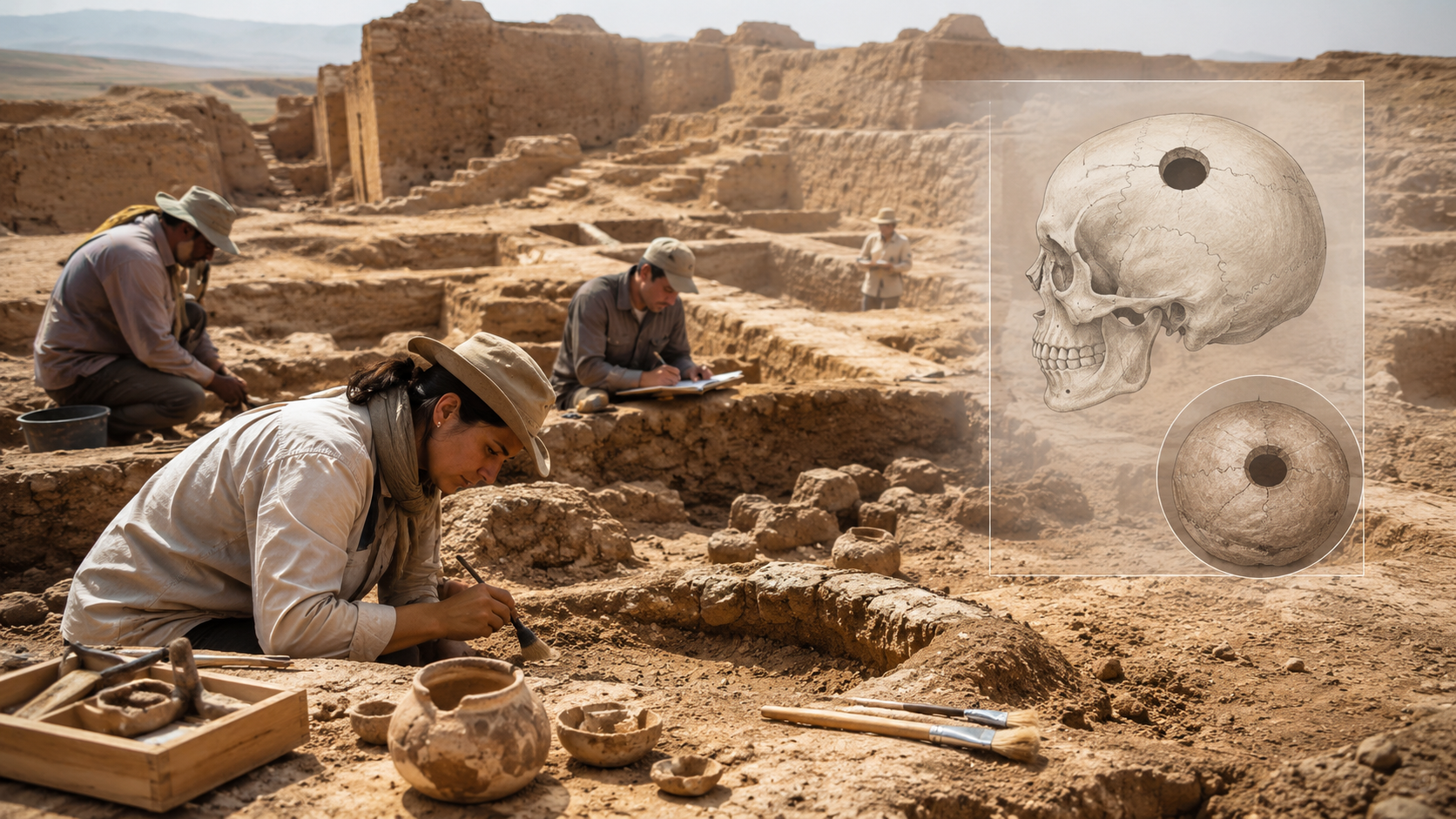
A small grave in southern Uzbekistan has drawn archaeologists into one of the most difficult corners of Bronze Age life: illness, childhood, and the decision to cut into a human skull.
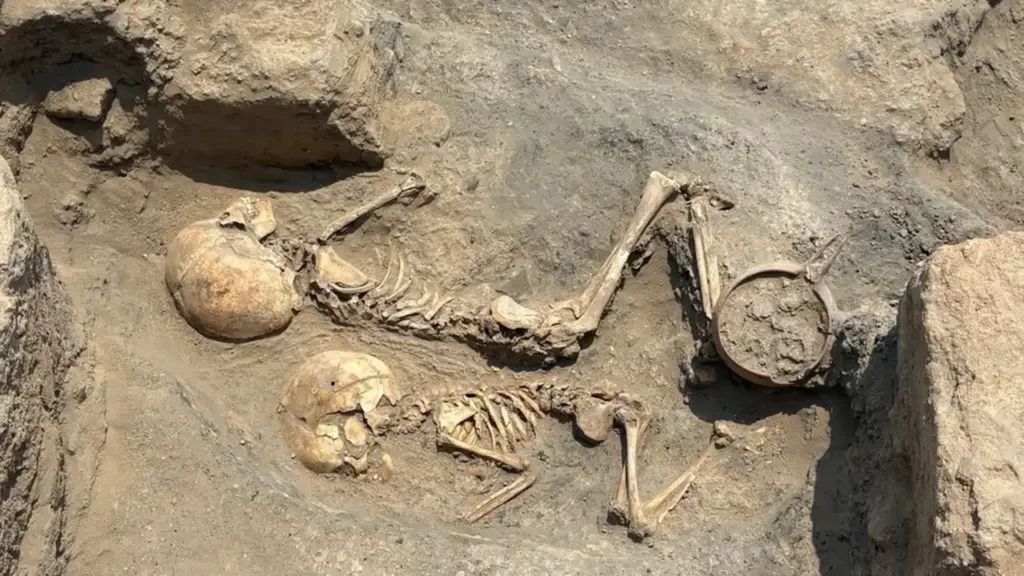
At Djarkutan, a major settlement of the ancient Oxus civilization, researchers uncovered the remains of two children buried side by side. One was about three years old. The other, around five, bore clear evidence of cranial trepanation, a deliberate opening made in the skull nearly 4,000 years ago.
The discovery was made during the April 2026 excavation campaign by a joint mission involving the University of Salento, Termez State University, and the Samarkand Archaeological Institute. According to the research team, the find is currently the oldest documented evidence of surgical intervention in Central Asia and among the earliest known examples of such a procedure in Asia.
A dangerous cut into the skull
Trepanation is one of the oldest surgical practices known from the archaeological record. In prehistoric communities, it usually involved scraping, cutting, or drilling into the cranial bone with stone or bone tools. The procedure was dangerous even under the best conditions. On a child, the risk would have been even greater.
Why it was done remains uncertain. Ancient trepanation has often been linked to attempts to treat head trauma, severe pain, epilepsy, migraines, neurological symptoms, or behavioral conditions. But Djarkutan belonged to a world where healing and ritual may not have been separate categories. A sickness of the body could also be read as a spiritual or social crisis.
That makes this grave difficult to treat as a simple medical case. Someone in Djarkutan looked at a five-year-old child and decided that opening the skull was necessary, or at least meaningful enough to attempt. The act suggests technical knowledge, but also a belief system in which the body could be entered, altered, and perhaps healed.
Djarkutan and the Oxus civilization
Djarkutan was not an isolated village. It was one of the important centers of Northern Bactria, in present-day southern Uzbekistan, close to the modern border with Afghanistan.
During the Bronze Age, the region formed part of the wider Oxus civilization, also known as the Bactria-Margiana Archaeological Complex. This cultural sphere flourished across parts of Central Asia, including present-day Uzbekistan, Turkmenistan, northern Afghanistan, eastern Iran, and neighboring regions.
Its communities developed in oases and river valleys, supported by irrigation, farming, craft production, and exchange networks. Archaeologists have found evidence of planned settlements, substantial architecture, ceramics, workshops, and burial grounds. Djarkutan belonged to this broader world of early urban growth and cultural contact.
The new burial adds a more intimate detail to that picture. It shows that the people of Djarkutan were not only building, trading, and organizing complex settlements. They were also dealing with pain, disease, and death in ways that required skill and authority.
Medicine, ritual, and childhood
The child’s skull raises a sensitive problem for archaeologists. The physical trace is clear: a cranial opening was made deliberately. The meaning behind it is harder to recover.
The operation may have been a practical attempt to treat a medical condition. It may also have been ritual. It may have been both. In many ancient societies, the person who healed the body could also have held religious or symbolic authority. Illness was not always understood as something confined to flesh and bone.
The age of the child makes the find especially rare. Trepanation is known from different regions of the ancient world, but evidence involving such a young individual in Central Asia around this period is unusual. It suggests that the procedure was not reserved only for adult trauma or elite display. In this case, it was applied to a child whose condition must have been serious enough to prompt an extraordinary response.
Whether the child survived the operation is not yet clear. Future anthropological study may reveal whether the bone began to heal after the procedure. If healing is present, it would mean the child lived for some time after the intervention. If not, the operation may have taken place shortly before death, or possibly as part of a final ritual act.
A mission built around more than objects
The Djarkutan project began in 2024 under the joint direction of Professor Enrico Ascalone of the University of Salento and Professor Alisher Shaidullaiev of Termez State University, with the collaboration of the Samarkand Archaeological Institute led by Dr. Komil Rakhimov.
The mission brings together archaeobotany, archaeozoology, physical anthropology, paleogenetics, topography, and archaeometry. The aim is not only to recover graves and artifacts, but to reconstruct how people at Djarkutan lived, what they ate, how they used the landscape, and how they treated the dead.
The wider research also connects Djarkutan with major Bronze Age centers in Iran, including Shahr-i Sokhta and Jiroft. Together, these projects are helping scholars rethink the cultural links between Central Asia and the Iranian plateau before the rise of the later Silk Road.
For now, the skull answers one question clearly: people at Djarkutan were willing to attempt a dangerous cranial operation 4,000 years ago. Everything else remains open. What happened to this child? Who made the cut? What did the community believe it was trying to heal?
Further paleogenetic and anthropological studies may bring those answers closer. Until then, the grave remains one of the most striking traces of Bronze Age medicine yet found in Central Asia.
Cover Image Credit: AI-generated illustration of an archaeological excavation at Djarkutan in Uzbekistan.