
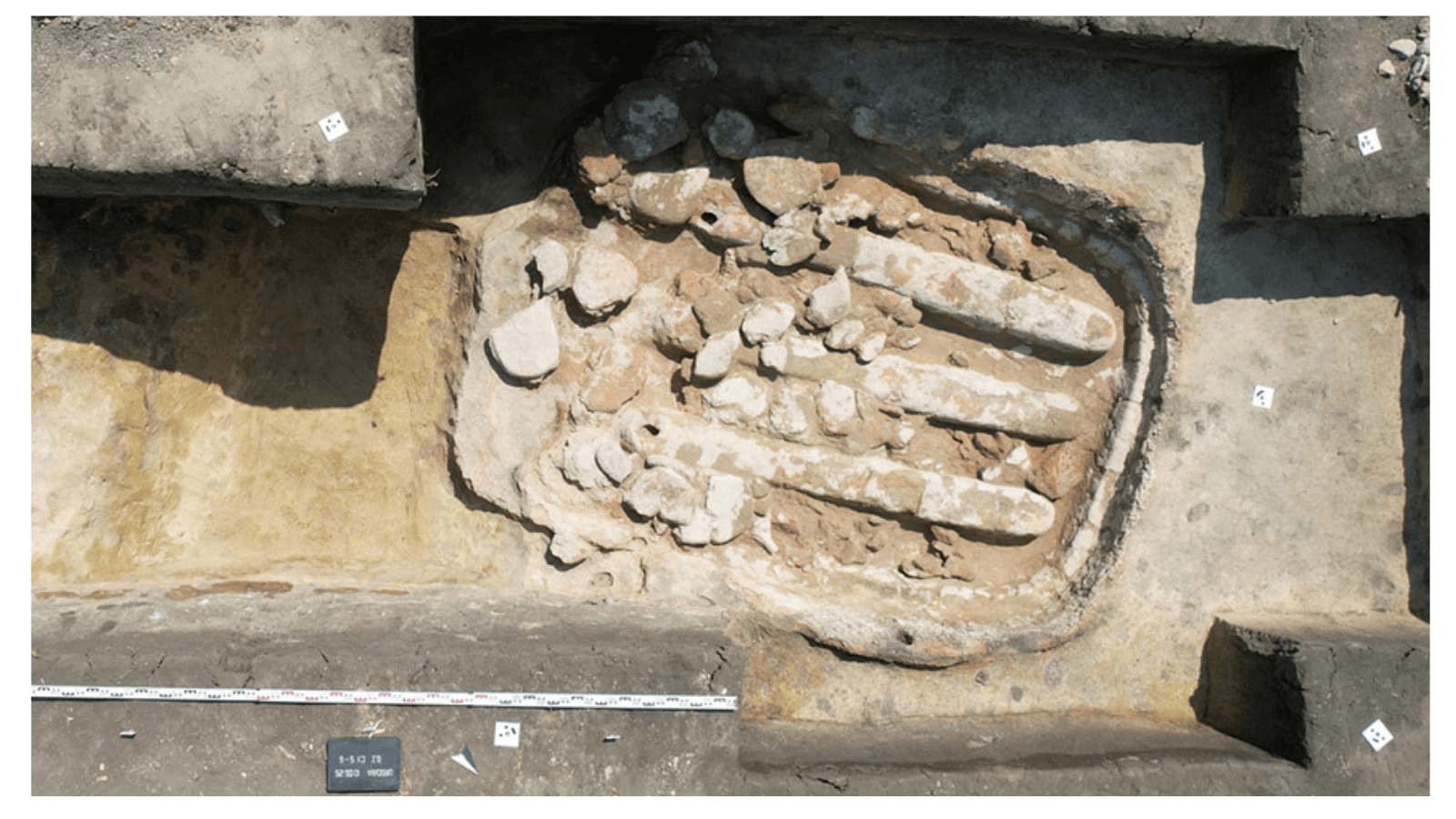
A giant 6,000-year-old pottery kiln unearthed at Ursoaia in north-eastern Romania is revealing just how large and technically sophisticated ceramic production had become in prehistoric Europe. With a working surface of about 7.5 square metres, it is the largest securely documented kiln of its type in the Cucuteni–Trypillia world.
Excavated in 2025, the bicameral structure was built for repeated, high-capacity firing rather than occasional household use. Its scale, carefully controlled airflow system and evidence of repeated maintenance point to a level of production that was beginning to move beyond domestic needs toward more specialised pottery making.
A Kiln Far Beyond the Usual Scale
Most known Cucuteni–Trypillia kilns had firing surfaces of roughly two to four square metres. Even the large example from Stolniceni I measured only about 4.6–4.8 square metres, making Ursoaia’s approximately 7.5-square-metre working surface exceptional within this pottery-making tradition.
The difference remains substantial beyond the Cucuteni–Trypillia region. A dataset covering 238 Early and Middle Chalcolithic kilns from Southwest Asia found average firing-chamber areas of only around 1.5–1.8 square metres, while examples exceeding seven square metres were rare.
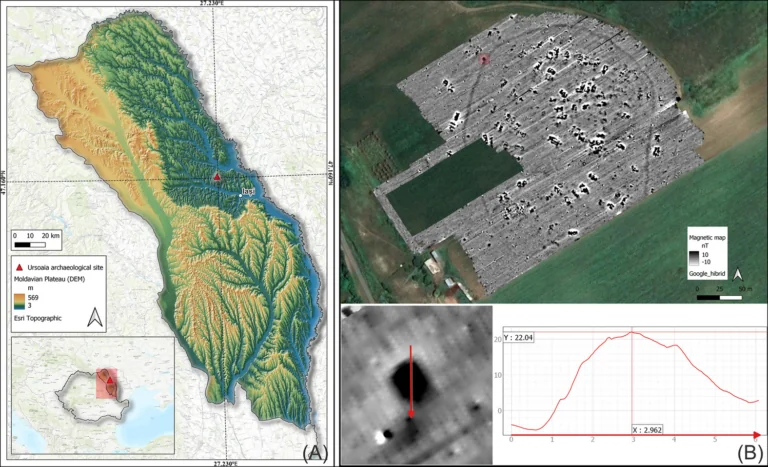
Ursoaia was not simply a settlement with one unusually large installation. A magnetometer survey carried out in 2024 mapped an area of almost eight hectares enclosed by a ditch, with around 60 burnt dwellings, numerous pits and at least eight kilns.
The settlement’s layout and abundant decorated pottery place it within the Cucuteni B1/Trypillia BII–CI phase, around the beginning of the fourth millennium BCE. Radiocarbon evidence supports the same chronological setting.
A Magnetic Anomaly Led Archaeologists to the Structure
The kiln was first detected as a strong magnetic anomaly close to the settlement ditch. Archaeologists opened a targeted trench at the location and exposed a well-preserved bicameral updraught kiln built into the inner slope of the ditch.
Its position offered several practical advantages. The slope provided stability and shelter from wind, while the adjacent ditch gave the potters controlled access to the firing area.
Four radiocarbon dates obtained from animal remains associated with the kiln indicate that it was used from the second half of the 40th century into the 39th century BCE. In broad terms, the installation was operating close to 6,000 years ago.
The lower chamber measured about 3.10 by 2.40 metres. Four long fire channels ran beneath the firing floor, separated by three substantial supports cut directly from natural clay and then shaped and levelled with additional clay.
Above them, potters placed removable slabs measuring roughly 60 by 35 centimetres. These created a permeable platform between the combustion chamber below and the firing chamber above, allowing heat and gases to rise through the structure while supporting the pottery load.
How the 6,000-Year-Old Firing System Worked
The design allowed heat to move through a large enclosed space while limiting thermal stress on the structure. Wide channels guided hot gases beneath the slabs before they rose into the upper chamber, producing the draught needed to maintain combustion and circulate heat around the vessels.
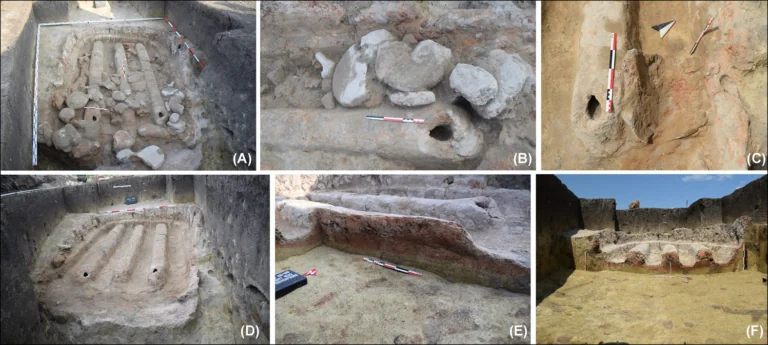
Based on surviving walls and fragments of the collapsed vault, the researchers estimate that the kiln may originally have stood around 2.2–2.5 metres high. The upper firing chamber may have contained approximately 12 cubic metres of space, giving the installation a substantial capacity.
The kiln also preserves evidence of repeated repair. Additional clay had been applied to parts of the floor, walls and supports, while localised thickening shows that damaged areas were reinforced during its working life.
These repairs indicate that the installation remained in use through multiple firing cycles. Its builders were maintaining a substantial piece of production infrastructure rather than using a temporary or experimental firing structure.
Microscopic and chemical analyses provide further evidence for intensive use. The floor slabs appear consistent with repeated exposure to temperatures of around 800–900°C, while parts of the vault and supporting structure may have experienced local peaks of approximately 950–1,100°C.
The authors caution that these figures are estimates rather than exact temperature readings. Raw materials, firing duration and atmospheric conditions can alter how clay responds to heat, but the evidence is consistent with long, controlled firing sequences involving preheating, sustained high temperatures and gradual cooling.
Was Ursoaia Becoming a Pottery Production Centre?
The scale of the kiln raises an important question about how prehistoric pottery production was organised at Ursoaia. A structure of this size required fuel, labour, maintenance and technical knowledge, while the presence of several kilns at the settlement suggests that firing was not limited to occasional domestic activity.
The researchers argue that the Ursoaia kiln points to intensified ceramic production that likely went beyond household needs. Its size and engineering are consistent with an early move toward greater craft specialisation in south-eastern Europe.
They stop short, however, of describing the settlement as a community-level workshop. Further excavation is needed to establish how many kilns operated at the same time, how production was organised and whether pottery made at Ursoaia circulated beyond the settlement.
What is already clear is that the Ursoaia potters were working with an unusually large and technically sophisticated firing installation. The kiln provides rare physical evidence for the point at which pottery production in prehistoric south-eastern Europe was beginning to move beyond the scale of the individual household.
Cover Image: The lower chamber of the 6,000-year-old Ursoaia pottery kiln in north-eastern Romania, with its grate slabs still in place. Credit: Vornicu et al. 2026 / Antiquity
Vornicu, D. M., Tencariu, F.-A., Asăndulesei, A., Drob, A., Pîrnău, R.-G., Ciobanu, M.-C., … Groapă, C. (2026). The Ursoaia Kiln (north-eastern Romania): a benchmark for Chalcolithic specialised pottery production. Antiquity, 1–10. doi:10.15184/aqy.2026.10428