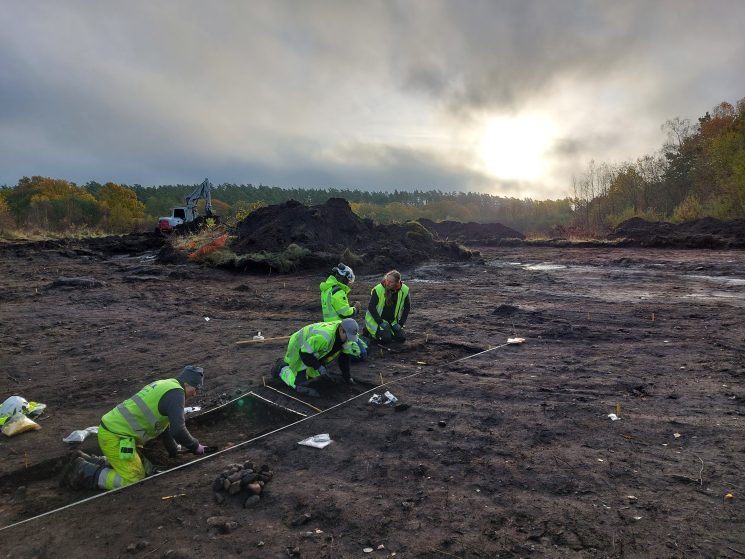
Archaeologists in Bohuslän, western Sweden, have uncovered two prehistoric settlements lying side by side on a grassy field — one dating back to the Stone Age, the other to the transition between the Bronze and Iron Ages. The discovery, announced in October 2025, traces more than 5,000 years of continuous human activity in the same landscape — from flint knapping near an ancient shoreline to farming and cattle keeping in early Iron Age Scandinavia.
Archaeologists in western Sweden are investigating two prehistoric settlements located on a grassy plain dotted with rocky outcrops — one dating back to the Stone Age, the other to the transition between the Late Bronze Age and Early Iron Age. The ongoing excavation, conducted in October 2025, aims to shed light on how people lived, worked, and adapted to changing landscapes over several millennia.
A Stone Age Settlement Near the Ancient Shoreline
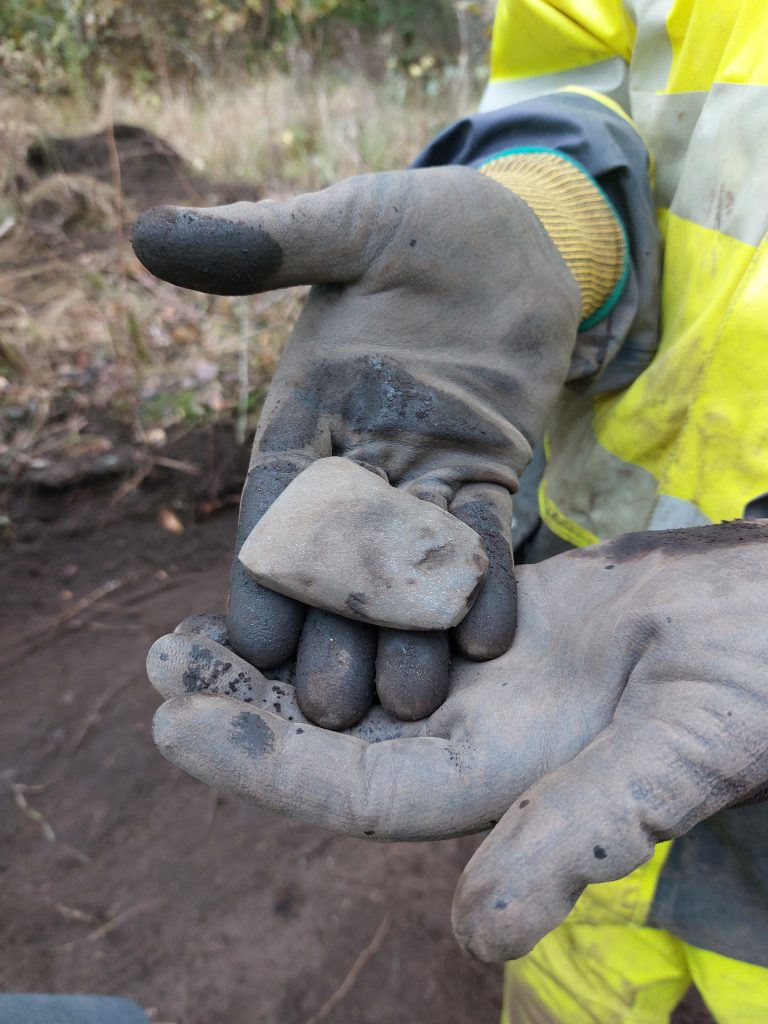
The older site, L2020:11516, stretches around a rocky rise and contains a dark, charcoal-rich cultural layer filled with fire-cracked stones and abundant flint tools. Researchers believe the site was repeatedly inhabited over a long period — either during extended stays or through seasonal visits.
Situated roughly 20 meters above sea level, the site lies near what would have been the ancient shoreline during the Stone Age, as post-glacial shoreline studies indicate. Flint artifacts recovered so far span three major cultural phases in western Sweden: the Sandarna Culture (8,400–6,000 BCE), the Lihult Culture (6,000–4,000 BCE), and the Funnel Beaker Culture (4,000–2,800 BCE). Most finds appear to belong to the transition between the Late Mesolithic and Early Neolithic periods, suggesting a dynamic phase when hunter-gatherer lifeways began merging with early farming.
The excavation will focus on the rich cultural deposit, where archaeologists expect to find flint and stone tools, burnt bones, and fragments of Funnel Beaker pottery. These finds may reveal daily activities carried out at the site — from tool production to food preparation.

A Bronze–Iron Age Farmstead Nearby
Just 50 meters east, another settlement — L2020:11517 — reveals traces from around 500 BCE, marking the transition between the Late Bronze Age and Early Iron Age. Beneath the topsoil, archaeologists have identified hearths, cooking pits, postholes, and other features indicating a longhouse and associated activity areas.
The pattern of postholes suggests multiple building phases — possibly reflecting several generations of structures. Clusters of hearths and refuse pits point to spaces used for cooking, food processing, and waste disposal, hinting at a self-sufficient farmstead whose livelihood likely revolved around cultivation and animal husbandry. Alternatively, the buildings may have served as seasonal or secondary outfield structures connected to larger settlements nearby.
Analyses of charcoal, plant remains, and animal bones will help determine the community’s diet, crop choices, and resource use. Radiocarbon dating and wood identification studies will also refine the chronology and reveal what materials were used for fuel and construction.
Together, these twin sites capture a remarkable continuity of human presence — from Stone Age toolmakers on a coastal plain to Iron Age farmers shaping the same landscape thousands of years later.
Cover Image Credit: Arkeologerna