
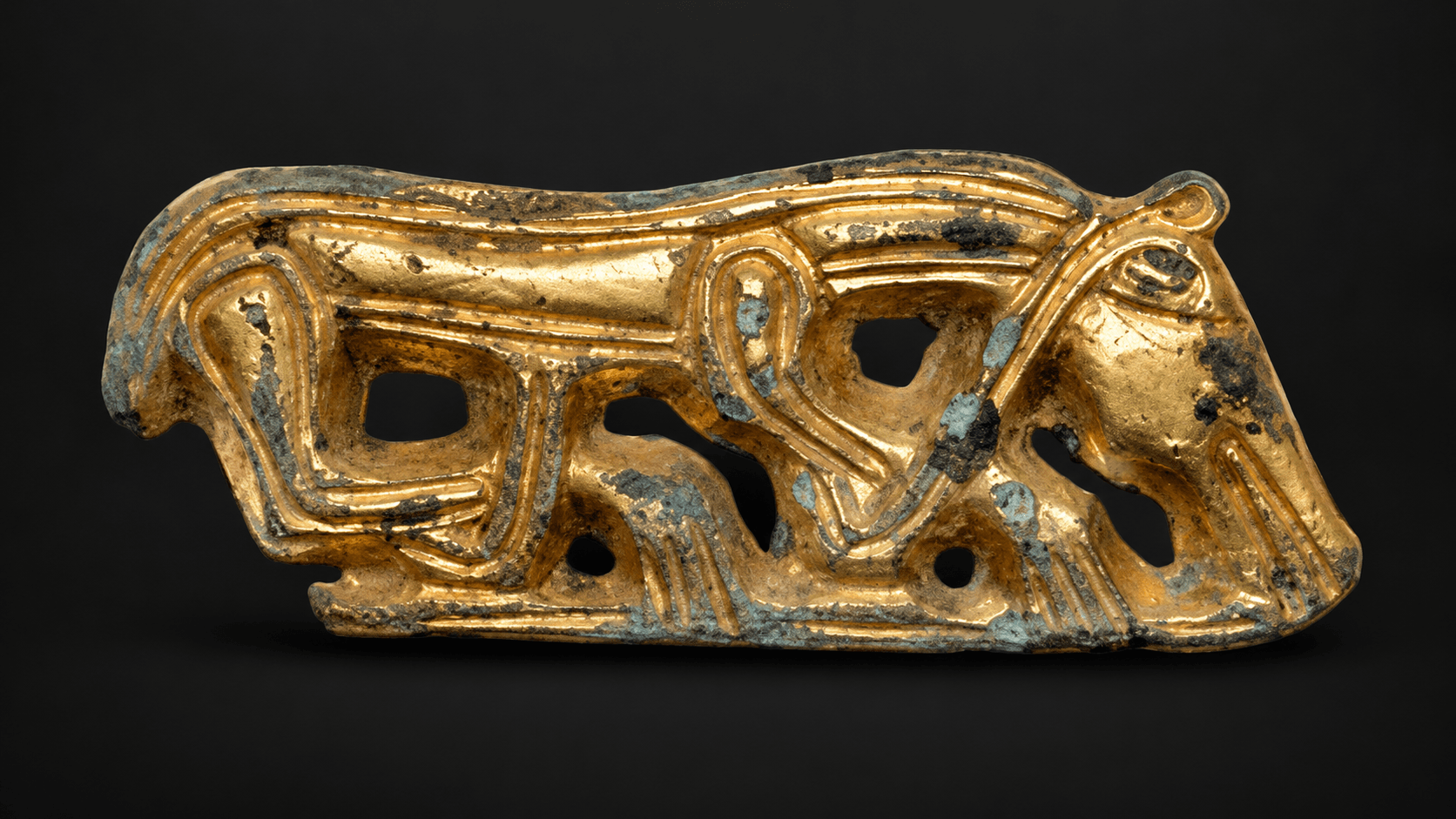
A tiny gilded ornament discovered by a metal detectorist in Norfolk has been recognized as an object of national importance, prompting the British government to give museums an opportunity to keep it in the country.
The 1,400-year-old Anglo-Saxon mount was found at Holme Hale in 2024. Although it measures only 33.7 millimeters and weighs five grams, its surface carries an exceptionally rare image of a thin-bodied, long-snouted, four-legged animal.
A rare animal from Anglo-Saxon England
The copper-alloy mount dates to the late fifth or early sixth century, a formative period in Anglo-Saxon England. Much of its gilding remains visible, while breaks around the tail and lower edge indicate that only part of the original object has survived.
Animal figures appeared frequently in early medieval metalwork, but they were often transformed into highly stylized or interwoven shapes. The Holme Hale mount stands apart because the creature’s body can be recognized clearly, making it especially valuable for understanding the visual culture of the period.
Two pierced lugs survive on the undecorated reverse, showing that the ornament was once fastened to a larger object. Its precise function remains unknown, although it may have decorated an item worn or displayed by its owner.
Depictions of animals are thought to have held an important place in the religious and mythological traditions of early medieval northern Europe. Further examination of the mount could reveal how artistic styles and symbolic imagery circulated between southern Scandinavia and communities in eastern and southeastern England. Another rare Anglo-Saxon object discovered in Kent has similarly offered evidence of the skilled metalworking and visual traditions that connected early medieval elites..
Museums given time to acquire the mount
The British government intervened after specialists concluded that the artifact met all three Waverley Criteria, which are used to determine whether a cultural object is of national importance. The assessment found that the mount has a close connection with British history, exceptional aesthetic importance and outstanding research value.
Helen Jacobsen, a member of the Reviewing Committee on the Export of Works of Art and Objects of Cultural Interest, said the object’s unusual form and rare imagery made it particularly significant for the study of early Anglo-Saxon kingdoms. She added that further research could help clarify both its original function and the movement of artistic traditions across the North Sea.
The decision gives a British museum or purchaser until November 3, 2026, to make an offer at the recommended price of £1,054, plus £40.80 in VAT. A further three-month period may begin if an agreement is reached and additional time is required to complete the purchase.
Arts Minister Ruth Mackenzie described the mount as an important window into Britain’s Anglo-Saxon past and expressed hope that it would remain accessible to researchers and the public.
A detector find preserved in the archaeological record
The detectorist recorded the discovery through the British Museum’s Portable Antiquities Scheme, where it received the reference NMS-15F391. This record preserves the location and archaeological context of a find that might otherwise have remained unknown.
The mount’s eventual destination has not yet been determined. Wherever it is placed, its unusually clear animal figure offers researchers a rare opportunity to examine the beliefs, artistic connections and material culture of early Anglo-Saxon England.
Cover Image: The gilded Anglo-Saxon mount depicts a long-snouted, four-legged animal and measures just 33.7 millimeters in length. Credit: UK Department for Culture, Media and Sport