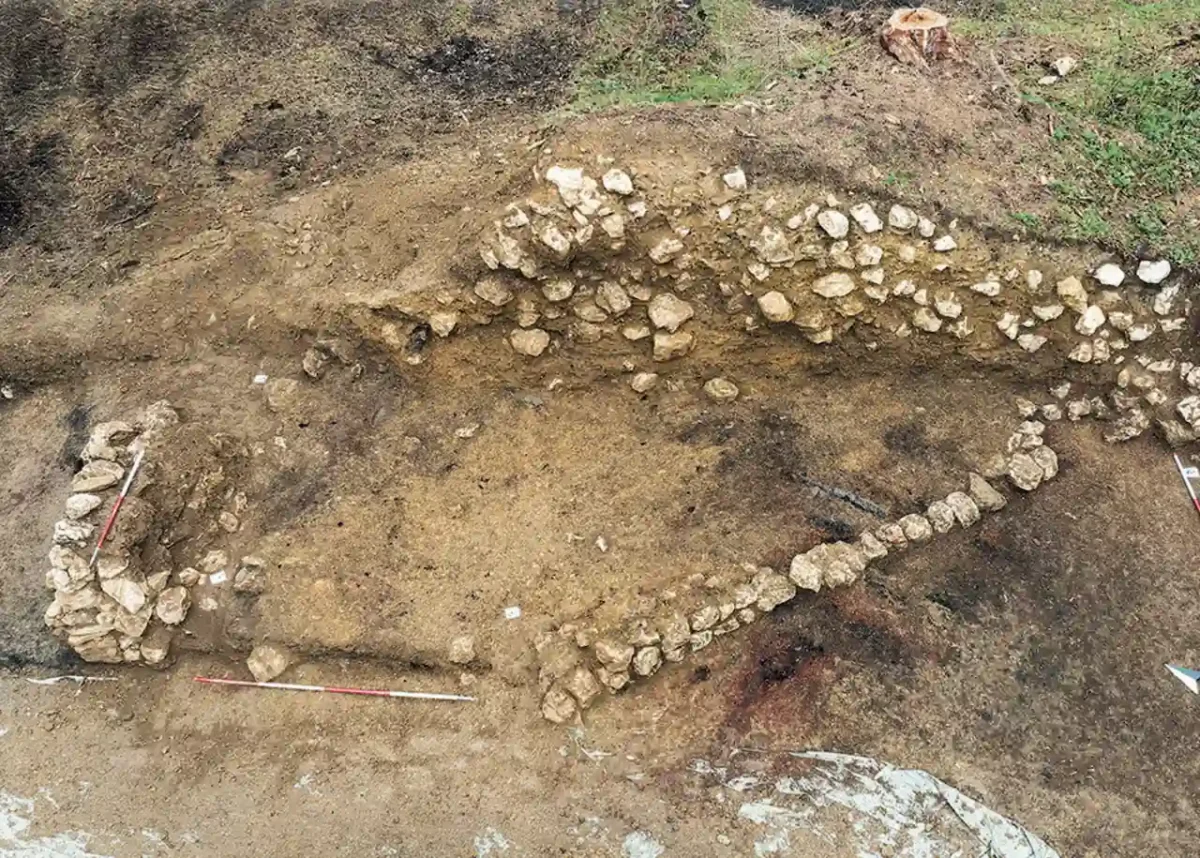
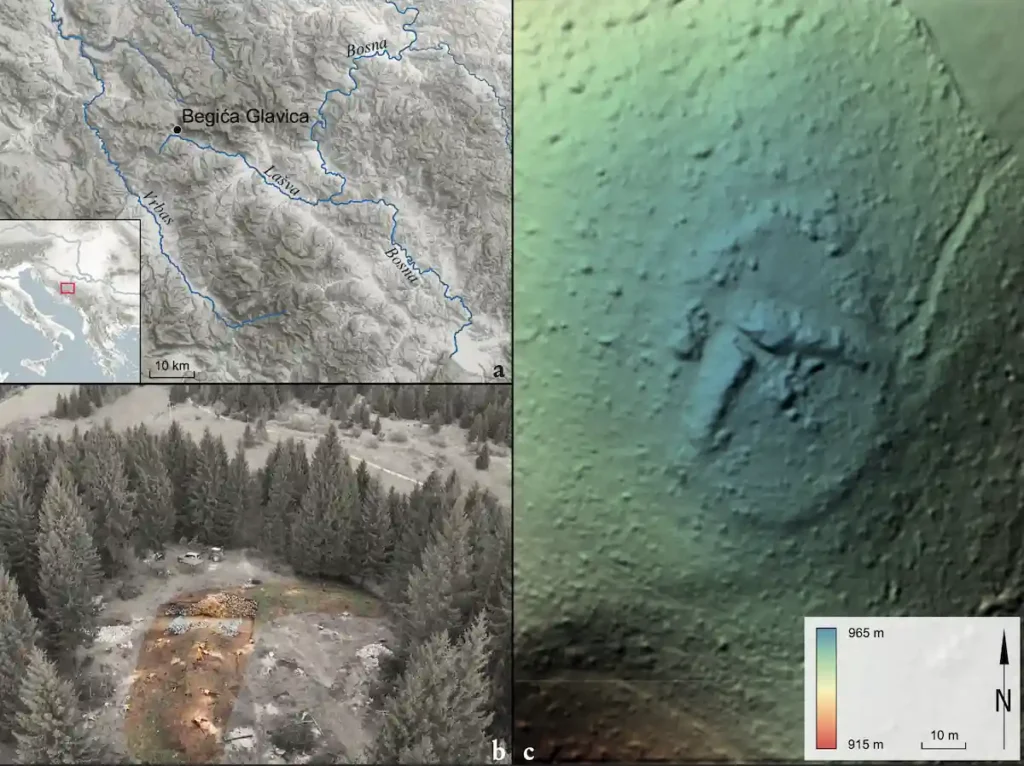
A quiet hill above the Lašva River in Bosnia and Herzegovina has produced one of the most puzzling discoveries in recent Balkan archaeology. What looked like an ordinary rise in the landscape turned out to conceal a Bronze Age ceremonial site built around a wall that doesn’t defend anything.
Instead of enclosing space, the structure cuts across it. And beneath it, archaeologists found something even more striking: the preserved remains of a building destroyed by fire, deliberately sealed under stone.
A discovery that started with looting
The story of Begića Glavica did not begin with a planned excavation. In 2022, unauthorized metal detectorists uncovered a group of metal objects along the visible edge of the wall and handed them over to the Regional Museum of Travnik.
The collection included hundreds of small metal items—belt fittings, buckles, and decorative fragments. Some pieces dated as late as the 6th century BCE. That alone was enough to raise questions. Why would such a modest hill hold material spanning centuries?
A joint team with the Austrian Archaeological Institute returned to the site in 2024 and 2025. What they found quickly made it clear: this was never a typical settlement.
A wall that divides, not protects
At first glance, the structure resembles a fortification. It stretches about 63 meters and rises up to three meters in places. But its shape changes everything.
The wall forms an L-shaped line across the plateau, leaving large sections open. It doesn’t block entry. It doesn’t surround anything. Instead, it simply splits the space in two.
That detail matters. In a region known for hilltop fortifications, this layout has no clear defensive logic.
Its construction adds another layer. The builders transported white limestone from over a kilometer away, a considerable effort for a structure that offers no protection. The stonework also reveals multiple phases, suggesting that the wall was expanded gradually rather than built in a single moment.
What lies beneath the stone
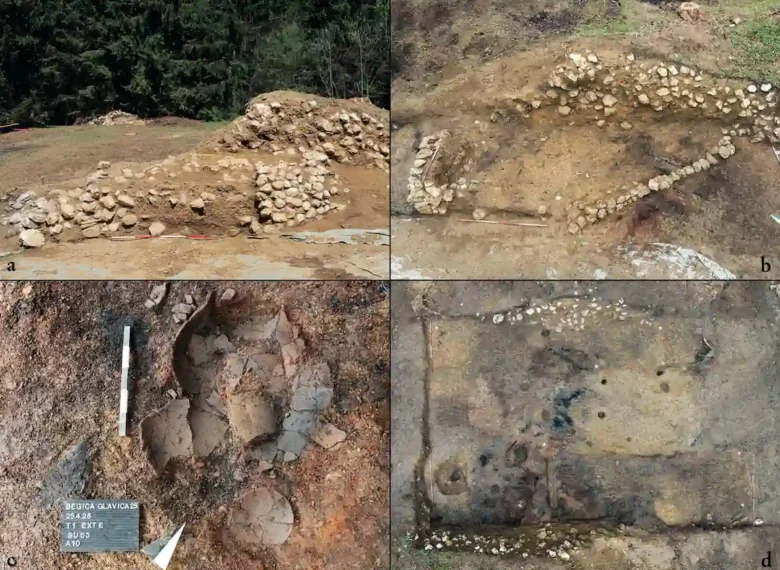
The real turning point came when archaeologists began removing the inner layers of the wall. Beneath it, they uncovered the remains of a burned structure preserved in remarkable detail.
Charred wooden beams still held their shape. Floor surfaces remained visible. Ceramic vessels were found exactly where they had stood before the fire.
Two large containers stood out. One had been set upright into the ground, almost deliberately fixed in place. The other lay overturned nearby.
The sequence is clear enough to raise new questions.
The structure burned first. Then the wall was built over it, sealing everything underneath.
This was not random destruction followed by reuse. It looks intentional.
No signs of everyday life
If this had been a settlement, traces of daily activity would be everywhere. They are not.
Excavation trenches on both sides of the wall revealed no houses, no domestic layers, no ordinary debris. Beneath the topsoil lies sterile ground. The only clear evidence of human activity comes from the burned structure and the wall itself.
That absence is as important as any artifact.
Objects placed, not lost
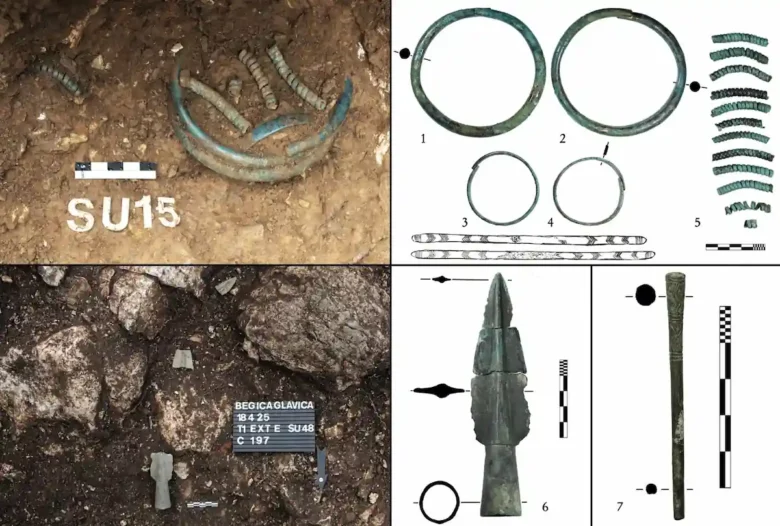
The finds from the site reinforce the same pattern. Archaeologists recovered a decorated bronze pin, fragments of a spearhead, and sets of ornaments including anklets, bracelets, and spiral forms.
These objects were not scattered randomly. Some appear to have been carefully arranged or deposited, suggesting deliberate placement rather than everyday loss.
A small clay figurine—part human, part animal—adds another layer of meaning. Such hybrid figures are rare in the region and often linked to symbolic or ritual contexts.
A different cultural signal
The pottery offers one of the clearest clues that this site does not fit local patterns.
Nearby hillforts are known for ceramics decorated with geometric incisions. At Begića Glavica, those are almost absent. Instead, most fragments show grooved and faceted decoration, a style more typical of the Urnfield cultural sphere in Central Europe.
That shift is difficult to ignore. It suggests that the people using this site were either connected to, or influenced by, groups beyond the immediate region.
A place revisited for centuries
Radiocarbon dating places the earliest confirmed activity between the 11th and 9th centuries BCE. Yet the metal finds show that people were still visiting the site hundreds of years later, into the 6th century BCE.
That kind of continuity changes how the site is understood.
This was not a place that was built, used briefly, and abandoned. It was returned to. Again and again.
Not a settlement, but a memory site
Taken together, the evidence points in one direction. Begića Glavica was not a village or a fortress. It was a place people came back to—perhaps to gather, to deposit objects, or to mark events tied to the past.
The wall, in this context, begins to make more sense. It does not protect the living. It defines and preserves something older, something that had already been marked by fire.
Excavations will continue, and much of the plateau remains unexplored. For now, Begića Glavica stands as a rare example of how prehistoric communities shaped landscapes not only for survival, but for meaning.
Mario Gavranović, Ajla Sejfuli, Irene M. Petschko, Nicole Mittermair, Begića Glavica, a Late Bronze and Early Iron Age Sanctuary in Central Bosnia. Archaeologia Austriaca 110/2026