
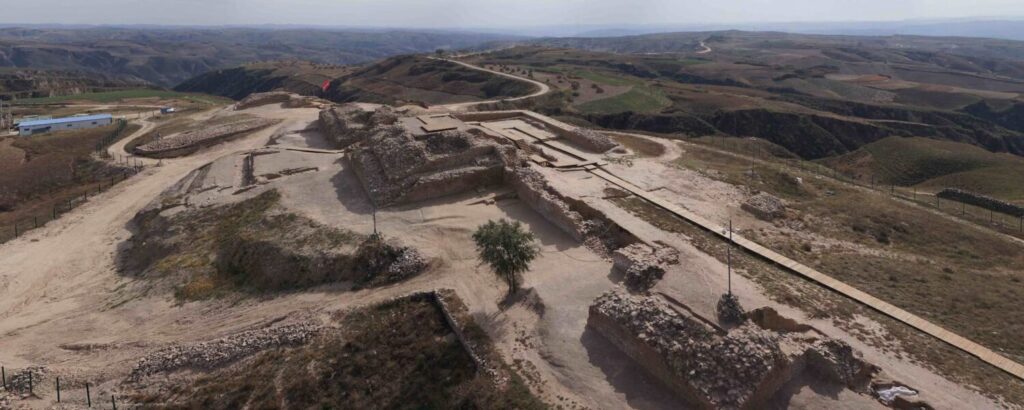
For decades, the stone walls of Shimao—one of the largest and most imposing Neolithic settlements in northern China—have guarded a silence that archaeology alone could not fully break. Now, a landmark genomic study published in Nature has begun to decode that silence, revealing who the people of Shimao were, how their society worked, and why more than eighty human skulls were buried at the city’s eastern gate.
Led by paleogeneticist Qiaomei Fu of the Chinese Academy of Sciences, researchers spent thirteen years assembling one of the most ambitious ancient-DNA datasets ever attempted in East Asia. The team sequenced the nuclear genomes of 169 ancient individuals, most from Shimao itself and neighboring sites across northern Shaanxi and southern Shanxi.
Deep Local Roots, Not Distant Migrations
The results anchor Shimao’s origins firmly in local continuity. Genomes overwhelmingly point to populations that lived in the same region a thousand years earlier—communities tied to the Yangshao culture, the iconic Neolithic tradition of the Loess Plateau. Shimao’s founders were not long-distance migrants; they were the inheritors of a deep regional lineage.
Yet this stability did not mean isolation. Genetic markers reveal ties to the Taosi culture of southern Shanxi, steppe-associated groups linked to Yumin, and southern farming communities connected to rice agriculture. Shimao stood at a crossroads where agricultural and pastoral worlds overlapped.
Family Pedigrees Reveal a Patrilineal Social Order

Where the new study becomes almost intimate is in the reconstruction of multi-generation family pedigrees. By mapping relatedness, the researchers charted lineages spanning up to four generations, exposing a society built on patrilineal descent and patrilocal residence—status passed through fathers, and women moved to their husbands’ communities. This is the first genetic evidence clarifying how early East Asian elites organized and maintained power.
Rethinking Shimao’s Most Disturbing Rituals
The most dramatic correction involves the site’s infamous eastern gate, where archaeologists uncovered roughly eighty human skulls. For years, these victims were assumed to be primarily women. DNA has now overturned that notion. Of the ten sampled individuals, nine were men—suggesting that male sacrifices were concentrated at this symbolically charged entrance, while female sacrificial victims appear instead in elite cemetery zones such as Huangchengtai and Hanjiagedan.
The pattern is unmistakable: sacrificial practices at Shimao followed a rigid gender-based ritual logic, not random violence.
A New, Multi-Layered Portrait of a Neolithic Power Center
The study produces the most detailed portrait of Shimao to date. It confirms over a millennium of genetic continuity, maps the city’s far-reaching cultural connections, exposes the patrilineal scaffolding of its hierarchy, and reshapes our understanding of its most haunting archaeological evidence.
Piece by piece, the language of Shimao’s DNA is allowing one of China’s most mysterious Neolithic societies to speak again.
Chen, Z., Gardner, J.D., Sun, Z. et al. Ancient DNA from Shimao city records kinship practices in Neolithic China. Nature (2025). doi.org/10.1038/s41586-025-09799-x