A sweeping archaeological survey on the northern Kazakh Steppe has revealed one of the most extensive Bronze Age settlements ever documented in Central Asia — a discovery that forces scholars to reassess how and where early urban life first emerged across Eurasia.
The site, known as Semiyarka, sprawls across an unexpectedly large area of the steppe, its architectural traces preserved beneath thin soil layers and grasslands. The new research, led by an international team and recently published in Antiquity (18 November 2025), combines geophysical mapping, drone-based photogrammetry, excavation units, and soil analysis to reconstruct a settlement far more complex than anything previously attributed to Bronze Age societies of this region.
The findings overturn the long-held assumption that steppe communities during the 2nd millennium BC were almost exclusively mobile pastoralists, loosely organised around seasonal herding cycles. Instead, Semiyarka reveals a society capable of planned architecture, long-term residence, food storage, ritual activity, and regional political coordination.
A City Hidden in the Grasslands
At first glance, the Kazakh Steppe appears empty: a wide, uninterrupted horizon of pale grass and wind-carved soil. Yet beneath that calm landscape, researchers identified large geometric enclosures, densely packed circular dwellings, and architectural rings reaching more than 250 meters across.
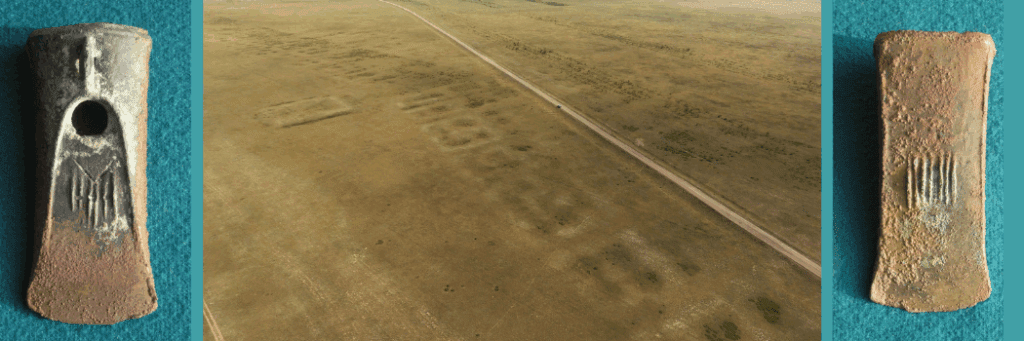
Drone imagery captured the ghostly outlines of fortification ditches and outer perimeters, suggesting a settlement built not just for shelter but for control and defence.
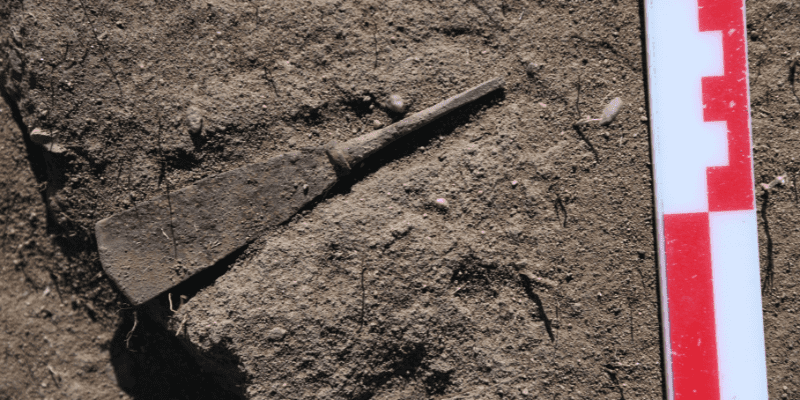
Excavation units opened in 2023 and 2024 reveal occupation layers stacked over centuries. Ceramic fragments, livestock bones, charcoal samples, and bronze tools point to a population that maintained continuity and stability, not seasonal movement.
Agriculture on the Steppe — Long Overlooked, Now Undeniable
One of the most striking revelations is the presence of grain-processing equipment, including grinding stones and storage pits. The steppe has long been framed as a world of herders, but the Semiyarka finds indicate mixed subsistence:
- Herding of cattle, sheep, and horses
- Cultivation and storage of cereals
- Local craft industries tied to bronze production
This combined economy brings the settlement closer to proto-urban centres of Western Asia than to the stereotypical nomadic camps traditionally imagined for this region.
Researchers emphasise that agriculture on the steppe does not erase pastoralism — rather, it suggests a hybrid form of life that allowed communities to grow larger and remain stable for generations.
Not a Remote Outpost — A Regional Hub
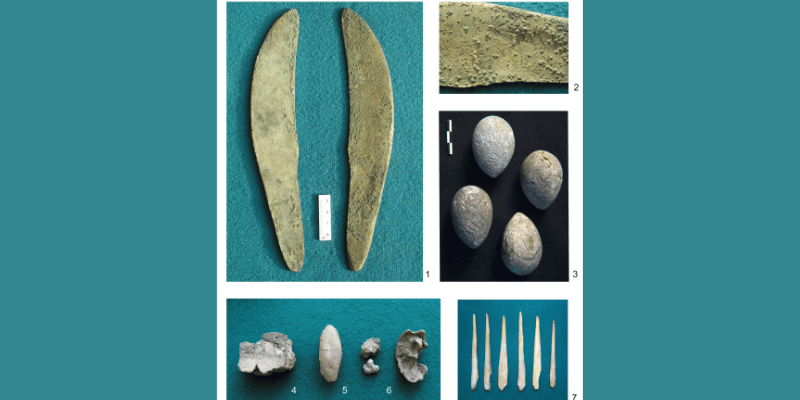
Analyses of pottery styles and metallurgical remains show influences from western Siberia, southern Kazakhstan, northern Uzbekistan, and the Altai region.
This broad network indicates that Semiyarka sat along an early trans-Eurasian interaction corridor, centuries before the Silk Road.
The settlement might have functioned as:
- A political centre coordinating surrounding communities
- A trade hub connecting river valleys and steppe routes
- A ritual landscape with recurrent gatherings and feasting
- A production centre for bronze tools distributed regionally
Whatever its exact role, it was not isolated — it was plugged into a dynamic, interconnected Bronze Age world.
Architecture Built for Continuity
The most distinctive pattern at Semiyarka is its ring-shaped architectural layout, a style rarely associated with steppe cultures.
These rings appear to have been divided into:
- Residential segments
- Craft areas
- Communal courtyards
- Storage clusters
- Possible ceremonial spaces
The settlement’s planning—its geometry, its repeating forms, its differentiated spaces—points to a level of organisation that would traditionally be classified as urban.
This challenges the outdated binary in Eurasian archaeology that divides early societies into either “cities” or “nomads,” with nothing in between.
Semiyarka demonstrates that early urbanism was not a single model born in Mesopotamia and exported elsewhere, but a phenomenon that took multiple forms across different ecological landscapes.
A Steppe City With Its Own Rules
What makes Semiyarka exceptional is not just its size, but its independent developmental pathway.
Instead of:
- walls of mudbrick
- monumental temples
- ziggurats
- palatial compounds
…the site shows a form of urban organisation derived from steppe lifeways, adapted to open grasslands rather than river basins. Houses were circular or oval, built of timber and earthen materials, arranged in repeating arcs that maximised visibility and mobility while still creating permanence.
The researchers argue that Semiyarka’s architecture reflects a steppe-specific model of urbanism — one that prioritised open layouts, communal access, and flexible spatial planning.
More Questions Than Answers
Despite the extensive survey, only a small percentage of the site has been excavated.
Key questions remain:
- How many people lived here at the settlement’s peak?
- Was Semiyarka governed by local elites or a broader regional alliance?
- How did climate fluctuations affect its stability?
- Why was the site ultimately abandoned?
Future excavation seasons will focus on exposing residential rings and analysing environmental samples to reconstruct diet, mobility, and demography.
Radivojević, M., Lawrence, D., Merz, V. K., Merz, I. V., Demidkova, E., Woolston-Houshold, M., … Brown, P. J. (2025). A major city of the Kazakh Steppe? Investigating Semiyarka’s Bronze Age legacy. Antiquity, 1–9. doi:10.15184/aqy.2025.10244
Cover Image Credit: Bronze Age metal tool discovered during excavations at Semiyarka, preserved in situ before removal. Durham University