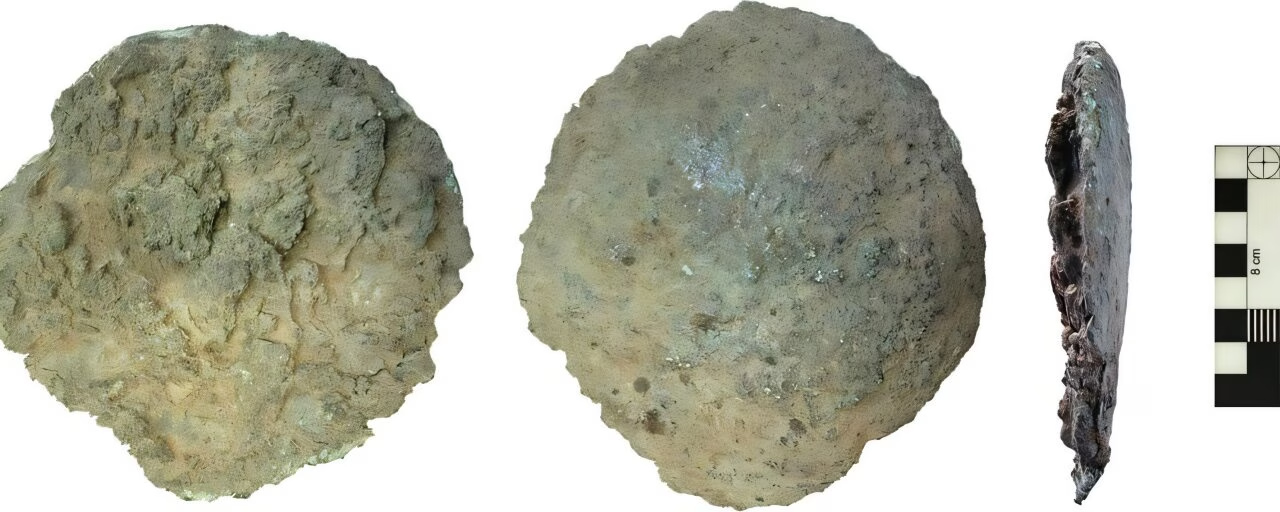
Archaeologists from the University of Gothenburg have identified the first complete plano-convex ingot ever discovered in Sweden. The find, unearthed in Särdal, was analyzed using advanced lead isotope and trace element analysis, and the results, published in Journal of Archaeological Science: Reports, confirm that this unique artifact dates to the Iron Age.
Plano-convex ingots—typically made of copper, but also of bronze or copper-based alloys—were widely used across the Mediterranean, continental Europe, and the Atlantic coast as standardized transport units for metal throughout the Bronze and Iron Ages.
From Bronze Age Assumption to Iron Age Revelation
Initially, the artifact’s shape and size led researchers to suspect a Bronze Age origin. However, detailed chemical tests revealed a copper-zinc-tin-lead alloy typical of Iron Age metallurgy.
“Due to its shape and size, we first assumed it was Bronze Age,” said Dr. Serena Sabatini of the University of Gothenburg. “But the analysis revealed a composition characteristic of the Iron Age and later periods.”
Further study showed striking similarities between the Särdal ingot and rod ingots uncovered in the Iława Lakeland region of northeastern Poland, strengthening existing theories about trade networks across the Baltic Sea during the Nordic Pre-Roman Iron Age.
Teamwork and Interdisciplinary Research
Sabatini emphasized that international collaboration played a crucial role:
“Networking and data sharing are essential. Without working closely with our Polish colleagues, we would never have achieved these results. This demonstrates how interdisciplinary approaches can transform isolated finds into valuable historical evidence.”
While lead isotope analysis has been a staple of archaeometallurgical research since the 1980s, this study pushed the approach further by combining analytical data with historical and archaeological records to reconstruct the artifact’s context.
A Window into Baltic Trade and Metallurgy
This research demonstrates that even unique, context-free artifacts can be transformed into powerful historical evidence through scientific collaboration. The study highlights the complex exchange systems and metallurgical expertise that shaped the Baltic region’s Iron Age societies.
Serena Sabatini et al, Iron age metal trade between the Atlantic and the Baltic Sea: new insights from the first complete plano-convex ingot found in Sweden and ingot rods from the Iława Lakeland in northeastern Poland, Journal of Archaeological Science: Reports (2025). DOI: 10.1016/j.jasrep.2025.105312
Cover Image Credit: University of Gothenburg