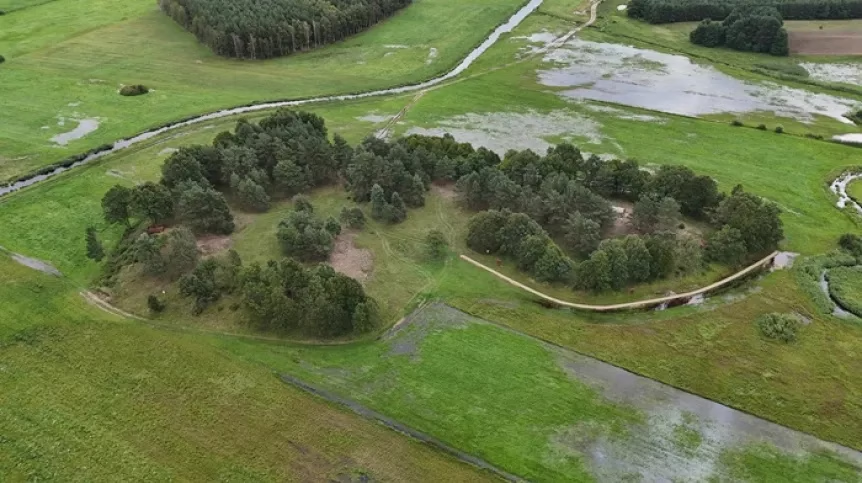
A team of Polish archaeologists has uncovered a rare surgical tool used for skull trepanation and traces of iron casting at the “Łysa Góra” site in Mazovia — offering new insight into the presence of Celtic communities in ancient Poland.
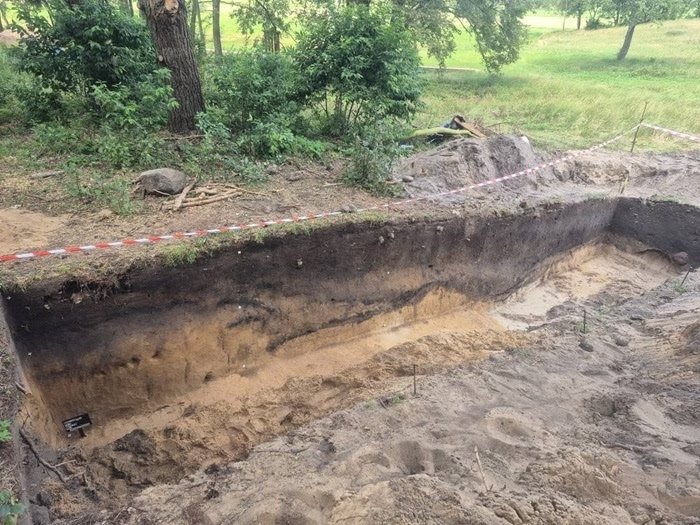
Archaeologists from the State Archaeological Museum in Warsaw and the University of Warsaw’s Faculty of Archaeology have completed their second excavation season at the Łysa Góra site in the Chorzele commune, central Poland. The area, linked to the Western Baltic Barrow culture, continues to reveal striking evidence of Celtic occupation, including a 4th-century BCE helmet discovered last year.
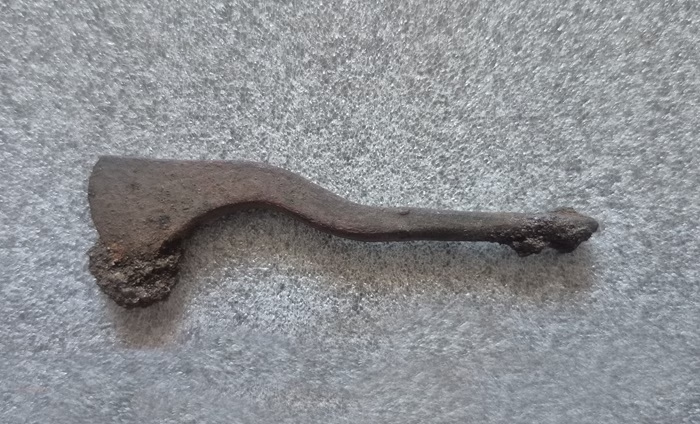
This season’s most remarkable find, however, was a rare iron instrument used for skull trepanation — an object so unusual that parallels exist only at a handful of Celtic sites in Romania, Croatia, and Austria.
“The find is even rarer than the Celtic helmet discovered earlier,” said Dr. Bartłomiej Kaczyński from the State Archaeological Museum. “Such tools are known from only a few sites across Central and Southern Europe.”
Initially mistaken for a small blade, the artifact was later identified as a scalpel-like instrument with a pointed end that once held a wooden handle.
According to Dr. Kaczyński, the tool suggests that Celtic settlers in the region included an individual skilled in early medicine — possibly a druid or healer.
“This group likely migrated here along a trade route, bringing not just warriors and artisans but also someone trained in ancient healing practices,” he explained.
“The tool may have had both medical and ritual functions, blending practical surgery with spiritual symbolism.”
Iron casting and craftsmanship on the hill
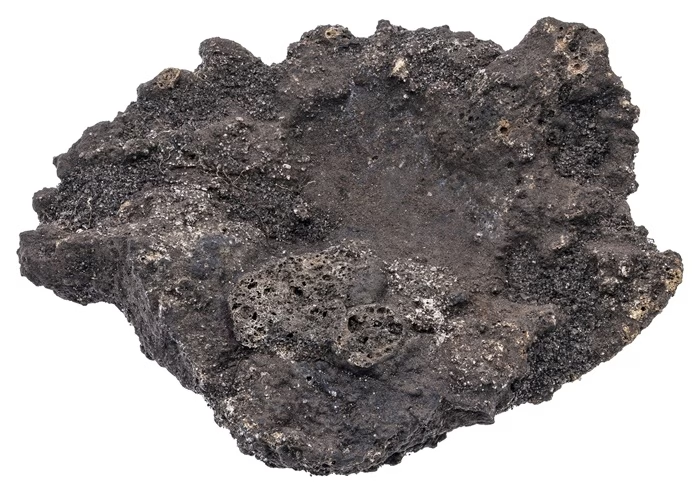
In the site’s northeastern sector, archaeologists also uncovered bowl-shaped slag, fragments of smelting debris, and a small iron anvil, pointing to local ironworking activity.
“It resembles a cube fixed to a wooden base,” said Kaczyński. “Smaller iron tools were probably forged here, suggesting that part of the equipment we found was produced locally.”
Other finds include brooches, spearheads, iron axes, and horse harness fittings — all characteristic of Celtic craftsmanship.
The site’s fortification system also revealed contrasting defensive structures between the southern and northern parts, implying a centralized settlement core surrounded by lighter enclosures.
Preserving the past for public education
Archaeological research at Łysa Góra began in the 1970s–80s, but renewed excavations started in 2024 to support the creation of an educational trail.
“After two seasons, the path is ready,” said Dr. Kaczyński. “Visitors will be able to see artifacts, read about the Celts, and learn how they lived and worked in this region over two millennia ago.”
Cover Image: Łysa Góra. Credit: Dr. Bartłomiej Kaczyński