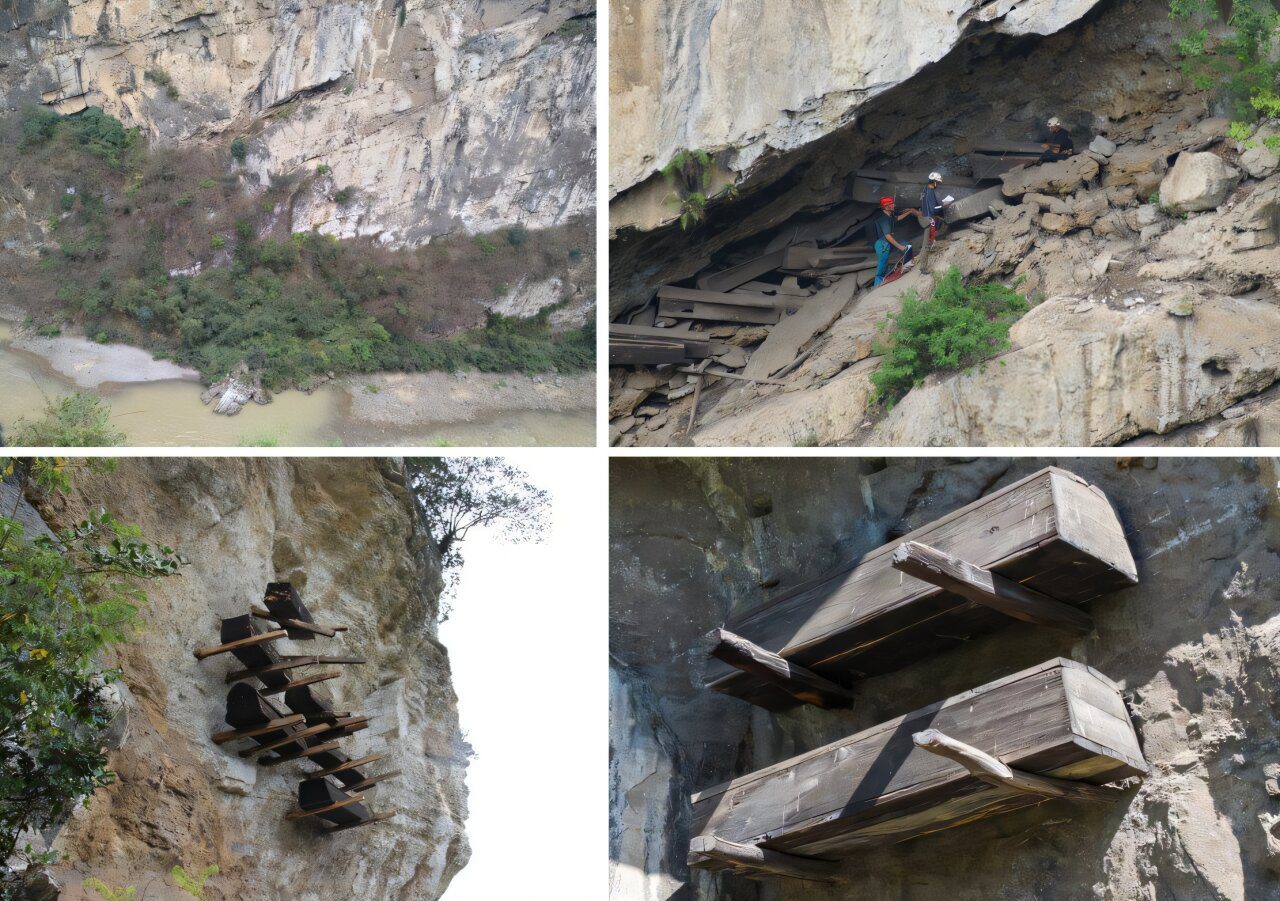
At the edge of mist-filled valleys in southwestern China, there are places where the dead once hovered above the living. Wooden coffins were fixed onto cliffs, tucked into limestone caverns or suspended on narrow ledges—silent shapes watching the rivers carve through the mountains. For centuries, scholars wondered who these people were and how such a dramatic funerary custom emerged and persisted. A new genomic study now delivers the clearest answer to date: the tradition’s guardians are not lost. Their descendants still walk the karst landscapes of Yunnan.
A living community reveals an ancient lineage
The Bo people of Qiubei County are few in number and long marginalized, their identity folded into broader ethnic classifications after the Ming period. Yet the new research shows that their ancestry reflects an unbroken thread stretching back to the Hanging Coffin practitioners of southern China. The study, led by Prof. Zhang Xiaoming of the Chinese Academy of Sciences, examined ancient DNA from cliff-burial sites in China and Log Coffin sites in Thailand, comparing them with newly sequenced genomes from contemporary Bo individuals.
Despite the remoteness of the modern Bo villages, the analysis uncovered remarkably high levels of genetic inheritance from ancient Hanging Coffin groups, confirming a direct biological relationship that historical documents had never been able to prove. The results place the Bo not on the margins of history, but at the center of one of East Asia’s most visually striking burial customs.
Roots along the ancient coastlines
The genetic signatures embedded in these cliff-burial individuals trace their origins to coastal populations of southern East Asia dating back to the Neolithic. These communities are widely recognized as ancestors of today’s Tai–Kadai and Austronesian language speakers, groups that played major roles in the settlement of island Southeast Asia and the Pacific. The continuity implies that the Hanging Coffin tradition was not an isolated practice carried out by a small mountain culture; it was part of a much broader world shaped by migration, trade and maritime interaction.
Unexpectedly, the study found that some Hanging Coffin individuals carried ancestry related to Yellow River farmers, Tibetan-influenced lineages and even ancient Northeast Asian populations. These signatures appear in two individuals buried around 1,200 years ago at Yunnan’s Wa Shi site. Such diversity reveals that the tradition was not bounded by ethnicity. By the Tang Dynasty, it had become a cultural refuge capable of absorbing newcomers from far beyond the region.
A funerary network spanning two regions
One of the most striking outcomes of the research is the genetic bridge linking China’s Hanging Coffin communities with the Log Coffin populations of Thailand. Archaeologists had long suspected a shared origin, based on similarities in craftsmanship and placement of wooden burials. The genomic comparison now gives this idea firm grounding. Ancient individuals from both regions show deep ancestry from southern East Asian Neolithic groups, with later layers of local admixture that created distinctive regional profiles.
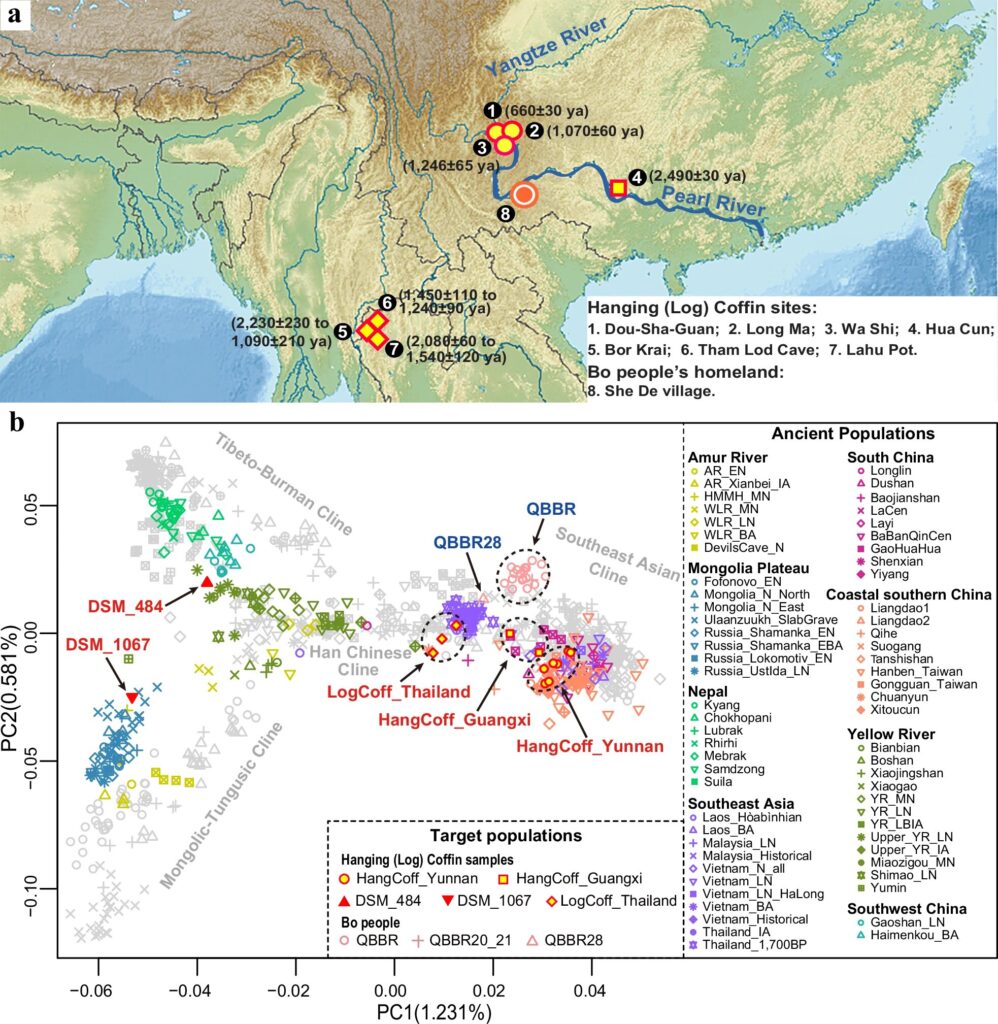
This connection hints at a cultural sphere that extended across mountains, river basins and tropical valleys, where funerary traditions could travel just as readily as technology or belief systems. The presence of Hoabinhian-related ancestry in Thailand adds yet another chapter to this story, suggesting local populations engaged with incoming groups rather than being displaced by them.
Re-centering the Bo in the archaeological record
For much of the last century, references to the Bo appeared sporadically—fragments in county gazetteers, passing mentions in Ming-era accounts, or vague statements in folklore. The new genomic evidence changes everything. It situates the Bo as the primary living heirs of the Hanging Coffin tradition, a role more enduring than historical texts ever acknowledged.
Their genetic landscape is not excessively isolated, despite their mountainous environment. Measures of homozygosity and linkage disequilibrium resemble those of other East Asian populations, indicating long-term community stability rather than extreme endogamy. In scientific terms, they have preserved an ancestral signature without becoming genetically sealed off.
What this means for the past—and for the living
The story emerging from these genomes is expansive. Cliff burials, once treated as a dramatic curiosity of regional archaeology, now stand at the crossroads of ancient migration routes. The tradition’s practitioners were connected to the sea, to river civilizations further north, and to peoples who crossed long distances. Through millennia, the custom survived shifts in population, language and empire.
And yet one truth remained constant: in the karst mountains of Yunnan, a community stayed long enough for their heritage to be written not only in wood and stone, but in their DNA.
Today’s Bo people are living proof that an ancient mortuary tradition did not vanish—it simply endured quietly, carried forward by families who still inhabit the same landscape where their ancestors once placed coffins high above the earth.
Hui Zhou et al, Exploration of hanging coffin customs and the bo people in China through comparative genomics, Nature Communications (2025). DOI: 10.1038/s41467-025-65264-3
Photographs documenting the Hanging Coffin sites were captured by Xie Peixia of the China Folklore Photography Association, with materials provided by the Zhaotong Municipal Bureau of Cultural Relics.