
A routine rescue excavation near the Dordogne River has revealed one of the most lavish Roman pyre burials ever documented in southwestern France.
When archaeologists from France’s National Institute for Preventive Archaeological Research (INRAP) opened a trench at the locality known as La Bourgatie Ouest in Lamonzie-Saint-Martin (Dordogne, Nouvelle-Aquitaine), they originally expected to uncover traces of a Late Neolithic settlement and medieval storage pits. Instead, an entirely different chapter of regional history surfaced: a single Roman bustum burial, sealed beneath layered ash, burned timber and a wealth of personal possessions that once belonged to an individual of unmistakably high status.

A funerary structure built to burn
The grave consists of a rectangular pit about 2.20 × 1.05 metres, its walls showing the characteristic reddening and heat alteration caused by an intense fire. This architecture identifies the structure as a bustum, a cremation rite in which the funeral pyre is built directly over the burial pit so that the body, fuel and offerings collapse together as the flames consume them.
INRAP’s field team, working between 28 April and 11 July 2025 under operation code F154076, documented every layer of the fill before removal across a large 8,000 m² excavation area. Charcoal fragments, calcined human bone and dense pockets of ash lay intermixed with personal objects that survived the fire. The entire feature was recorded using high-resolution photogrammetry, allowing specialists to reconstruct the grave in 3D once the material reached the laboratory.

Grave goods that point to privilege
The assemblage recovered from the pit reveals a life lived at the upper tiers of Roman Aquitania. A finely made terra sigillata beaker – its reddish surface characteristic of production from the workshops of Montans around the turn of the 1st and 2nd centuries AD – was found near one corner of the pit, accompanied by a delicate glass vessel.
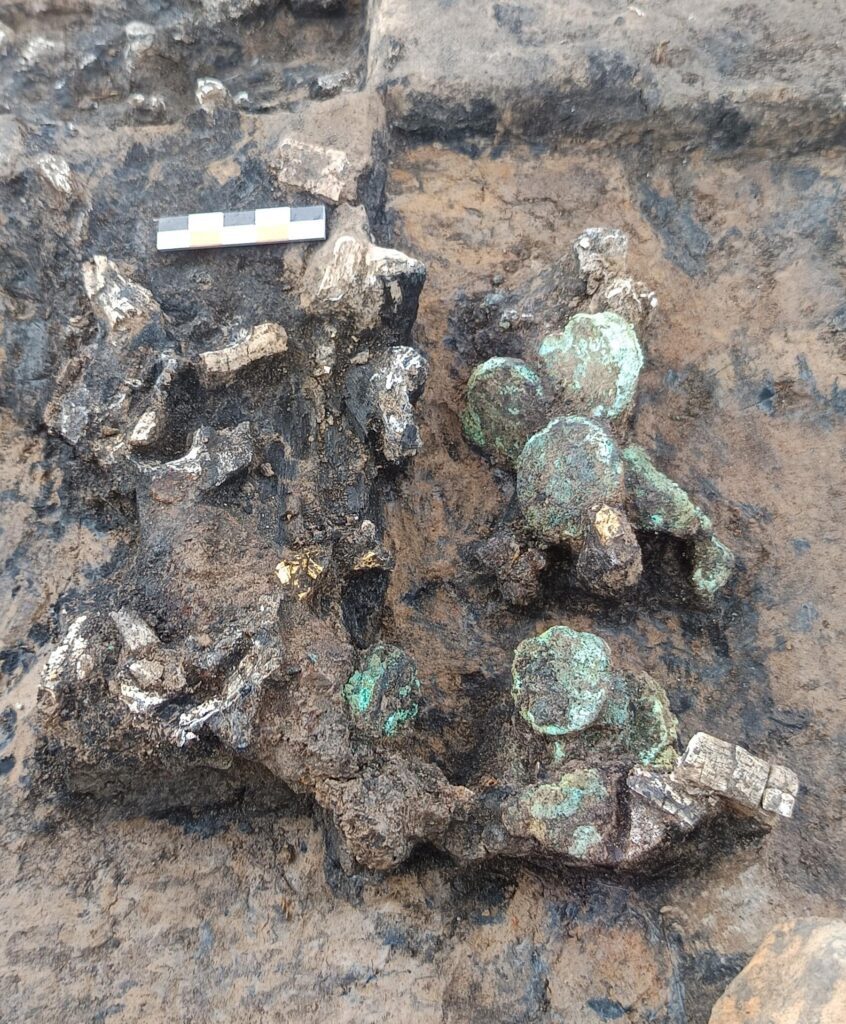
Elsewhere, clusters of burned debris concealed tightly grouped Roman bronze coins, including several sestertii and asses, probably placed as symbolic payments or ritual offerings during the funerary ceremony. In the southern sector of the structure, archaeologists uncovered a concentration of thin gold sheets, now warped by heat, which most likely once decorated a purse or wooden casket placed on or beside the body at the time of cremation.

Among the bone fragments, the team also identified small crystals that had originally been set onto an organic backing, hinting at decorated clothing or accessories that did not survive the flames. In total, twenty-two individual gold objects were recovered, including tiny droplets, gold wires and a twisted bracelet ending in a loop clasp. This bracelet strongly recalls the protective bulla pendants traditionally worn by elite Roman youths, emphasising both the social rank and perhaps even the age group of the deceased.
Perhaps the most enigmatic artefact is a signet ring set with an intaglio engraved in Greek lettering. Although the stone has been heat-damaged, the inscription is thought to preserve a personal or family name, raising the possibility that the individual – or their lineage – maintained cultural or commercial connections with the Greek-speaking Mediterranean. The combination of Roman provincial setting, Latin coinage and Greek-inscribed gemstone encapsulates the cosmopolitan identity of certain provincial elites.
Rewriting the map of Roman Aquitania
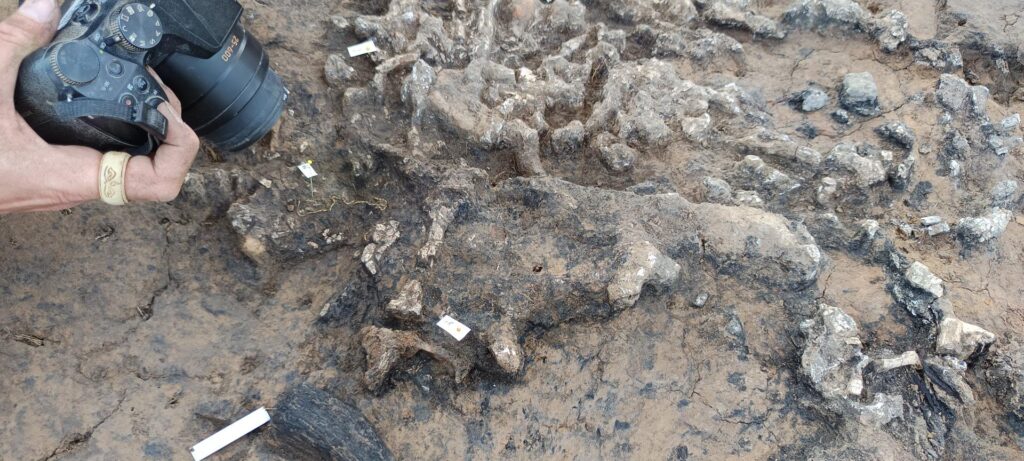
The burial’s isolation within a landscape previously associated with prehistoric habitation forces archaeologists to rethink the region’s Roman-period dynamics. A bustum of this calibre implies the presence of a rural estate or villa of significant wealth nearby, or at the very least a family with both economic means and strong cultural ambitions. Its existence also underscores that elite funerary practices in Roman Gaul were not confined to major urban centres such as Burdigala (Bordeaux) or Mediolanum Santonum (Saintes), but extended deep into the Dordogne valley.
For INRAP, the Lamonzie-Saint-Martin bustum is now a key reference site for understanding cremation rituals in the High Empire. Anthropological analysis of the cremated remains, detailed study of the metalwork, jewellery and glassware, and comparison with other Gallo-Roman cemeteries will help refine the profile of the deceased and the social world to which they belonged.
For now, the discovery stands as a vivid reminder of how a single grave can illuminate social hierarchy, cultural networks and ritual customs at the edge of the Roman world. In a quiet corner of rural Dordogne, a funeral pyre that burned nearly two millennia ago is once again reshaping the story of Roman Aquitania.
Cover Image: Anne Viero, Inrap